

WHI-P180 hydrochloride (Synonyms: Janex 3 hydrochloride;) |
Catalog No.GC37933
 One-Click Copy Product Info
|

WHI-P180 (Janex 3) is a multi-kinase inhibitor; inhibits RET, KDR and EGFR with IC50s of 5 nM, 66 nM and 4 μM, respectively.
Products are for research use only. Not for human use. We do not sell to patients.
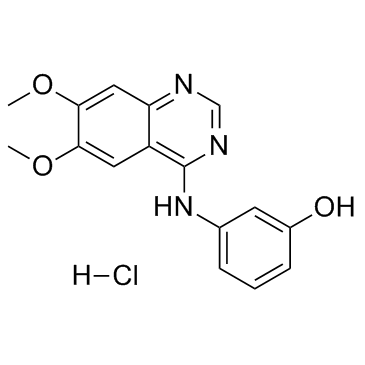
Cas No.: 153437-55-9
Sample solution is provided at 25 µL, 10mM.
_1-3.$$$39978408@51.jpg');)
_1-9.$$$38538795@65.jpg');)
_1-9.$$$39112701@51.jpg');)
_1-7.$$$37316672@70.jpg');)
_366-372.$$$36198801@70.jpg');)
.$$$38565142@65.jpg');)
_1867-1883.$$$33248023@67.jpg');)
_eads6055.$$$39977546@45.jpg');)
_eadm9805.$$$40080571@45.jpg');)
_eadj3020.$$$39666821@45.jpg');)
_1-20.$$$39757301@28.jpg');)
_1-24.$$$38898113@28.jpg');)
_273-287.$$$36806353@46.jpg');)
_1-16.$$$37156877@44.jpg');)
_1-19.$$$37460805@44.jpg');)
_1291-1307.$$$34518654@46.jpg');)
WHI-P180 (Janex 3) is a multi-kinase inhibitor; inhibits RET, KDR and EGFR with IC50s of 5 nM, 66 nM and 4 μM, respectively. EGFR|4 μM (IC50)|KDR|66 nM (IC50)|RET|5 nM (IC50)
WHI-P180 is also an active inhibitor of IgE-mediated mast cell responses. The elimination half-life of WHI-P180 in CD-1 mice (BALB/c mice) following i.v., i.p., or p.o. administration is less than 10 min. Systemic clearance of WHI-P180 is 6742 mL/h/kg in CD-I mice and 8188 mL/h/kg in BALB/c mice. Notably, WHI-P180, when administered in two consecutive nontoxic i.p. bolus doses of 25 mg/kg, inhibits IgE/antigen-induced vascular hyperpermeability in a well-characterized murine model of passive cutaneous anaphylaxis[3].
[1]. Newton R, et al. The discovery of 2-substituted phenol quinazolines as potent RET kinase inhibitors with improved KDR selectivity. Eur J Med Chem. 2016 Apr 13;112:20-32. [2]. Ghosh S, et al. 4-[3-Bromo-4-hydroxyphenyl)amino]-6,7-dimethoxyquinazolin-1-ium chloride methanol solvateand 4-[(3-hydroxyphenyl)amino]-6,7-dimethoxy-1-quinazolinium chloride. Acta Crystallogr C. 2001 Jan;57(Pt 1):76-8. [3]. Chen CL, et al. Pharmacokinetics and biologic activity of the novel mast cell inhibitor, 4-(3-hydroxyphenyl)-amino-6,7-dimethoxyquinazoline in mice. Pharm Res. 1999 Jan;16(1):117-22.
Kinase experiment: | Inhibitors (WHI-P180) are pre-incubated in the plate for 15 min with 5 μL kinase and assay buffer at the following concentrations; 13 pM RET and 150 pM KDR. The reaction is initiated by the addition of 5 μL ATP and substrate at 2×final reaction concentrations. For RET, this is 18 μM and 2 μM; for KDR, this is 16 μM and 1 μM, respectively. Reactions are performed at ATP Km for each target. The assay is allowed to proceed at room temperature for 20 min before terminating with the addition of 10 μL HTRF detection buffer containing EDTA supplemented with TK-antibody labelled with Eu3+-Cryptate (1:100 dilution) and streptavidin-XL665 (128 nM). Following incubation at room temperature for 1 h, FRET signal is measured[1]. |
Cell experiment: | IL3-dependent BaF3 cells are modified to express an activated recombinant kinase. Following removal of IL3, the modified cells are dependent on the activity of the recombinant kinase for survival and proliferation. The BaF3 cell lines, expressing KIF5B-RET and KDR are maintained in RPMI-1640 media containing 10% FBS and appropriate antibiotics. Non-modified BaF3 cells (WT) are maintained in RPMI-1640 media containing 10% FBS and supplemented with 10 ng/mL recombinant mouse IL3. For assessment of compound IC50, cells are plated into 384-well plates at 1500 or 3000 cells per well in 30 μL culture medium and compounds dispensed using an acoustic liquid handling platform. Following incubation of the cells for 48 h at 37 °C in a humidified 5% CO2 atmosphere, viability is determined by addition of 10 μL CellTiter-Glo reagent and measurement of luminescence[1]. |
Animal experiment: | Mice: A high performance liquid chromatography (HPLC)-based quantitative detection method is used to measure plasma WHI-P180levels in mice. The plasma concentration-time data is fit to a single compartment pharmacokinetic model by using the WinNonlin program to calculate the pharmacokinetic parameters. A cutaneous anaphylaxis model is used to examine the pharmacodynamic effects of WHI-P180 on anaphylaxis-associated vascular hyperpermeability[3]. |
References: [1]. Newton R, et al. The discovery of 2-substituted phenol quinazolines as potent RET kinase inhibitors with improved KDR selectivity. Eur J Med Chem. 2016 Apr 13;112:20-32. | |
| Cas No. | 153437-55-9 | SDF | |
| Synonyms | Janex 3 hydrochloride; | ||
| Canonical SMILES | COC1=CC2=NC=NC(NC3=CC=CC(O)=C3)=C2C=C1OC.[H]Cl | ||
| Formula | C16H16ClN3O3 | M.Wt | 333.77 |
| Solubility | Soluble in DMSO | Storage | Store at -20°C |
| General tips | Please select the appropriate solvent to prepare the stock solution according to the
solubility of the product in different solvents; once the solution is prepared, please store it in
separate packages to avoid product failure caused by repeated freezing and thawing.Storage method
and period of the stock solution: When stored at -80°C, please use it within 6 months; when stored
at -20°C, please use it within 1 month. To increase solubility, heat the tube to 37°C and then oscillate in an ultrasonic bath for some time. |
||
| Shipping Condition | Evaluation sample solution: shipped with blue ice. All other sizes available: with RT, or with Blue Ice upon request. | ||
| Prepare stock solution | |||

|
1 mg | 5 mg | 10 mg |
| 1 mM | 2.9961 mL | 14.9804 mL | 29.9608 mL |
| 5 mM | 599.2 μL | 2.9961 mL | 5.9922 mL |
| 10 mM | 299.6 μL | 1.498 mL | 2.9961 mL |
Step 1: Enter information below (Recommended: An additional animal making an allowance for loss during the experiment)
 g
μL
g
μL
Step 2: Enter the in vivo formulation (This is only the calculator, not formulation. Please contact us first if there is no in vivo formulation at the solubility Section.)
Calculation results:
Working concentration: mg/ml;
Method for preparing DMSO master liquid: mg drug pre-dissolved in μL DMSO ( Master liquid concentration mg/mL, Please contact us first if the concentration exceeds the DMSO solubility of the batch of drug. )
Method for preparing in vivo formulation: Take μL DMSO master liquid, next addμL PEG300, mix and clarify, next addμL Tween 80, mix and clarify, next add μL saline, mix and clarify.
Method for preparing in vivo formulation: Take μL DMSO master liquid, next add μL Corn oil, mix and clarify.
Note: 1. Please make sure the liquid is clear before adding the next solvent.
2. Be sure to add the solvent(s) in order. You must ensure that the solution obtained, in the previous addition, is a clear solution before proceeding to add the next solvent. Physical methods such as vortex, ultrasound or hot water bath can be used to aid dissolving.
3. All of the above co-solvents are available for purchase on the GlpBio website.
Quality Control & SDS
- View current batch:
- Purity: >98.00% Appearance: A solid
- COA (Certificate of Analysis)
- SDS (Safety Data Sheet)
- Datasheet
Average Rating: 5 (Based on Reviews and 36 reference(s) in Google Scholar.)