

Shield-1 (Synonyms: Shld1) |
Catalog No.GC38060
 One-Click Copy Product Info
|

Shield-1 is a specific, cell-permeable ligand for FK506-binding protein 12 (FKBP).
Products are for research use only. Not for human use. We do not sell to patients.
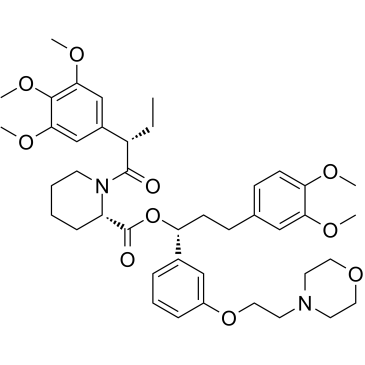
Cas No.: 914805-33-7
Sample solution is provided at 25 µL, 10mM.
_1-3.$$$39978408@51.jpg');)
_1-9.$$$38538795@65.jpg');)
_1-9.$$$39112701@51.jpg');)
_1-7.$$$37316672@70.jpg');)
_366-372.$$$36198801@70.jpg');)
.$$$38565142@65.jpg');)
_1867-1883.$$$33248023@67.jpg');)
_eads6055.$$$39977546@45.jpg');)
_eadm9805.$$$40080571@45.jpg');)
_eadj3020.$$$39666821@45.jpg');)
_1-20.$$$39757301@28.jpg');)
_1-24.$$$38898113@28.jpg');)
_273-287.$$$36806353@46.jpg');)
_1-16.$$$37156877@44.jpg');)
_1-19.$$$37460805@44.jpg');)
_1291-1307.$$$34518654@46.jpg');)
Shield-1 is a specific, cell-permeable ligand for FK506-binding protein 12 (FKBP)[1]. Shield-1 reverses the instability of mutated FKBP by binding to FKBP, allowing for the conditional expression of the mtFKBP fusion protein[2]. Shield-1 can influence viral replication by modulating the stability of the mtFKBP fusion protein[3]. Shield-1 is also a commonly used gene-editing tool with the function of erasing RNA N6-methyladenosine modifications[4].
In vitro, treatment of NIH3T3 cells stably expressing the FKBP L106P fusion protein with Shield-1 (1µM) for 24 hours significantly reversed the protein degradation mediated by the destabilizing domain, restored the expression levels of RhoA and Cdc42 proteins, and induced stress fiber formation and pseudopod extension[5]. Treatment of HEK293 cells expressing the mtFKBP-TRPV5 fusion protein with Shield-1 (1µM) for 24 hours significantly reversed the protein degradation mediated by the mtFKBP domain, restoring the cell membrane expression and functional activity of the TRPV5 ion channel[6].
In vivo, systemic administration of Shield-1 (1µM) via the aquatic environment (water dosing) was used to stabilize a systemic DD-YFP fusion protein in Transgenic Medaka fish from the embryonic to adult stages. Shield-1 induced YFP reporter gene expression in a concentration-dependent manner in various organs, including the brain, gills, intestine, liver, kidney, spleen, heart, and gonads. Shield-1 effectively crossed the blood-brain barrier and successfully achieved protein stabilization in germ cells[7].
References:
[1] Madsen D, Jørgensen FP, Palmer D, et al. Design and Combinatorial Development of Shield-1 Peptide Mimetics Binding to Destabilized FKBP12. ACS Comb Sci. 2020 Mar 9;22(3):156-164.
[2] Li X, Wang S, Li Q, et al. A Rapid and Reversible Molecular "Switch" Regulating Protein Expression in Chlamydomonas reinhardtii. Plant Cell Environ. 2025 Jun;48(6):3913-3924.
[3] Schleiss MR, Fernández-Alarcón C, Bierle CJ, et al. Replication-deficient whole-virus vaccines against cytomegalovirus induce protective immunity in a guinea pig congenital infection model. J Virol. 2025 Jul 22;99(7):e0020725.
[4] Xu Y, Wang Y, Liang FS. Site-Specific m6 A Erasing via Conditionally Stabilized CRISPR-Cas13b Editor. Angew Chem Int Ed Engl. 2023 Oct 23;62(43):e202309291.
[5] Banaszynski LA, Chen LC, Maynard-Smith LA, et al. A rapid, reversible, and tunable method to regulate protein function in living cells using synthetic small molecules. Cell. 2006 Sep 8;126(5):995-1004.
[6] Schoeber JP, van de Graaf SF, Lee KP, et al. Conditional fast expression and function of multimeric TRPV5 channels using Shield-1. Am J Physiol Renal Physiol. 2009 Jan;296(1):F204-11.
[7] Froschauer A, Kube L, Kegler A, et al. Tunable Protein Stabilization In Vivo Mediated by Shield-1 in Transgenic Medaka. PLoS One. 2015 Jul 6;10(7):e0131252.
| Cell experiment [1]: | |
Cell lines | HEK293 cells (human embryonic kidney cell line), NIH3T3 cells (mouse embryonic fibroblast cell line), HeLa cells (human epithelial immortal cell line) |
Preparation Method | Cells were transfected to express a fusion protein consisting of a protein of interest (TRPV5 ion channel, YFP, RhoA, Cdc42) tagged with a mutant FK506-binding protein (FKBP) destabilizing domain (DD). Cells were maintained in appropriate culture medium supplemented with serum. The expression of the DD-fused protein is constitutively degraded by the ubiquitin-proteasome system under standard conditions. Shield-1 was applied at concentrations ranging from 0.1nM to 1μM, with 1μM being a commonly used effective concentration. |
Reaction Conditions | 0.1nM to 1μM; 24h |
Applications | Shield-1 treatment rapidly stabilizes the DD-fused protein, preventing its degradation. This leads to the restoration of specific protein functions, such as TRPV5 ion channel activity (evidenced by increased Na⁺ and Ca²⁺ current densities) or induction of specific cellular phenotypes like stress fiber formation. This effect is dose-dependent, reversible upon Shield-1 withdrawal (with a protein half-life of approximately 2-3 hours), and can be repeated over multiple cycles |
| Animal experiment [2]: | |
Animal models | Transgenic Medaka fish (Oryzias latipes) |
Preparation Method | Transgenic fish were generated by microinjection of transposase mRNA and plasmid pDS-actb-DD-YFP into 1-cell stage embryos. Shield-1 (10nM, 100nM, and 1µM) stock solution was dissolved in absolute ethanol and administered directly to the aquarium water. |
Dosage form | 10nM, 100nM, and 1µM; added to water |
Applications | Shield-1 administration led to a rapid, concentration-dependent, and reversible stabilization of the DD-YFP fusion protein in vivo. Induction was observed ubiquitously in various organs (brain, liver, testis, gills, gut, kidney, spleen, heart) throughout the animal's life, including successful crossing of the blood-brain barrier and effective targeting of gonadal stem cells (spermatogonia in testis). The system allowed for fine-tuning of protein expression levels. |
References: | |
| Cas No. | 914805-33-7 | SDF | |
| Synonyms | Shld1 | ||
| Canonical SMILES | O=C([C@H]1N(C([C@H](C2=CC(OC)=C(OC)C(OC)=C2)CC)=O)CCCC1)O[C@@H](C3=CC=CC(OCCN4CCOCC4)=C3)CCC5=CC=C(OC)C(OC)=C5 | ||
| Formula | C42H56N2O10 | M.Wt | 748.9 |
| Solubility | DMSO: ≥ 250 mg/mL (333.82 mM) | Storage | Store at -20°C |
| General tips | Please select the appropriate solvent to prepare the stock solution according to the
solubility of the product in different solvents; once the solution is prepared, please store it in
separate packages to avoid product failure caused by repeated freezing and thawing.Storage method
and period of the stock solution: When stored at -80°C, please use it within 6 months; when stored
at -20°C, please use it within 1 month. To increase solubility, heat the tube to 37°C and then oscillate in an ultrasonic bath for some time. |
||
| Shipping Condition | Evaluation sample solution: shipped with blue ice. All other sizes available: with RT, or with Blue Ice upon request. | ||
| Prepare stock solution | |||

|
1 mg | 5 mg | 10 mg |
| 1 mM | 1.3353 mL | 6.6765 mL | 13.3529 mL |
| 5 mM | 267.1 μL | 1.3353 mL | 2.6706 mL |
| 10 mM | 133.5 μL | 667.6 μL | 1.3353 mL |
Step 1: Enter information below (Recommended: An additional animal making an allowance for loss during the experiment)
 g
μL
g
μL
Step 2: Enter the in vivo formulation (This is only the calculator, not formulation. Please contact us first if there is no in vivo formulation at the solubility Section.)
Calculation results:
Working concentration: mg/ml;
Method for preparing DMSO master liquid: mg drug pre-dissolved in μL DMSO ( Master liquid concentration mg/mL, Please contact us first if the concentration exceeds the DMSO solubility of the batch of drug. )
Method for preparing in vivo formulation: Take μL DMSO master liquid, next addμL PEG300, mix and clarify, next addμL Tween 80, mix and clarify, next add μL saline, mix and clarify.
Method for preparing in vivo formulation: Take μL DMSO master liquid, next add μL Corn oil, mix and clarify.
Note: 1. Please make sure the liquid is clear before adding the next solvent.
2. Be sure to add the solvent(s) in order. You must ensure that the solution obtained, in the previous addition, is a clear solution before proceeding to add the next solvent. Physical methods such as vortex, ultrasound or hot water bath can be used to aid dissolving.
3. All of the above co-solvents are available for purchase on the GlpBio website.
Quality Control & SDS
- View current batch:
- Purity: >98.00% Appearance: A solid
- COA (Certificate of Analysis)
- SDS (Safety Data Sheet)
- Datasheet
Average Rating: 5 (Based on Reviews and 6 reference(s) in Google Scholar.)