

Epithalon |
Catalog No.GC38102
 One-Click Copy Product Info
|

Epithalon is a tetrapeptide that induces telomerase activity and telomere elongation.
Products are for research use only. Not for human use. We do not sell to patients.
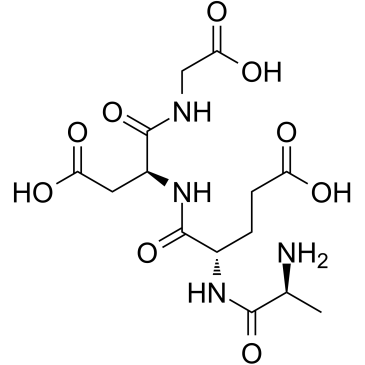
Cas No.: 307297-39-8
Sample solution is provided at 25 µL, 10mM.
_1-3.$$$39978408@51.jpg');)
_1-9.$$$38538795@65.jpg');)
_1-9.$$$39112701@51.jpg');)
_1-7.$$$37316672@70.jpg');)
_366-372.$$$36198801@70.jpg');)
.$$$38565142@65.jpg');)
_1867-1883.$$$33248023@67.jpg');)
_eads6055.$$$39977546@45.jpg');)
_eadm9805.$$$40080571@45.jpg');)
_eadj3020.$$$39666821@45.jpg');)
_1-20.$$$39757301@28.jpg');)
_1-24.$$$38898113@28.jpg');)
_273-287.$$$36806353@46.jpg');)
_1-16.$$$37156877@44.jpg');)
_1-19.$$$37460805@44.jpg');)
_1291-1307.$$$34518654@46.jpg');)
Epithalon is a tetrapeptide that induces telomerase activity and telomere elongation [1]. Epithalon can penetrate through the cell membrane and enter the nucleus, where Epithalon increases the transcriptional levels of Nestin and GAP43[2]. Epithalon has been widely used to stimulate evening melatonin production and normalize circadian rhythms of cortisol production in old monkeys[3].
In vitro, Epithalon treatment at 0.01μg/ml for 7 days significantly upregulated the expression of neurogenesis-related genes and the synthesis of β-tubulin III and Doublecortin in human gingival mesenchymal stem cells (hGMSCs)[4]. Treatment with 50nM Epithalon for 24h significantly prevented the decrease in neprilysin and insulin-degrading enzyme expression induced by hypoxia in NB7 neuroblastoma cells[5]. Treatment with 400ng/ml Epithalon for 24h significantly alleviated UV-induced oxidative stress and increased the expression of SOD-1, NQO1, and CATALASE genes in dermal fibroblasts[6].
In vivo, Epithalon treatment via oral administration at a dose of 100µg/day for one month significantly improved the transport properties of the small intestine in aged rats and promoted active glucose accumulation in the proximal and distal segments of the small intestine[7]. Epithalon (1µg) administered subcutaneously five times a week for six months significantly suppressed tumor growth in female transgenic FVB/N mice carrying the breast cancer gene HER-2/neu[8].
References:
[1] Khavinson V K, Bondarev I E, Butyugov A A. Epithalon peptide induces telomerase activity and telomere elongation in human somatic cells[J]. Bulletin of Experimental Biology and Medicine, 2003, 135(6): 590-592.
[2] Araj S K, Brzezik J, Mądra-Gackowska K, et al. Overview of Epitalon—Highly Bioactive Pineal Tetrapeptide with Promising Properties[J]. International Journal of Molecular Sciences, 2025, 26(6): 2691.
[3] Khavinson V K, Konovalov S S, Yuzhakov V V, et al. Modulating effects of epithalamin and epithalon on the functional morphology of the spleen in old pinealectomized rats[J]. Bulletin of Experimental Biology and Medicine, 2001, 132(5): 1116-1120.
[4] Khavinson V, Diomede F, Mironova E, et al. AEDG peptide (Epitalon) stimulates gene expression and protein synthesis during neurogenesis: possible epigenetic mechanism[J]. Molecules, 2020, 25(3): 609.
[5] Kozina L S, Kochkina E G, Nalivaeva N N, et al. The effects of vilon and epithalon peptides on the expression of neprilysin and insulin-degrading enzyme in human neuroblastoma NB7 cells under normal and hypoxic conditions[J]. Neurochemical Journal, 2008, 2(1): 69-71.
[6] Gutop E O, Linkova N S, Kozhevnikova E O, et al. AEDG Peptide Prevents Oxidative Stress in the Model of Induced Aging of Skin Fibroblasts[J]. Advances in Gerontology, 2022, 12(2): 143-148.
[7] Khavinson V K, Egorova V V, Timofeeva N M, et al. Effect of Vilon and Epithalon on glucose and glycine absorption in various regions of small intestine in aged rats[J]. Bulletin of Experimental Biology and Medicine, 2002, 133(5): 494-496.
[8] Anisimov V N, Khavinson V K, Alimova I N, et al. Epithalon decelerates aging and suppresses development of breast adenocarcinomas in transgenic her-2/neu mice[J]. Bulletin of Experimental Biology and Medicine, 2002, 134(2): 187-190.
| Cell experiment [1]: | |
Cell lines | NB7 neuroblastoma cells |
Preparation Method | NB7 neuroblastoma cells were cultured in standard RPMI1640 medium containing 10% fetal calf serum, 5% penicillin/streptomycin, and 5% L-glutamine. The cells were grown in 30ml of the medium in 175cm2 flasks at 37°C in 5% (v/v) CO2 to 70% confluency. After that, the culture medium was replaced by serum-free medium, and the following testing agents were added: vilon and Epithalon to a final concentration of 50nM. The cells were maintained either in standard conditions or at hypoxic concentrations (1% O2) for 24h and were collected for analysis of Neprilysin and Insulin-degrading enzyme expression. |
Reaction Conditions | 50nM; 24h |
Applications | Epithalon treatment prevented the decrease in neprilysin and insulin-degrading enzyme expression induced by hypoxia in NB7 neuroblastoma cells. |
| Animal experiment [2]: | |
Animal models | HER-2/neu transgenic FVB/N mice |
Preparation Method | HER-2/neu transgenic FVB/N mice were housed in a specific pathogen-free (SPF) animal house maintained at 23°C with a 12h light/dark cycle and free access to water and food. Transgenic mice (n=80) were randomly divided into 3 groups. Control animals received monthly subcutaneous injections of 0.1ml 0.9% NaCl for 5 consecutive days starting from the 2nd month of life. Group 1 and 2 mice were subcutaneously injected with Epithalon and Vilon (1µg), respectively. The whole experiment lasted for 6 months, and the development of breast tumors was estimated weakly by palpation. |
Dosage form | 1µg; 5 times a week for 6 months; s.c. |
Applications | Epithalon treatment suppressed tumor growth and extended the lifetime in mice. |
References: | |
| Cas No. | 307297-39-8 | SDF | |
| Formula | C14H22N4O9 | M.Wt | 390.35 |
| Solubility | Soluble in DMSO | Storage | Store at -20°C |
| General tips | Please select the appropriate solvent to prepare the stock solution according to the
solubility of the product in different solvents; once the solution is prepared, please store it in
separate packages to avoid product failure caused by repeated freezing and thawing.Storage method
and period of the stock solution: When stored at -80°C, please use it within 6 months; when stored
at -20°C, please use it within 1 month. To increase solubility, heat the tube to 37°C and then oscillate in an ultrasonic bath for some time. |
||
| Shipping Condition | Evaluation sample solution: shipped with blue ice. All other sizes available: with RT, or with Blue Ice upon request. | ||
| Prepare stock solution | |||

|
1 mg | 5 mg | 10 mg |
| 1 mM | 2.5618 mL | 12.809 mL | 25.618 mL |
| 5 mM | 512.4 μL | 2.5618 mL | 5.1236 mL |
| 10 mM | 256.2 μL | 1.2809 mL | 2.5618 mL |
Step 1: Enter information below (Recommended: An additional animal making an allowance for loss during the experiment)
 g
μL
g
μL
Step 2: Enter the in vivo formulation (This is only the calculator, not formulation. Please contact us first if there is no in vivo formulation at the solubility Section.)
Calculation results:
Working concentration: mg/ml;
Method for preparing DMSO master liquid: mg drug pre-dissolved in μL DMSO ( Master liquid concentration mg/mL, Please contact us first if the concentration exceeds the DMSO solubility of the batch of drug. )
Method for preparing in vivo formulation: Take μL DMSO master liquid, next addμL PEG300, mix and clarify, next addμL Tween 80, mix and clarify, next add μL saline, mix and clarify.
Method for preparing in vivo formulation: Take μL DMSO master liquid, next add μL Corn oil, mix and clarify.
Note: 1. Please make sure the liquid is clear before adding the next solvent.
2. Be sure to add the solvent(s) in order. You must ensure that the solution obtained, in the previous addition, is a clear solution before proceeding to add the next solvent. Physical methods such as vortex, ultrasound or hot water bath can be used to aid dissolving.
3. All of the above co-solvents are available for purchase on the GlpBio website.
Quality Control & SDS
- View current batch:
- Purity: >98.00% Appearance: A solid
- COA (Certificate of Analysis)
- SDS (Safety Data Sheet)
- Datasheet
Average Rating: 5 (Based on Reviews and 19 reference(s) in Google Scholar.)