

Echinatin |
Catalog No.GC38226
 One-Click Copy Product Info
|

Echinatin is the chalcone in the Chinese herbal medicine Gancao, with anti-inflammatory effects and antioxidant properties.
Products are for research use only. Not for human use. We do not sell to patients.
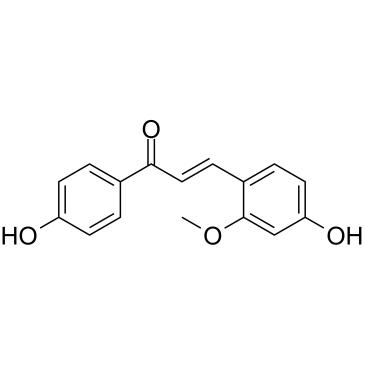
Cas No.: 34221-41-5
Sample solution is provided at 25 µL, 10mM.
Echinatin is the chalcone in the Chinese herbal medicine Gancao, with anti-inflammatory effects and antioxidant properties[1]. Echinatin binds to heat shock protein 90 (HSP90), inhibits the ATPase activity, and disrupts the interaction between cochaperone SGT1 and HSP90-NLRP3[2]. Echinatin has been widely used in animal models of ischemia/reperfusion to improve cardiac function[3].
In vitro, Echinatin treatment for 24 hours significantly inhibited the viability of HepG2 and Huh-7 cells with IC50 values of 23.48μM and 23.08μM, respectively[4]. Echinatin treatment at 20µM for 48 hours significantly promoted KYSE30 cell apoptosis and inhibited AKT/mTOR signaling pathway[5]. Echinatin treatment at 30µM for 24h inhibited lipopolysaccharide (LPS)-induced inflammatory response and downregulated the mRNA expression and release of IL-1β and IL-6 in RAW264.7 cells[6].
In vivo, Echinatin treatment (60mg/kg; every two days; p.o.) for 2 weeks inhibited the growth of 143B cell-xenograft tumors in mice, decreased the expression levels of PCNA, Bcl-2, vimentin, MMP2, Snail, and β-catenin, and increased the expression levels of p-p38 and GSK3β[7]. Oral Echinatin at a dose of 25mg/kg/day for 45 consecutive days improved lipid levels and alleviated pancreatic and renal impairment in a diabetic rat model[8].
References:
[1] Liang M, Li X, Ouyang X, et al. Antioxidant mechanisms of echinatin and licochalcone A[J]. Molecules, 2018, 24(1): 3.
[2] Xu G, Fu S, Zhan X, et al. Echinatin effectively protects against NLRP3 inflammasome–driven diseases by targeting HSP90[J]. JCI insight, 2021, 6(2): e134601.
[3] Tian X, Liu C, Jiang H L, et al. Cardioprotection provided by Echinatin against ischemia/reperfusion in isolated rat hearts[J]. BMC cardiovascular disorders, 2016, 16(1): 119.
[4] Wang J, Li Z, Han X, et al. Echinatin inhibits the growth and metastasis of human hepatocellular carcinoma cells through p38 and JNK signaling pathways[J]. Tissue and Cell, 2025, 95: 102907.
[5] Hong P, Liu Q W, Xie Y, et al. Echinatin suppresses esophageal cancer tumor growth and invasion through inducing AKT/mTOR-dependent autophagy and apoptosis[J]. Cell Death & Disease, 2020, 11(7): 524.
[6] Luo L, Wang H, Xiong J, et al. Echinatin attenuates acute lung injury and inflammatory responses via TAK1-MAPK/NF-κB and Keap1-Nrf2-HO-1 signaling pathways in macrophages[J]. Plos one, 2024, 19(5): e0303556.
[7] Lu Q, Huang H, Wang X, et al. Echinatin inhibits the growth and metastasis of human osteosarcoma cells through Wnt/β-catenin and p38 signaling pathways[J]. Pharmacological Research, 2023, 191: 106760.
[8] Li X, Lu P, Wan H, et al. Echinatin ameliorates hyperglycemia and associated pathogenesis, oxidative stress and inflammation in STZ-induced diabetes in rats[J]. Biochemical and Biophysical Research Communications, 2025: 152174.
| Cell experiment [1]: | |
Cell lines | HepG2 cells |
Preparation Method | HepG2 cells were cultured in DMEM medium containing 10% fetal bovine serum (FBS) and placed in an incubator at 37℃ with 5% CO2 saturation. 2.5×10³ HepG2 cells were seeded in 96-well plates and allowed to adhere completely before subsequent operations. Cells were treated with Echinatin (0, 10, 15, 20, and 25μM) in different concentration gradients. After waiting for 24 hours, 10μl of predissolved MTT solution (5mg/ml) was added to the wells and the incubation was continued for another 4 hours. Subsequently, 100μl of DMSO solution was added after the liquid in the wells was completely aspirated. Finally, the absorbance value at the wavelength of 492nm was recorded. |
Reaction Conditions | 0, 10, 15, 20, and 25μM; 24h |
Applications | Echinatin treatment significantly inhibited the cell viability of HepG2 cells in a dose-dependent manner. |
| Animal experiment [2]: | |
Animal models | Female BALB/c nude mice |
Preparation Method | BALB/c nude mice (female, 4 weeks of age) were maintained under SPF grade conditions. After acclimatization to the experimental environment for 1 week, the mice were subcutaneously injected with 80µl sterile PBS solution containing 143B osteosarcoma cells suspension (cell density of 2×10⁶ cells/mL). Ten mice were randomly divided into two groups (n=5 in each group) and treated with Echinatin (60mg/kg) or 0.5% carboxymethylcellulose sodium (CMC-Na) by gavage once every two days. Body weight and tumor volume were recorded, and after 2 weeks, all mice were sacrificed by cervical dislocation. Finally, tumor samples were collected for analysis. |
Dosage form | 60mg/kg; every two days for 2 weeks; p.o. |
Applications | Echinatin inhibited the growth of xenograft tumors in mice, decreased the expression levels of PCNA, Bcl-2, vimentin, MMP2, Snail and β-catenin, and increased the expression levels of p-p38 and GSK3β. |
References: | |
| Cas No. | 34221-41-5 | SDF | |
| Canonical SMILES | O=C(C1=CC=C(O)C=C1)/C=C/C2=CC=C(O)C=C2OC | ||
| Formula | C16H14O4 | M.Wt | 270.28 |
| Solubility | DMSO: 250 mg/mL (924.97 mM) | Storage | 4°C, protect from light |
| General tips | Please select the appropriate solvent to prepare the stock solution according to the
solubility of the product in different solvents; once the solution is prepared, please store it in
separate packages to avoid product failure caused by repeated freezing and thawing.Storage method
and period of the stock solution: When stored at -80°C, please use it within 6 months; when stored
at -20°C, please use it within 1 month. To increase solubility, heat the tube to 37°C and then oscillate in an ultrasonic bath for some time. |
||
| Shipping Condition | Evaluation sample solution: shipped with blue ice. All other sizes available: with RT, or with Blue Ice upon request. | ||
| Prepare stock solution | |||

|
1 mg | 5 mg | 10 mg |
| 1 mM | 3.6999 mL | 18.4993 mL | 36.9987 mL |
| 5 mM | 740 μL | 3.6999 mL | 7.3997 mL |
| 10 mM | 370 μL | 1.8499 mL | 3.6999 mL |
Step 1: Enter information below (Recommended: An additional animal making an allowance for loss during the experiment)
 g
μL
g
μL
Step 2: Enter the in vivo formulation (This is only the calculator, not formulation. Please contact us first if there is no in vivo formulation at the solubility Section.)
Calculation results:
Working concentration: mg/ml;
Method for preparing DMSO master liquid: mg drug pre-dissolved in μL DMSO ( Master liquid concentration mg/mL, Please contact us first if the concentration exceeds the DMSO solubility of the batch of drug. )
Method for preparing in vivo formulation: Take μL DMSO master liquid, next addμL PEG300, mix and clarify, next addμL Tween 80, mix and clarify, next add μL saline, mix and clarify.
Method for preparing in vivo formulation: Take μL DMSO master liquid, next add μL Corn oil, mix and clarify.
Note: 1. Please make sure the liquid is clear before adding the next solvent.
2. Be sure to add the solvent(s) in order. You must ensure that the solution obtained, in the previous addition, is a clear solution before proceeding to add the next solvent. Physical methods such as vortex, ultrasound or hot water bath can be used to aid dissolving.
3. All of the above co-solvents are available for purchase on the GlpBio website.
Quality Control & SDS
- View current batch:
- Purity: >98.00% Appearance: A solid
- COA (Certificate of Analysis)
- SDS (Safety Data Sheet)
- Datasheet
Average Rating: 5 (Based on Reviews and 34 reference(s) in Google Scholar.)