

2-Phenylethylamine hydrochloride (Synonyms: βPhenylethylamine, 2Phenylethylammonium) |
Catalog No.GC38692
 One-Click Copy Product Info
|

Products are for research use only. Not for human use. We do not sell to patients.
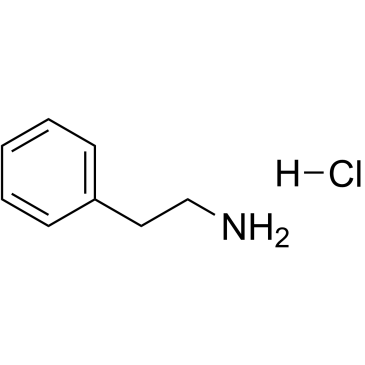
Cas No.: 156-28-5
Sample solution is provided at 25 µL, 10mM.
_1-3.$$$39978408@51.jpg');)
_1-9.$$$38538795@65.jpg');)
_1-9.$$$39112701@51.jpg');)
_1-7.$$$37316672@70.jpg');)
_366-372.$$$36198801@70.jpg');)
.$$$38565142@65.jpg');)
_1867-1883.$$$33248023@67.jpg');)
_eads6055.$$$39977546@45.jpg');)
_eadm9805.$$$40080571@45.jpg');)
_eadj3020.$$$39666821@45.jpg');)
_1-20.$$$39757301@28.jpg');)
_1-24.$$$38898113@28.jpg');)
_273-287.$$$36806353@46.jpg');)
_1-16.$$$37156877@44.jpg');)
_1-19.$$$37460805@44.jpg');)
_1291-1307.$$$34518654@46.jpg');)
2-Phenylethanamine hydrochloride is believed to function as a neuromodulator or neurotransmitter.
2-Phenylethanamine (PEA) is soluble in water, ethanol, and ether. Phenethylamine is a skin irritant and possible sensitizer. 2-Phenylethanamine is believed to function as a neuromodulator or neurotransmitter (a trace amine). It is also found in many foods such as chocolate, especially after microbial fermentation. 2-Phenylethanamine is a precursor to the neurotransmitter phenylethanolamine. High levels of 2-Phenylethanamine have been found in the urine of schizophrenics but it is not significantly elevated in the serum or CSF of schizophrenics[1][2]. Urinary levels of 2-Phenylethanamine are significantly lower in children with attention deficit hyperactivity disorder. 2-Phenylethanamine is useful for scaring off rodent pests[3].
[1]. O'Reilly RL, et al. Phenylethylamine and schizophrenia. Prog Neuropsychopharmacol Biol Psychiatry. 1994 Jan;18(1):63-75. [2]. Potkin SG, et al. Phenylethylamine (PEA) and phenylacetic acid (PAA) in the urine of chronic schizophrenic patients and controls. Psychopharmacol Bull. 1980 Jan;16(1):52-4. [3]. Kusaga A, et al. Increased urine phenylethylamine after methylphenidate treatment in children with ADHD. Ann Neurol. 2002 Sep;52(3):372-4.
| Cas No. | 156-28-5 | SDF | |
| Synonyms | βPhenylethylamine, 2Phenylethylammonium | ||
| Canonical SMILES | NCCC1=CC=CC=C1.[H]Cl | ||
| Formula | C8H12ClN | M.Wt | 157.64 |
| Solubility | DMF: 30 mg/ml,DMSO: 30 mg/ml,Ethanol: 25 mg/ml,PBS (pH 7.2): 10 mg/ml | Storage | Store at -20°C |
| General tips | Please select the appropriate solvent to prepare the stock solution according to the
solubility of the product in different solvents; once the solution is prepared, please store it in
separate packages to avoid product failure caused by repeated freezing and thawing.Storage method
and period of the stock solution: When stored at -80°C, please use it within 6 months; when stored
at -20°C, please use it within 1 month. To increase solubility, heat the tube to 37°C and then oscillate in an ultrasonic bath for some time. |
||
| Shipping Condition | Evaluation sample solution: shipped with blue ice. All other sizes available: with RT, or with Blue Ice upon request. | ||
| Prepare stock solution | |||

|
1 mg | 5 mg | 10 mg |
| 1 mM | 6.3436 mL | 31.7178 mL | 63.4357 mL |
| 5 mM | 1.2687 mL | 6.3436 mL | 12.6871 mL |
| 10 mM | 634.4 μL | 3.1718 mL | 6.3436 mL |
Step 1: Enter information below (Recommended: An additional animal making an allowance for loss during the experiment)
 g
μL
g
μL
Step 2: Enter the in vivo formulation (This is only the calculator, not formulation. Please contact us first if there is no in vivo formulation at the solubility Section.)
Calculation results:
Working concentration: mg/ml;
Method for preparing DMSO master liquid: mg drug pre-dissolved in μL DMSO ( Master liquid concentration mg/mL, Please contact us first if the concentration exceeds the DMSO solubility of the batch of drug. )
Method for preparing in vivo formulation: Take μL DMSO master liquid, next addμL PEG300, mix and clarify, next addμL Tween 80, mix and clarify, next add μL saline, mix and clarify.
Method for preparing in vivo formulation: Take μL DMSO master liquid, next add μL Corn oil, mix and clarify.
Note: 1. Please make sure the liquid is clear before adding the next solvent.
2. Be sure to add the solvent(s) in order. You must ensure that the solution obtained, in the previous addition, is a clear solution before proceeding to add the next solvent. Physical methods such as vortex, ultrasound or hot water bath can be used to aid dissolving.
3. All of the above co-solvents are available for purchase on the GlpBio website.
Quality Control & SDS
- View current batch:
- Purity: >99.50% Appearance: A solid
- COA (Certificate of Analysis)
- SDS (Safety Data Sheet)
- Datasheet
Average Rating: 5 (Based on Reviews and 21 reference(s) in Google Scholar.)