

GSK864 |
Catalog No.GC17809
 One-Click Copy Product Info
|

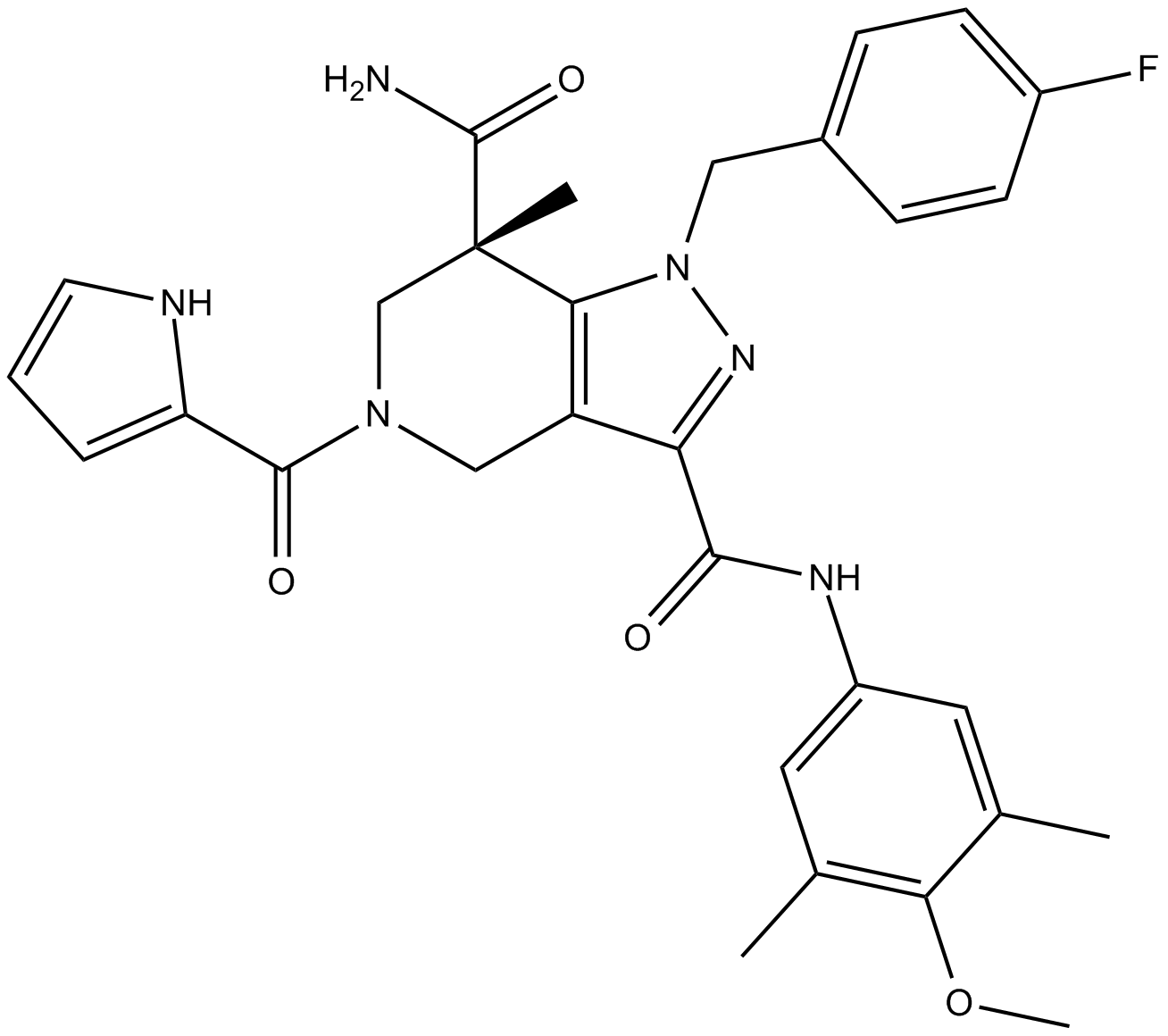
GSK864 is a mutant isocitrate dehydrogenases 1 (mIDH1) inhibitor, with EC50 values of 0.16μM, 0.10μM, 2.74μM for IDH1 R132H, IDH1 R132C, and IDH1 WT, respectively.
Products are for research use only. Not for human use. We do not sell to patients.
Cas No.: 1816331-66-4
Sample solution is provided at 25 µL, 10mM.
_1-3.$$$39978408@51.jpg');)
_1-9.$$$38538795@65.jpg');)
_1-9.$$$39112701@51.jpg');)
_1-7.$$$37316672@70.jpg');)
_366-372.$$$36198801@70.jpg');)
.$$$38565142@65.jpg');)
_1867-1883.$$$33248023@67.jpg');)
_eads6055.$$$39977546@45.jpg');)
_eadm9805.$$$40080571@45.jpg');)
_eadj3020.$$$39666821@45.jpg');)
_1-20.$$$39757301@28.jpg');)
_1-24.$$$38898113@28.jpg');)
_273-287.$$$36806353@46.jpg');)
_1-16.$$$37156877@44.jpg');)
_1-19.$$$37460805@44.jpg');)
_1291-1307.$$$34518654@46.jpg');)
GSK864 is a mutant isocitrate dehydrogenases 1 (mIDH1) inhibitor, with EC50 values of 0.16μM, 0.10μM, 2.74μM for IDH1 R132H, IDH1 R132C, and IDH1 WT, respectively [1]. GSK864 can specifically inhibit the WT IDH1, resulting in a dose-dependent decrease in the NADPH/NADP+ ratio[2]. GSK864 has been widely used in cell and animal models to inhibit the progression of acute myeloid leukemia (AML)[3].
In vitro, GSK864 treatment for 48 hours significantly inhibited the proliferation of Jurkat cells and MV4-11 cells, with IC50 values of 2μM and 8μM respectively[4]. Treatment with 15μM GSK864 for 7 days significantly inhibited the proliferation of Ovcar3 cells and increased the SA-β-Gal activity in the cells[5].
In vivo, GSK864 treatment at a dose of 150mg/kg/day for 10 days (i.p.) significantly reduced the progression of GIC-20 xenograft tumors and prolonged the survival time of mice[6]. Intraperitoneal administration of GSK864 (150mg/kg/day) for 12 days significantly reduced leukemia cells in R132H IDH1 mutant engrafted mice, and led to a slight increase in the number of huCD45+CD38+ cells[7]. GSK864 treatment (150mg/kg/day; i.p.) for 14 days significantly reduced the tumor volume in the YCC3 xenograft mouse model[8].
References:
[1] Urban D J, Martinez N J, Davis M I, et al. Assessing inhibitors of mutant isocitrate dehydrogenase using a suite of pre-clinical discovery assays[J]. Scientific reports, 2017, 7(1): 12758.
[2] Tommasini-Ghelfi S, Murnan K, Kouri F M, et al. Cancer-associated mutation and beyond: The emerging biology of isocitrate dehydrogenases in human disease[J]. Science advances, 2019, 5(5): eaaw4543.
[3] Kandarp J, Kloos A, Goerlich K, et al. Characterizing Secondary-Site Mutations in Isocitrate-Dehydrogenase-1 (IDH1)[J]. Blood, 2024, 144: 4139.
[4] Shait Mohammed M R, Alzahrani F, Hosawi S, et al. Profiling the effect of targeting wild isocitrate dehydrogenase 1 (IDH1) on the cellular metabolome of leukemic cells[J]. International Journal of Molecular Sciences, 2022, 23(12): 6653.
[5] Dahl E S, Buj R, Leon K E, et al. Targeting IDH1 as a prosenescent therapy in high-grade serous ovarian cancer[J]. Molecular Cancer Research, 2019, 17(8): 1710-1720.
[6] Calvert A E, Chalastanis A, Wu Y, et al. Cancer-associated IDH1 promotes growth and resistance to targeted therapies in the absence of mutation[J]. Cell reports, 2017, 19(9): 1858-1873.
[7] Okoye-Okafor U C, Bartholdy B, Cartier J, et al. New IDH1 mutant inhibitors for treatment of acute myeloid leukemia[J]. Nature chemical biology, 2015, 11(11): 878-886.
[8] Xu C, Ooi W F, Qamra A, et al. HNF4α pathway mapping identifies wild-type IDH1 as a targetable metabolic node in gastric cancer[J]. Gut, 2020, 69(2): 231-242.
| Cell experiment [1]: | |
Cell lines | Ovcar3 cells |
Preparation Method | Ovcar3 cells were cultured in RPMI 1640 medium supplemented with 10% fetal bovine serum (FBS), under a temperature of 37°C and a CO2 concentration of 5%. 1×10⁵ cells were seeded in 6-well plates. The cells were treated with 15μM GSK864 or DMSO and cultured for 7 days. The cell proliferation and SA-β-Gal activity were analyzed. |
Reaction Conditions | 15μM; 7 days |
Applications | GSK864 treatment suppressed proliferation of Ovcar3 cells and increased SA-β-Gal activity. |
| Animal experiment [2]: | |
Animal models | CB17 SCID mice |
Preparation Method | CB17 SCID mice were intracranially injected with Luciferase-expressing GIC-20 cells (3x10⁵ cells). Two weeks after implantation, mice were randomized into two groups based on bioluminescence. 10 mice received 150mg/kg/day GSK864 or vehicle through intraperitoneal injection for 10 days. The biological luminescence signal was used to monitor tumor growth. |
Dosage form | 150mg/kg/day for 10 days; i.p. |
Applications | GSK864 treatment significantly reduced the progression of GIC-20 xenograft tumors and prolonged the survival time of mice. |
References: | |
| Cas No. | 1816331-66-4 | SDF | |
| Chemical Name | (S)-1-(4-fluorobenzyl)-N3-(4-methoxy-3,5-dimethylphenyl)-7-methyl-5-(1H-pyrrole-2-carbonyl)-4,5,6,7-tetrahydro-1H-pyrazolo[4,3-c]pyridine-3,7-dicarboxamide | ||
| Canonical SMILES | O=C(C1=NN(C2=C1CN(C[C@@]2(C(N)=O)C)C(C3=CC=CN3)=O)CC4=CC=C(C=C4)F)NC5=CC(C)=C(C(C)=C5)OC | ||
| Formula | C30H31FN6O4 | M.Wt | 558.6 |
| Solubility | DMF: 20 mg/ml,DMSO: 20 mg/ml,Ethanol: 20 mg/ml,Ethanol:PBS(pH 7.2) (1:1): 0.5 mg/ml | Storage | Store at -20°C |
| General tips | Please select the appropriate solvent to prepare the stock solution according to the
solubility of the product in different solvents; once the solution is prepared, please store it in
separate packages to avoid product failure caused by repeated freezing and thawing.Storage method
and period of the stock solution: When stored at -80°C, please use it within 6 months; when stored
at -20°C, please use it within 1 month. To increase solubility, heat the tube to 37°C and then oscillate in an ultrasonic bath for some time. |
||
| Shipping Condition | Evaluation sample solution: shipped with blue ice. All other sizes available: with RT, or with Blue Ice upon request. | ||
| Prepare stock solution | |||

|
1 mg | 5 mg | 10 mg |
| 1 mM | 1.7902 mL | 8.9509 mL | 17.9019 mL |
| 5 mM | 358 μL | 1.7902 mL | 3.5804 mL |
| 10 mM | 179 μL | 895.1 μL | 1.7902 mL |
Step 1: Enter information below (Recommended: An additional animal making an allowance for loss during the experiment)
 g
μL
g
μL
Step 2: Enter the in vivo formulation (This is only the calculator, not formulation. Please contact us first if there is no in vivo formulation at the solubility Section.)
Calculation results:
Working concentration: mg/ml;
Method for preparing DMSO master liquid: mg drug pre-dissolved in μL DMSO ( Master liquid concentration mg/mL, Please contact us first if the concentration exceeds the DMSO solubility of the batch of drug. )
Method for preparing in vivo formulation: Take μL DMSO master liquid, next addμL PEG300, mix and clarify, next addμL Tween 80, mix and clarify, next add μL saline, mix and clarify.
Method for preparing in vivo formulation: Take μL DMSO master liquid, next add μL Corn oil, mix and clarify.
Note: 1. Please make sure the liquid is clear before adding the next solvent.
2. Be sure to add the solvent(s) in order. You must ensure that the solution obtained, in the previous addition, is a clear solution before proceeding to add the next solvent. Physical methods such as vortex, ultrasound or hot water bath can be used to aid dissolving.
3. All of the above co-solvents are available for purchase on the GlpBio website.
Quality Control & SDS
- View current batch:
- Purity: >98.00% Appearance: A solid
- COA (Certificate of Analysis)
- SDS (Safety Data Sheet)
- Datasheet
Average Rating: 5 (Based on Reviews and 8 reference(s) in Google Scholar.)