

HTS01037 |
Catalog No.GC31356
 One-Click Copy Product Info
|

An antagonist of AFABP/aP2 proteinprotein interactions
Products are for research use only. Not for human use. We do not sell to patients.
Cas No.: 682741-29-3
Sample solution is provided at 25 µL, 10mM.
_1-3.$$$39978408@51.jpg');)
_1-9.$$$38538795@65.jpg');)
_1-9.$$$39112701@51.jpg');)
_1-7.$$$37316672@70.jpg');)
_366-372.$$$36198801@70.jpg');)
.$$$38565142@65.jpg');)
_1867-1883.$$$33248023@67.jpg');)
_eads6055.$$$39977546@45.jpg');)
_eadm9805.$$$40080571@45.jpg');)
_eadj3020.$$$39666821@45.jpg');)
_1-20.$$$39757301@28.jpg');)
_1-24.$$$38898113@28.jpg');)
_273-287.$$$36806353@46.jpg');)
_1-16.$$$37156877@44.jpg');)
_1-19.$$$37460805@44.jpg');)
_1291-1307.$$$34518654@46.jpg');)
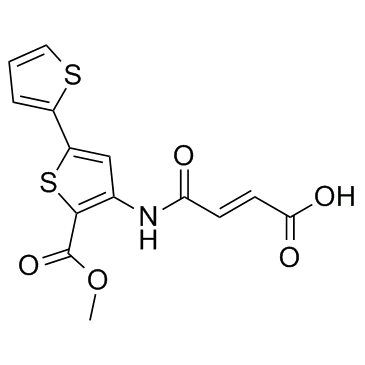
HTS01037 is an inhibitor of fatty acid binding; and a competitive antagonist of protein-protein interactions mediated by AFABP/aP2 with a Ki of 0.67 μM.
HTS01037 functions as a high affinity ligand of AFABP/aP2 with an apparent Ki of 0.67 μM. HTS01037 is somewhat selective for AFABP/aP2, but at higher concentrations is a pan-specific FABP inhibitor. HTS01037 inhibits lipolysis in 3T3-L1 adipocytes and reduces LPS-stimulated inflammation in cultured macrophages. HTS01037 acts as an antagonist of the protein-protein interaction between AFABP/aP2 and hormone sensitive lipase but does not activate PPARγ in macrophage or CV-1 cells[1]. Treatment of microglial cells with HTS01037 increases expression of Ucp2 and arginase in the presence or absence of palmitic acid. Moreover, cells exposed to HTS01037 exhibits attenuated expression of inducible nitric oxide synthase (iNOS) compared to palmitic acid alone indicating reduced NFκB signaling[2]. Treatment of macrophages with HTS01037results in a marked decrease in both basal and fatty acid-stimulated LTC4 secretion but no change in 5-HETE production or 5-lipoxygenase expression[3].
[1]. Hertzel AV, et al. Identification and characterization of a small molecule inhibitor of Fatty Acid binding proteins. J Med Chem. 2009 Oct 8;52(19):6024-31. [2]. Duffy CM, et al. Identification of a fatty acid binding protein4-UCP2 axis regulating microglial mediated neuroinflammation. Mol Cell Neurosci. 2017 Apr;80:52-57. [3]. Long EK, et al. Fatty acids induce leukotriene C4 synthesis in macrophages in a fatty acid binding protein-dependent manner. Biochim Biophys Acta. 2013 Jul;1831(7):1199-207.
Kinase experiment: | To analyze the ligand (HTS01037) binding properties of the FABPs, the fluorescent ligand 1-anilinonapthalene 8-sulfonic acid (1,8-ANS) is utilized. 1,8 ANS is dissolved in absolute ethanol and diluted with 25 mM Tris-HCl (pH 7.4) to a final concentration of 5 μM (final EtOH concentration of 0.05%). Protein is titrated into 500 μL 1,8-ANS and the fluorescence enhancement is measured using a Perkin Elmer 650-10S fluorescence spectrophotometer with 4 nm excitation and emission slit widths. Quantitative analysis of ligand binding is evaluated using non-linear regression using PRISM software[1]. |
Cell experiment: | Cells are pretreated with HTS01037 or vehicle for 3 h and then challenged with or without palmitic acid for 1 h. Cells are then exposed to the ROS Deep Red Dye for 1 h in 5% CO2 at 37°C. Intracellular superoxide and hydroxyl radicals react with the deep red dye, producing a fluorescent signal which is measured using a spectrophotometer at 650Ex/675Em[2]. |
References: [1]. Hertzel AV, et al. Identification and characterization of a small molecule inhibitor of Fatty Acid binding proteins. J Med Chem. 2009 Oct 8;52(19):6024-31. | |
| Cas No. | 682741-29-3 | SDF | |
| Canonical SMILES | O=C(C1=C(NC(/C=C/C(O)=O)=O)C=C(C2=CC=CS2)S1)OC | ||
| Formula | C14H11NO5S2 | M.Wt | 337.37 |
| Solubility | DMSO : ≥ 150 mg/mL (444.62 mM);Water : < 0.1 mg/mL (insoluble) | Storage | Store at -20°C |
| General tips | Please select the appropriate solvent to prepare the stock solution according to the
solubility of the product in different solvents; once the solution is prepared, please store it in
separate packages to avoid product failure caused by repeated freezing and thawing.Storage method
and period of the stock solution: When stored at -80°C, please use it within 6 months; when stored
at -20°C, please use it within 1 month. To increase solubility, heat the tube to 37°C and then oscillate in an ultrasonic bath for some time. |
||
| Shipping Condition | Evaluation sample solution: shipped with blue ice. All other sizes available: with RT, or with Blue Ice upon request. | ||
| Prepare stock solution | |||

|
1 mg | 5 mg | 10 mg |
| 1 mM | 2.9641 mL | 14.8205 mL | 29.641 mL |
| 5 mM | 592.8 μL | 2.9641 mL | 5.9282 mL |
| 10 mM | 296.4 μL | 1.4821 mL | 2.9641 mL |
Step 1: Enter information below (Recommended: An additional animal making an allowance for loss during the experiment)
 g
μL
g
μL
Step 2: Enter the in vivo formulation (This is only the calculator, not formulation. Please contact us first if there is no in vivo formulation at the solubility Section.)
Calculation results:
Working concentration: mg/ml;
Method for preparing DMSO master liquid: mg drug pre-dissolved in μL DMSO ( Master liquid concentration mg/mL, Please contact us first if the concentration exceeds the DMSO solubility of the batch of drug. )
Method for preparing in vivo formulation: Take μL DMSO master liquid, next addμL PEG300, mix and clarify, next addμL Tween 80, mix and clarify, next add μL saline, mix and clarify.
Method for preparing in vivo formulation: Take μL DMSO master liquid, next add μL Corn oil, mix and clarify.
Note: 1. Please make sure the liquid is clear before adding the next solvent.
2. Be sure to add the solvent(s) in order. You must ensure that the solution obtained, in the previous addition, is a clear solution before proceeding to add the next solvent. Physical methods such as vortex, ultrasound or hot water bath can be used to aid dissolving.
3. All of the above co-solvents are available for purchase on the GlpBio website.
Quality Control & SDS
- View current batch:
- Purity: >99.50% Appearance: A solid
- COA (Certificate of Analysis)
- SDS (Safety Data Sheet)
- Datasheet
Average Rating: 5 (Based on Reviews and 14 reference(s) in Google Scholar.)