

IMR-1 (Synonyms: Inhibitor of Mastermind Recruitment-1) |
Catalog No.GC12741
 One-Click Copy Product Info
|

Notch pathway inhibitor
Products are for research use only. Not for human use. We do not sell to patients.
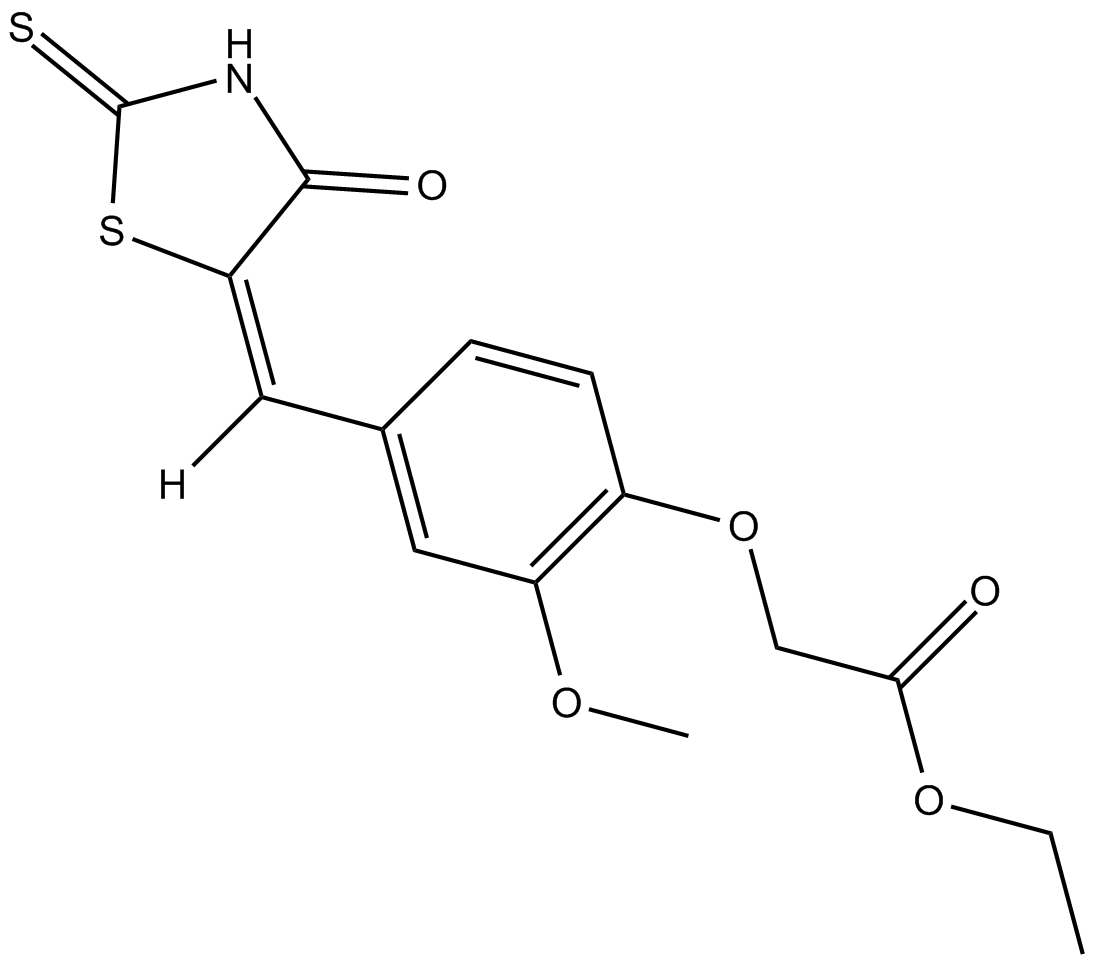
Cas No.: 310456-65-6
Sample solution is provided at 25 µL, 10mM.
_1-3.$$$39978408@51.jpg');)
_1-9.$$$38538795@65.jpg');)
_1-9.$$$39112701@51.jpg');)
_1-7.$$$37316672@70.jpg');)
_366-372.$$$36198801@70.jpg');)
.$$$38565142@65.jpg');)
_1867-1883.$$$33248023@67.jpg');)
_eads6055.$$$39977546@45.jpg');)
_eadm9805.$$$40080571@45.jpg');)
_eadj3020.$$$39666821@45.jpg');)
_1-20.$$$39757301@28.jpg');)
_1-24.$$$38898113@28.jpg');)
_273-287.$$$36806353@46.jpg');)
_1-16.$$$37156877@44.jpg');)
_1-19.$$$37460805@44.jpg');)
_1291-1307.$$$34518654@46.jpg');)
IC50: 26 μmol/L
IMR-1 is a inhibitor of Notch pathway.
Aberrant Notch activity has been reported to play a important role in the initiation and maintenance of the neoplastic phenotype and in various cancer stem cells, which alludes to its additional involvement in metastasis and resistance.
In vitro: In order to determine the effect of IMR-1 on the assembly of the Notch ternary complex (NTC) in cells, Notch-dependent cell lines OE33 and 786-0 were treated with IMR-1 or DAPT. Results showed that treatment of OE33 and 786-0 with IMR-1 could decrease the occupancy of Maml1 on the HES1 promoter but, in contrast to DAPT, IMR-1 treatment could not affect the occupancy of Notch1 on the HES1 promoter. In addition, western blot analyses indicated that IMR-1 treatment did not change the cellular levels of NICD [1].
In vivo: Animal study showed that treatment of mice with 15 mg/kg IMR-1 could readily block tumor establishment. Moreover, IMR-1 treatment at 15 mg/kg caused no observable adverse effects on the animal. In two independent PDX models, IMR-1 could significantly abrogate the tumor growth to a similar level achieved with DAPT treatment, without any significant weight loss or other visible signs of adverse effects in the treated mice [1].
Clinical trial: Up to now, IMR-1 is still in the preclinical development stage.
Reference:
[1] Astudillo L,Da Silva TG,Wang Z,et al. The Small Molecule IMR-1 Inhibits the Notch Transcriptional Activation Complex to Suppress Tumorigenesis. Cancer Res.2016 Jun 15;76(12):3593-603.
| Cas No. | 310456-65-6 | SDF | |
| Synonyms | Inhibitor of Mastermind Recruitment-1 | ||
| Chemical Name | (E)-ethyl 2-(2-methoxy-4-((4-oxo-2-thioxothiazolidin-5-ylidene)methyl)phenoxy)acetate | ||
| Canonical SMILES | CCOC(COC1=C(OC)C=C(/C([H])=C(S2)\C(NC2=S)=O)C=C1)=O | ||
| Formula | C15H15NO5S2 | M.Wt | 353.41 |
| Solubility | ≥ 35.3mg/mL in DMSO | Storage | Store at -20°C |
| General tips | Please select the appropriate solvent to prepare the stock solution according to the
solubility of the product in different solvents; once the solution is prepared, please store it in
separate packages to avoid product failure caused by repeated freezing and thawing.Storage method
and period of the stock solution: When stored at -80°C, please use it within 6 months; when stored
at -20°C, please use it within 1 month. To increase solubility, heat the tube to 37°C and then oscillate in an ultrasonic bath for some time. |
||
| Shipping Condition | Evaluation sample solution: shipped with blue ice. All other sizes available: with RT, or with Blue Ice upon request. | ||
| Prepare stock solution | |||

|
1 mg | 5 mg | 10 mg |
| 1 mM | 2.8296 mL | 14.1479 mL | 28.2957 mL |
| 5 mM | 565.9 μL | 2.8296 mL | 5.6591 mL |
| 10 mM | 283 μL | 1.4148 mL | 2.8296 mL |
Step 1: Enter information below (Recommended: An additional animal making an allowance for loss during the experiment)
 g
μL
g
μL
Step 2: Enter the in vivo formulation (This is only the calculator, not formulation. Please contact us first if there is no in vivo formulation at the solubility Section.)
Calculation results:
Working concentration: mg/ml;
Method for preparing DMSO master liquid: mg drug pre-dissolved in μL DMSO ( Master liquid concentration mg/mL, Please contact us first if the concentration exceeds the DMSO solubility of the batch of drug. )
Method for preparing in vivo formulation: Take μL DMSO master liquid, next addμL PEG300, mix and clarify, next addμL Tween 80, mix and clarify, next add μL saline, mix and clarify.
Method for preparing in vivo formulation: Take μL DMSO master liquid, next add μL Corn oil, mix and clarify.
Note: 1. Please make sure the liquid is clear before adding the next solvent.
2. Be sure to add the solvent(s) in order. You must ensure that the solution obtained, in the previous addition, is a clear solution before proceeding to add the next solvent. Physical methods such as vortex, ultrasound or hot water bath can be used to aid dissolving.
3. All of the above co-solvents are available for purchase on the GlpBio website.
Quality Control & SDS
- View current batch:
- Purity: >98.50% Appearance: A solid
- COA (Certificate of Analysis)
- SDS (Safety Data Sheet)
- Datasheet
Average Rating: 5 (Based on Reviews and 5 reference(s) in Google Scholar.)