

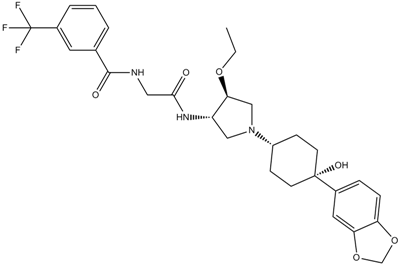
INCB3344 (Synonyms: INCB 3344; INCB-3344) |
Catalog No.GC10207
 One-Click Copy Product Info
|

An antagonist of CCR2
Products are for research use only. Not for human use. We do not sell to patients.
Cas No.: 1262238-11-8
Sample solution is provided at 25 µL, 10mM.
_1-3.$$$39978408@51.jpg');)
_1-9.$$$38538795@65.jpg');)
_1-9.$$$39112701@51.jpg');)
_1-7.$$$37316672@70.jpg');)
_366-372.$$$36198801@70.jpg');)
.$$$38565142@65.jpg');)
_1867-1883.$$$33248023@67.jpg');)
_eads6055.$$$39977546@45.jpg');)
_eadm9805.$$$40080571@45.jpg');)
_eadj3020.$$$39666821@45.jpg');)
_1-20.$$$39757301@28.jpg');)
_1-24.$$$38898113@28.jpg');)
_273-287.$$$36806353@46.jpg');)
_1-16.$$$37156877@44.jpg');)
_1-19.$$$37460805@44.jpg');)
_1291-1307.$$$34518654@46.jpg');)
INCB3344 is a novel potent and selective antagonist of CCR2 receptor, which possesses an IC 50 of 10 nM for CCL2. [1]
CCR2 is a chemokine receptor mainly expressed on monocytes which acts as the key receptor in mediating their tissue influx in the context of immune-based inflammation. CCR2 is a G protein-coupled receptor (GPCR), whose ligands include the chemokines MCP family, including CCL2, CCL7, CCL8. These ligands bind CCR2 receptor with high affinity and elicit a chemotactic signal which leads to directed migration of the receptor-bearing cells. CCL2 has been shown to be relevant in high concentrations in various inflammatory lesions, implicating this chemokine as a physiologically important chemotactic signal for monocytes. [1]
Characterization of the pharmacological activity of INCB3344 was first evaluated by testing its ability to inhibit CCL2 binding to CCR2 in a whole cell binding assay using a murine monocyte cell line, WEHI-274.1 and 125I-labeled mCCL2 as a tracer. The binding IC 50 of INCB3344 in this assay was determined to be 10±5 nM, and inhibition greater than 90% binding was observed at a concentration of 90nM . The chemotaxis inhibitory activity of different concentrations of INCB3344 was evaluated using 30nM mCCL2 as the agonist. The result showed a similar potency to the binding assay. Selectivity of INCB3344 was evaluated against a panel of GPCRs including several human chemokine receptors using radioligand binding assays. Results from these studies demonstrate at least 100-fold selectivity of INCB3344 against all of the receptors tested. [1]
INCB3344 treatment results in a dose-dependent inhibition of macrophage influx in a mouse delayed-type hypersensitivity model. The histopathological analysis of tissues from the delayed-type hypersensitivity model illustrates that inhibitory activity of CCR2 leads to a substantial reduction in tissue inflammation. [1]
Reference:
[1]. Brodmerkel C M, Huber R, Covington M, et al. Discovery and pharmacological characterization of a novel rodent-active CCR2 antagonist, INCB3344[J]. The Journal of Immunology, 2005, 175(8): 5370-5378.
| Kinase experiment [1]: | |
|
Binding assays |
WEHI 274.1 (murine monocytic cell line) cells were used in a whole cell binding assay. Cells (5×10⁵) inRPMI 1640, 0.1% BSA, 20 mM HEPES were added to various concentrations of INCB3344 in RPMI 1640 followed immediately by the addition of 150 pM 125I-labeled mCCL2 (mouse CCL2(JE)) and incubated for 30 min at room temperature (RT). For the nonspecific control, 0.3 μM mCCL2 was added in place of INCB3344. Cells were then harvested through 1.2-μM polyvinylidene difluoride filters, the filters were airdried, and binding was determined by counting in a gamma counter. Antagonist activity is reported as the inhibitor concentration required for IC50 of specific binding. Specific binding is defined as the total binding minus the nonspecific binding and typically represents 97% of the total binding. |
| Cell experiment [1]: | |
|
Cell lines |
WEHI-274.1 cells |
|
Preparation method |
Dissolved in DMSO. General tips for obtaining a higher concentration: Please warm the tube at 37℃ for 10 minutes and/or shake it in the ultrasonic bath for a while. Stock solution can be stored below -20℃ for several months. |
|
Reaction Conditions |
0.3-300 nM; 6 min. |
|
Applications |
In WEHI-274.1 cells, INCB3344 inhibits monocyte chemotaxis with IC50 value of 10 nM using 30 nM mCCL2 as the agonist. INCB3344 blocks ERK phosphorylation in response to mCCL2 with IC50 value of 3-10 nM, which is mediated by CCR2 signaling. |
| Animal experiment [1]: | |
|
Animal models |
Female BALB/c mice (20 g) received i.p. injection of thioglycolate. |
|
Dosage form |
30, 60, or 100 mg/kg BID; 48 h; administrated orally. |
|
Applications |
INCB3344 dose-dependently reduces total cell number in the lavage fluid and inhibits monocyte influx by 36%, 55% and 73% at 30 mg/kg, 60 mg/kg and 100 mg/kg, respectively. |
|
Other notes |
Please test the solubility of all compounds indoor, and the actual solubility may slightly differ with the theoretical value. This is caused by an experimental system error and it is normal. |
|
References: [1]. Brodmerkel CM, Huber R, Covington M, et al. Discovery and pharmacological characterization of a novel rodent-active CCR2 antagonist, INCB3344[J]. The Journal of Immunology, 2005, 175(8): 5370-5378. | |
| Cas No. | 1262238-11-8 | SDF | |
| Synonyms | INCB 3344; INCB-3344 | ||
| Chemical Name | N-[2-[[(3S,4S)-1-[4-(1,3-benzodioxol-5-yl)-4-hydroxycyclohexyl]-4-ethoxypyrrolidin-3-yl]amino]-2-oxoethyl]-3-(trifluoromethyl)benzamide | ||
| Canonical SMILES | CCOC1CN(CC1NC(=O)CNC(=O)C2=CC(=CC=C2)C(F)(F)F)C3CCC(CC3)(C4=CC5=C(C=C4)OCO5)O | ||
| Formula | C29H34F3N3O6 | M.Wt | 577.24 |
| Solubility | ≥ 25.9 mg/mL in DMSO, ≥ 89.8 mg/mL in EtOH | Storage | Store at -20°C |
| General tips | Please select the appropriate solvent to prepare the stock solution according to the
solubility of the product in different solvents; once the solution is prepared, please store it in
separate packages to avoid product failure caused by repeated freezing and thawing.Storage method
and period of the stock solution: When stored at -80°C, please use it within 6 months; when stored
at -20°C, please use it within 1 month. To increase solubility, heat the tube to 37°C and then oscillate in an ultrasonic bath for some time. |
||
| Shipping Condition | Evaluation sample solution: shipped with blue ice. All other sizes available: with RT, or with Blue Ice upon request. | ||
| Prepare stock solution | |||

|
1 mg | 5 mg | 10 mg |
| 1 mM | 1.7324 mL | 8.6619 mL | 17.3238 mL |
| 5 mM | 346.5 μL | 1.7324 mL | 3.4648 mL |
| 10 mM | 173.2 μL | 866.2 μL | 1.7324 mL |
Step 1: Enter information below (Recommended: An additional animal making an allowance for loss during the experiment)
 g
μL
g
μL
Step 2: Enter the in vivo formulation (This is only the calculator, not formulation. Please contact us first if there is no in vivo formulation at the solubility Section.)
Calculation results:
Working concentration: mg/ml;
Method for preparing DMSO master liquid: mg drug pre-dissolved in μL DMSO ( Master liquid concentration mg/mL, Please contact us first if the concentration exceeds the DMSO solubility of the batch of drug. )
Method for preparing in vivo formulation: Take μL DMSO master liquid, next addμL PEG300, mix and clarify, next addμL Tween 80, mix and clarify, next add μL saline, mix and clarify.
Method for preparing in vivo formulation: Take μL DMSO master liquid, next add μL Corn oil, mix and clarify.
Note: 1. Please make sure the liquid is clear before adding the next solvent.
2. Be sure to add the solvent(s) in order. You must ensure that the solution obtained, in the previous addition, is a clear solution before proceeding to add the next solvent. Physical methods such as vortex, ultrasound or hot water bath can be used to aid dissolving.
3. All of the above co-solvents are available for purchase on the GlpBio website.
Quality Control & SDS
- View current batch:
- Purity: >99.50% Appearance: A solid
- COA (Certificate of Analysis)
- SDS (Safety Data Sheet)
- Datasheet
Average Rating: 5 (Based on Reviews and 30 reference(s) in Google Scholar.)