

Iopromide (Synonyms: Ultravist) |
Catalog No.GC32480
 One-Click Copy Product Info
|

A contrast reagent
Products are for research use only. Not for human use. We do not sell to patients.
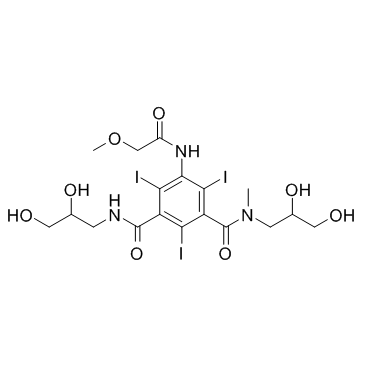
Cas No.: 73334-07-3
Sample solution is provided at 25 µL, 10mM.
_1-3.$$$39978408@51.jpg');)
_1-9.$$$38538795@65.jpg');)
_1-9.$$$39112701@51.jpg');)
_1-7.$$$37316672@70.jpg');)
_366-372.$$$36198801@70.jpg');)
.$$$38565142@65.jpg');)
_1867-1883.$$$33248023@67.jpg');)
_eads6055.$$$39977546@45.jpg');)
_eadm9805.$$$40080571@45.jpg');)
_eadj3020.$$$39666821@45.jpg');)
_1-20.$$$39757301@28.jpg');)
_1-24.$$$38898113@28.jpg');)
_273-287.$$$36806353@46.jpg');)
_1-16.$$$37156877@44.jpg');)
_1-19.$$$37460805@44.jpg');)
_1291-1307.$$$34518654@46.jpg');)
Iopromide is a water-soluble, non-ionic, monomeric, low-osmolar, iodine-based contrast medium for intravascular administration.
Contrast medium-induced nephropathy can be induced by tail intravenous administration of iopromide[1]. In randomized controlled trials, the global image quality and diagnostic quality with iobitridol does not differ from those with other low-osmolar contrast media (iohexol, iopromide, iopamidol, iomeprol and ioxaglate) or the iso-osmolar contrast medium iodixanol in adults or children undergoing radiographic imaging. Large post-marketing surveillance studies have confirmed that iobitridol produces good or excellent opacification and is an effective contrast agent in the vast majority of patients. Iobitridol is generally well tolerated and had a tolerability profile similar to that of other low-osmolar and iso-osmolar contrast media. Thus, iobitridol is an effective intravascular agent for contrast enhancement in diagnostic imaging[2].
[1]. Jiang W, et al. Breviscapine attenuatted contrast medium-induced nephropathy via PKC/Akt/MAPK signalling in diabetic mice. Am J Transl Res. 2016 Feb 15;8(2):329-41. [2]. McCormack PL, et al. Iobitridol: a review of its use as a contrast medium in diagnostic imaging. Clin Drug Investig. 2013 Feb;33(2):155-66.
Animal experiment: | Mice: Male C57/BL6J mice are randomly divided into 7 groups: control, diabetes mellitus (D), CIN, diabetes mellitus+CIN (DC), diabetes mellitus+Breviscapine (DB), CIN+Breviscapine (CIN+B) and diabetes mellitus+CIN+Breviscapine (DCB). After the model of diabetes mellitus is established, mice are prohibited drinking water for one night, and then mice are injected at a dose of 10 mL/kg iopromide via tail vein administration over the course of 1 minute. Then the mice are treated intragastrically with or without Breviscapine (10 mg/kg/d) for 4 weeks. Other mice groups except for Breviscapine treatment groups (DB, DCB and CIN+B) are administered the same volume of phosphate buffered solution intragastrically for 4 weeks. Then mice are sacrificed by an intraperitoneal injection of chloral hydrate[1]. |
References: [1]. Jiang W, et al. Breviscapine attenuatted contrast medium-induced nephropathy via PKC/Akt/MAPK signalling in diabetic mice. Am J Transl Res. 2016 Feb 15;8(2):329-41. | |
| Cas No. | 73334-07-3 | SDF | |
| Synonyms | Ultravist | ||
| Canonical SMILES | O=C(C1=C(I)C(NC(COC)=O)=C(I)C(C(NCC(O)CO)=O)=C1I)N(CC(O)CO)C | ||
| Formula | C18H24I3N3O8 | M.Wt | 791.11 |
| Solubility | DMSO : ≥ 150 mg/mL (189.61 mM) | Storage | Store at -20°C |
| General tips | Please select the appropriate solvent to prepare the stock solution according to the
solubility of the product in different solvents; once the solution is prepared, please store it in
separate packages to avoid product failure caused by repeated freezing and thawing.Storage method
and period of the stock solution: When stored at -80°C, please use it within 6 months; when stored
at -20°C, please use it within 1 month. To increase solubility, heat the tube to 37°C and then oscillate in an ultrasonic bath for some time. |
||
| Shipping Condition | Evaluation sample solution: shipped with blue ice. All other sizes available: with RT, or with Blue Ice upon request. | ||
| Prepare stock solution | |||

|
1 mg | 5 mg | 10 mg |
| 1 mM | 1.264 mL | 6.3202 mL | 12.6405 mL |
| 5 mM | 252.8 μL | 1.264 mL | 2.5281 mL |
| 10 mM | 126.4 μL | 632 μL | 1.264 mL |
Step 1: Enter information below (Recommended: An additional animal making an allowance for loss during the experiment)
 g
μL
g
μL
Step 2: Enter the in vivo formulation (This is only the calculator, not formulation. Please contact us first if there is no in vivo formulation at the solubility Section.)
Calculation results:
Working concentration: mg/ml;
Method for preparing DMSO master liquid: mg drug pre-dissolved in μL DMSO ( Master liquid concentration mg/mL, Please contact us first if the concentration exceeds the DMSO solubility of the batch of drug. )
Method for preparing in vivo formulation: Take μL DMSO master liquid, next addμL PEG300, mix and clarify, next addμL Tween 80, mix and clarify, next add μL saline, mix and clarify.
Method for preparing in vivo formulation: Take μL DMSO master liquid, next add μL Corn oil, mix and clarify.
Note: 1. Please make sure the liquid is clear before adding the next solvent.
2. Be sure to add the solvent(s) in order. You must ensure that the solution obtained, in the previous addition, is a clear solution before proceeding to add the next solvent. Physical methods such as vortex, ultrasound or hot water bath can be used to aid dissolving.
3. All of the above co-solvents are available for purchase on the GlpBio website.
Quality Control & SDS
- View current batch:
- Purity: >98.00% Appearance: A solid
- COA (Certificate of Analysis)
- SDS (Safety Data Sheet)
- Datasheet
Average Rating: 5 (Based on Reviews and 14 reference(s) in Google Scholar.)