

Itacitinib (Synonyms: INCB 039110) |
Catalog No.GC19204
 One-Click Copy Product Info
|

Itacitinib is a JAK1 inhibitor (IC₅₀=2nM). Itacitinib selectively inhibits JAK1 tyrosine kinase to modulate the JAK-STAT signaling pathway while regulating immune responses by reducing the production of pro-inflammatory cytokines.
Products are for research use only. Not for human use. We do not sell to patients.
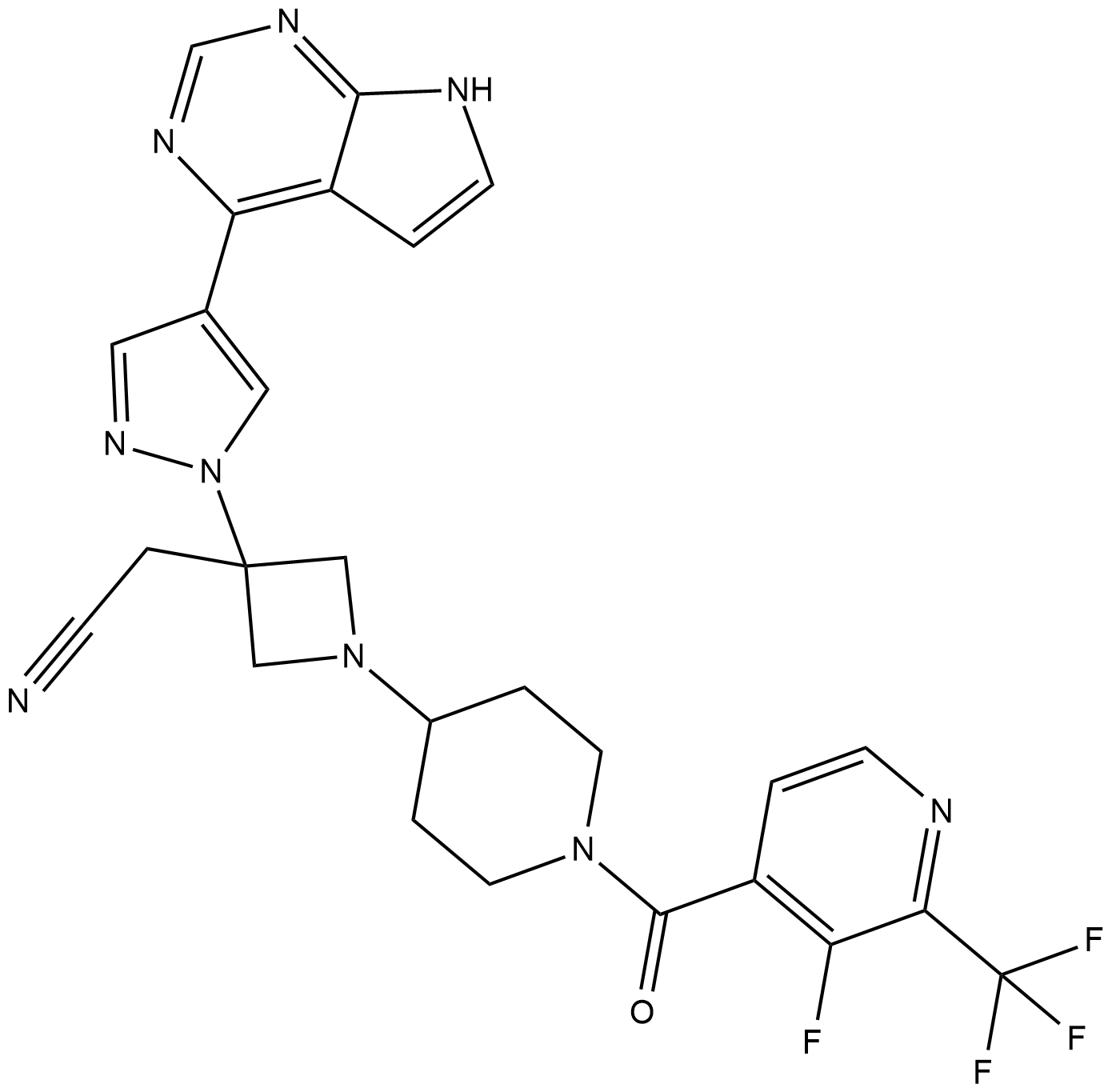
Cas No.: 1334298-90-6
Sample solution is provided at 25 µL, 10mM.
_1-3.$$$39978408@51.jpg');)
_1-9.$$$38538795@65.jpg');)
_1-9.$$$39112701@51.jpg');)
_1-7.$$$37316672@70.jpg');)
_366-372.$$$36198801@70.jpg');)
.$$$38565142@65.jpg');)
_1867-1883.$$$33248023@67.jpg');)
_eads6055.$$$39977546@45.jpg');)
_eadm9805.$$$40080571@45.jpg');)
_eadj3020.$$$39666821@45.jpg');)
_1-20.$$$39757301@28.jpg');)
_1-24.$$$38898113@28.jpg');)
_273-287.$$$36806353@46.jpg');)
_1-16.$$$37156877@44.jpg');)
_1-19.$$$37460805@44.jpg');)
_1291-1307.$$$34518654@46.jpg');)
Itacitinib is a JAK1 inhibitor (IC₅₀=2nM). Itacitinib selectively inhibits JAK1 tyrosine kinase to modulate the JAK-STAT signaling pathway while regulating immune responses by reducing the production of pro-inflammatory cytokines[1-2]. Itacitinib can be used in research related to myelofibrosis, graft-versus-host disease (GVHD), and cytokine release syndrome (CRS)[3-4].
In vitro, human CAR-T cells (including GD2, EGFR, and CD19 constructs) were pretreated with Itacitinib (100–250nM) and cultured under anti-CD3/CD28 antibody activation conditions. Itacitinib did not inhibit T cell proliferation and maintained the specific killing activity of CAR-T cells against target tumor cells (SY5Y neuroblastoma cells)[5]. Mouse colon cancer cells CT26.WT were pretreated with Itacitinib (0.5μM) for 2 hours and then co-cultured with IFN-γ (100ng/mL). Itacitinib significantly inhibited IFN-γ-induced phosphorylation of JAK1/STAT1 and cleavage of caspase-3, while reducing the apoptosis rate. Itacitinib blocked the JAK-STAT signaling pathway, thereby inhibiting IFN-γ-mediated pro-apoptotic effects[6].
In vivo, Itacitinib (120mg/kg) was administered twice daily via oral gavage to xenograft graft-versus-host disease (xGVHD) model mice induced by intravenous injection of 2×10⁷ human peripheral blood mononuclear cells (hPBMCs) from day 3 to day 28 post-transplantation. Itacitinib significantly prolonged the median survival of the model mice, reduced the absolute numbers of human CD4⁺ T cells and human CD8⁺ T cells in peripheral blood, and increased the frequency of human regulatory T cells (Tregs) among CD4⁺ T cells[7]. In a secondary hemophagocytic lymphohistiocytosis (HLH) model induced by CpG/αIL-10R, Itacitinib (120mg/kg; twice daily) was administered from days 4 to 8 post-induction. Itacitinib significantly improved mouse survival rates, enhanced clinical scores, and reduced serum levels of cytokines such as CXCL10, IL-12, IL-6, and GM-CSF, as well as the number of neutrophils in the spleen[8].
References:
[1] Mascarenhas JO, Talpaz M, Gupta V, et al. Primary analysis of a phase II open-label trial of INCB039110, a selective JAK1 inhibitor, in patients with myelofibrosis. Haematologica. 2017 Feb;102(2):327-335.
[2] Lescoat A, Lelong M, Jeljeli M, et al. Combined anti-fibrotic and anti-inflammatory properties of JAK-inhibitors on macrophages in vitro and in vivo: Perspectives for scleroderma-associated interstitial lung disease. Biochem Pharmacol. 2020 Aug;178:114103.
[3] Chen X, Xun Z, Yuska B, et al. Itacitinib Population Pharmacokinetics and Exposure-Response in Patients With Acute Graft-Versus-Host Disease. J Clin Pharmacol. 2023 May;63(5):622-632.
[4] Etra A, Capellini A, Alousi A, et al. Effective treatment of low-risk acute GVHD with itacitinib monotherapy. Blood. 2023 Feb 2;141(5):481-489.
[5] Huarte E, O'Connor RS, Peel MT, et al. Itacitinib (INCB039110), a JAK1 Inhibitor, Reduces Cytokines Associated with Cytokine Release Syndrome Induced by CAR T-cell Therapy. Clin Cancer Res. 2020 Dec 1;26(23):6299-6309.
[6] Yang X, Gao DD, Zhang H, et al. Combining Radiation and anti-PD-L1 Enhances the Antitumor Activity in Colorectal Cancer via IFN-γ-Dependent Activation of STAT1. Technol Cancer Res Treat. 2025 Jan-Dec;24:15330338251406931.
[7] Courtois J, Ritacco C, Dubois S, et al. Itacitinib prevents xenogeneic GVHD in humanized mice. Bone Marrow Transplant. 2021 Nov;56(11):2672-2681.
[8] Keenan C, Albeituni S, Oak N, et al. Differential effects of itacitinib, fedratinib, and ruxolitinib in mouse models of hemophagocytic lymphohistiocytosis. Blood. 2024 Jun 6;143(23):2386-2400.
| Cell experiment [1]: | |
Cell lines | CT26.WT murine colon carcinoma cells |
Preparation Method | CT26.WT cells were treated with the JAK1 inhibitor Itacitinib (0.5μM) for 6 hours. To directly test the requirement of STAT1 signaling, cells were pre-treated with Itacitinib prior to stimulation with interferon-gamma (IFN-γ, 100ng/mL) or a combination of ionizing radiation (IR, 6Gy) and IFN-γ. |
Reaction Conditions | 0.5μM; 6h pre-treatment before stimulation with IFN-γ |
Applications | Pharmacologic inhibition of JAK1 by Itacitinib abolished IFN-γ-induced and IR+IFN-γ-induced phosphorylation of STAT1 and cleavage of caspase-3 in CT26.WT cells. IR and IFN-γ each significantly increased apoptosis, pre-treatment with Itacitinib abolished these pro-apoptotic effects, reducing apoptosis rates to near-control levels. |
| Animal experiment [2]: | |
Animal models | C57BL/6J mice (wildtype and perforin-deficient Prf1-/- mice) |
Preparation Method | Mice were treated with Itacitinib (120mg/kg) administered by oral gavage twice daily. In the secondary HLH model, WT mice received CpG DNA and anti-IL-10R antibody injections on days 0, 2, 4, and 7, with Itacitinib treatment from days 4 to 8. In the primary HLH model, Prf1-/- mice were infected with lymphocytic choriomeningitis virus (LCMV) and treated with Itacitinib from days 4 to 29 post-infection. Mice were sacrificed on day 9 or 30 for analysis. |
Dosage form | 120mg/kg; oral gavage; twice daily administration. |
Applications | Itacitinib significantly improved survival and clinical scores in CpG-induced secondary HLH, with median survival of 45 days versus 33 days in controls. However, in LCMV-induced primary HLH, Itacitinib provided only partial survival benefit and clinical improvement compared to the superior effects of ruxolitinib (JAK1/2 inhibitor). Itacitinib treatment significantly reduced serum levels of proinflammatory cytokines including CXCL10, IL-12(p70), IL-6, GM-CSF, MCP-1, and MIP-1a, and decreased splenic neutrophil numbers and activation in secondary HLH. RNA-sequencing revealed that Itacitinib targeted inflammatory and metabolic pathway genes in CD8+ T cells but had minimal transcriptional impact on monocytes. |
References: | |
| Cas No. | 1334298-90-6 | SDF | |
| Synonyms | INCB 039110 | ||
| Canonical SMILES | N#CCC1(N2N=CC(C3=C4C(NC=C4)=NC=N3)=C2)CN(C5CCN(C(C6=C(F)C(C(F)(F)F)=NC=C6)=O)CC5)C1 | ||
| Formula | C26H23F4N9O | M.Wt | 553.51 |
| Solubility | DMSO : ≥ 30 mg/mL (54.20 mM) | Storage | Store at -20°C |
| General tips | Please select the appropriate solvent to prepare the stock solution according to the
solubility of the product in different solvents; once the solution is prepared, please store it in
separate packages to avoid product failure caused by repeated freezing and thawing.Storage method
and period of the stock solution: When stored at -80°C, please use it within 6 months; when stored
at -20°C, please use it within 1 month. To increase solubility, heat the tube to 37°C and then oscillate in an ultrasonic bath for some time. |
||
| Shipping Condition | Evaluation sample solution: shipped with blue ice. All other sizes available: with RT, or with Blue Ice upon request. | ||
| Prepare stock solution | |||

|
1 mg | 5 mg | 10 mg |
| 1 mM | 1.8067 mL | 9.0333 mL | 18.0665 mL |
| 5 mM | 361.3 μL | 1.8067 mL | 3.6133 mL |
| 10 mM | 180.7 μL | 903.3 μL | 1.8067 mL |
Step 1: Enter information below (Recommended: An additional animal making an allowance for loss during the experiment)
 g
μL
g
μL
Step 2: Enter the in vivo formulation (This is only the calculator, not formulation. Please contact us first if there is no in vivo formulation at the solubility Section.)
Calculation results:
Working concentration: mg/ml;
Method for preparing DMSO master liquid: mg drug pre-dissolved in μL DMSO ( Master liquid concentration mg/mL, Please contact us first if the concentration exceeds the DMSO solubility of the batch of drug. )
Method for preparing in vivo formulation: Take μL DMSO master liquid, next addμL PEG300, mix and clarify, next addμL Tween 80, mix and clarify, next add μL saline, mix and clarify.
Method for preparing in vivo formulation: Take μL DMSO master liquid, next add μL Corn oil, mix and clarify.
Note: 1. Please make sure the liquid is clear before adding the next solvent.
2. Be sure to add the solvent(s) in order. You must ensure that the solution obtained, in the previous addition, is a clear solution before proceeding to add the next solvent. Physical methods such as vortex, ultrasound or hot water bath can be used to aid dissolving.
3. All of the above co-solvents are available for purchase on the GlpBio website.
Quality Control & SDS
- View current batch:
- Purity: >99.50% Appearance: A solid
- COA (Certificate of Analysis)
- SDS (Safety Data Sheet)
- Datasheet
Average Rating: 5 (Based on Reviews and 36 reference(s) in Google Scholar.)