

JMV 449 |
Catalog No.GC17784
 One-Click Copy Product Info
|

JMV 449 is a potent and long-acting neurotensin receptor (NTR) agonist peptide. JMV 449 inhibits [125I]-neurotensin binding to newborn mouse brain (IC50=0.15nM) and contracts guinea pig ileum (EC50=1.9nM).
Products are for research use only. Not for human use. We do not sell to patients.
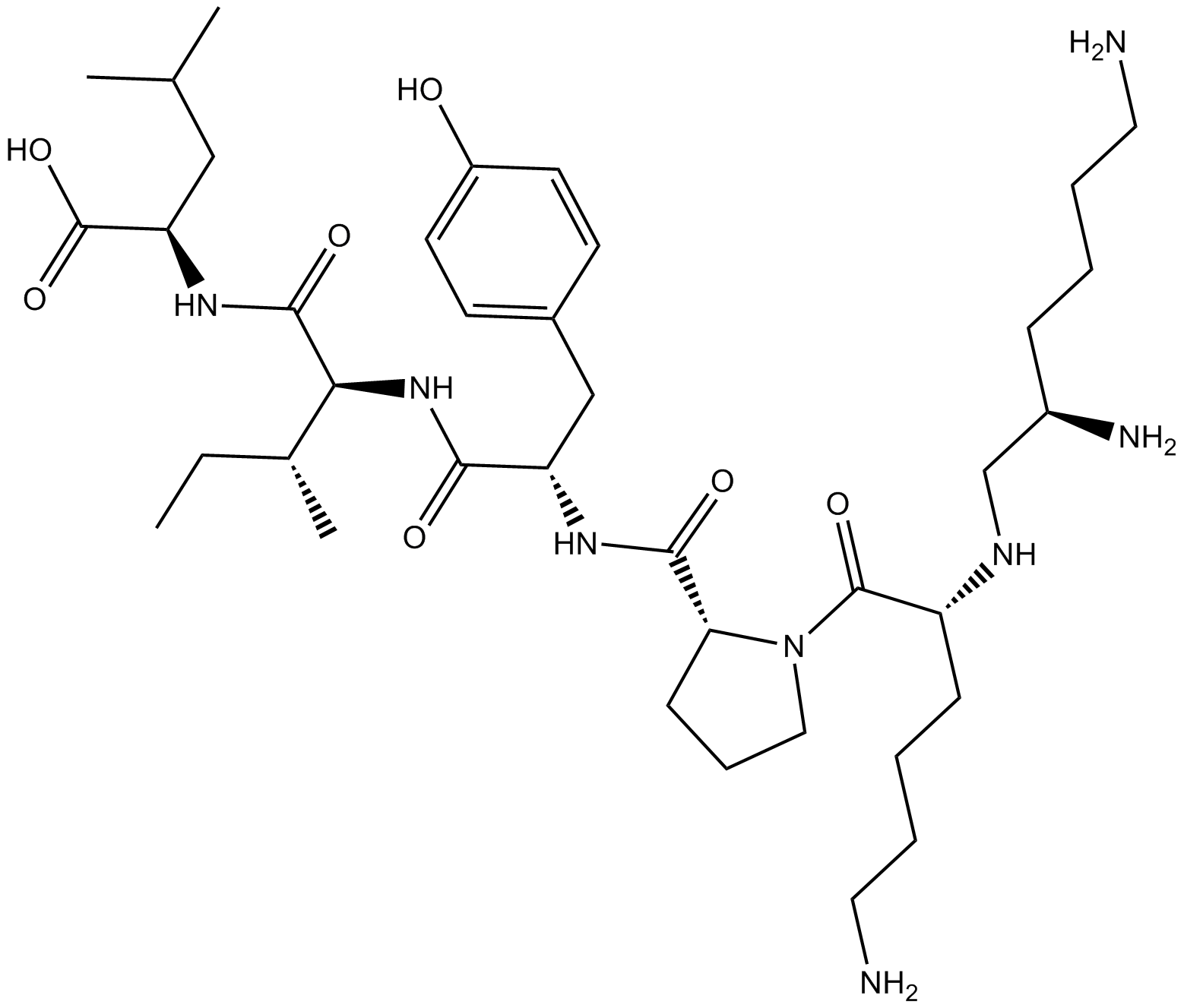
Cas No.: 139026-66-7
Sample solution is provided at 25 µL, 10mM.
_1-3.$$$39978408@51.jpg');)
_1-9.$$$38538795@65.jpg');)
_1-9.$$$39112701@51.jpg');)
_1-7.$$$37316672@70.jpg');)
_366-372.$$$36198801@70.jpg');)
.$$$38565142@65.jpg');)
_1867-1883.$$$33248023@67.jpg');)
_eads6055.$$$39977546@45.jpg');)
_eadm9805.$$$40080571@45.jpg');)
_eadj3020.$$$39666821@45.jpg');)
_1-20.$$$39757301@28.jpg');)
_1-24.$$$38898113@28.jpg');)
_273-287.$$$36806353@46.jpg');)
_1-16.$$$37156877@44.jpg');)
_1-19.$$$37460805@44.jpg');)
_1291-1307.$$$34518654@46.jpg');)
JMV 449 is a potent and long-acting neurotensin receptor (NTR) agonist peptide. JMV 449 inhibits [125I]-neurotensin binding to newborn mouse brain (IC50=0.15nM) and contracts guinea pig ileum (EC50=1.9nM). JMV 449 activates central and peripheral neurotensin receptors to induce sustained hypothermia, central analgesia and neuroprotection. JMV 449 modulates dopaminergic pathways, affects gastrointestinal motility and insulin secretion. JMV 449 can be used for related research on psychiatric disorders, pain, cerebral ischemia, metabolic disorders and tumors such as liver cancer and pancreatic cancer[1-4].
In vitro, treatment of CHO-NTR cells with 3nM JMV 449 for 12-20 hours induced significant morphological changes, increased the proportion of elongated cells, and delayed cell division[5]. Treatment of CHP 212 and N1E-115 cells with 1µM JMV 449 for 5-72 hours activated tyrosine hydroxylase gene expression and mobilized intracellular Ca2+[6]. Treatment of CHP212 cells with 1µM JMV 449 for 5-72 hours elevated tyrosine hydroxylase protein levels and enhanced tyrosine hydroxylase transcriptional activity[7].
In vivo, intraperitoneal injection of 25nmol/kg JMV 449 combined with 18mmol/kg glucose in male C57BL/6 mice fasted for 18 hours lowered blood glucose concentration and reduced cumulative food intake[8]. Intracerebroventricular injection of 60-240pmol JMV 449 in Swiss mice decreased colonic temperature, produced a dose-dependent hypothermic effect, prolonged tail-flick latency and produced an analgesic effect[9]. Intracerebroventricular injection of 0.6nmol JMV 449 in NMRI mice 10 minutes after permanent distal middle cerebral artery occlusion reduced core body temperature and decreased infarct volume[10].
References:
[1] Peltonen I, Myöhänen TT, Männistö PT. Different interactions of prolyl oligopeptidase and neurotensin in dopaminergic function of the rat nigrostriatal and mesolimbic pathways. Neurochem Res. 2012 Sep;37(9):2033-41.
[2] Camby I, Salmon I, Bourdel E, et al. Neurotensin-mediated effects on astrocytic tumor cell proliferation. Neuropeptides. 1996 Apr;30(2):133-9.
[3] Borroto-Escuela DO, Ravani A, Tarakanov AO, et al. Dopamine D2 receptor signaling dynamics of dopamine D2-neurotensin 1 receptor heteromers. Biochem Biophys Res Commun. 2013 May 24;435(1):140-6.
[4] Souazé F, Rostène W, Forgez P. Neurotensin agonist induces differential regulation of neurotensin receptor mRNA. Identification of distinct transcriptional and post-transcriptional mechanisms. J Biol Chem. 1997 Apr 11;272(15):10087-94.
[5] Xu-Van Opstal WY, Ranger C, Lejeune O, et al. Automated image analyzing system for the quantitative study of living cells in culture. Microsc Res Tech. 1994;28(5):440-447.
[6] Najimi M, Souazé F, Méndez M, et al. Activation of receptor gene transcription is required to maintain cell sensitization after agonist exposure: study on neurotensin receptor. J Biol Chem. 1998 Aug 21;273(34):21634-21641.
[7] Najimi M, Hermans E, Rostène W, et al. Transcriptional Regulation of the Tyrosine Hydroxylase Gene by Neurotensin in Human Neuroblastoma CHP212 Cells. Metab Brain Dis. 2001 Dec;16(3-4):165-174.
[8] Craig SL, Gault VA, Shiels CE, et al. Comparison of independent and combined effects of the neurotensin receptor agonist, JMV-449, and incretin mimetics on pancreatic islet function, glucose homeostasis and appetite control. BBA Gen Subj. 2021;1865:129917.
[9] Dubuc I, Costentin J, Doulut S, et al. JMV 449: a pseudopeptide analogue of neurotensin-(8-13) with highly potent and long-lasting hypothermic and analgesic effects in the mouse. Eur J Pharmacol. 1992 Jul 21;219(2):327-329.
[10] Torup L, Borsdal J, Sager T. Neuroprotective effect of the neurotensin analogue JMV-449 in a mouse model of permanent middle cerebral ischaemia. Neurosci Lett. 2003 Sep 11;351(3):173-176.
| Cell experiment [1]: | |
|
Cell lines |
CHO-NTR cells (Chinese hamster ovary cells expressing neurotensin receptor cDNA) |
|
Preparation Method |
CHO-NTR cells were seeded at 5×10³ cells per well in 24-well plates and grown for 48 hours, then treated with 3nM JMV 449 for 12 or 20 hours; living unstained cells were analyzed, cell division timing, and morphological classification (round, thin-long, oval) at multiple time points. |
|
Reaction Conditions |
3nM; 12h and 20h |
|
Applications |
JMV 449 retarded CHO-NTR cell division with delayed cell doubling time at 20 hours, and induced significant morphological changes with increased proportion of thin and long cells at 12 hours. |
| Animal experiment [2]: | |
|
Animal models |
Male C57BL/6 mice (10 months old) |
|
Preparation Method |
Overnight fasted (18h) mice received a single intraperitoneal injection of 25nmol/kg JMV 449 alone, or co-injected with 18mmol/kg glucose, or co-injected with 25nmol/kg (D-Ala2)GIP or 25nmol/kg exendin-4, or co-injected with 25nmol/kg (D-Ala2)GIP plus 2.5nmol/kg exendin-4; blood glucose and plasma insulin were measured at 0, 15, 30, 60 and 105min, and cumulative food intake was measured at 30min intervals for 180min. |
|
Dosage form |
25nmol/kg; i.p.; single injection |
|
Applications |
JMV 449 lowered blood glucose at 15 and 30min after glucose co-injection, increased 0-105min plasma insulin AUC, reduced cumulative food intake in overnight fasted mice, and enhanced the glucose-lowering effect of (D-Ala2)GIP and exendin-4 and the appetite-suppressing effect of 2.5nmol/kg exendin-4. |
References: [1] Xu-Van Opstal WY, Ranger C, Lejeune O, et al. Automated image analyzing system for the quantitative study of living cells in culture. Microsc Res Tech. 1994;28(5):440-447. [2] Craig SL, Gault VA, Shiels CE, et al. Comparison of independent and combined effects of the neurotensin receptor agonist, JMV-449, and incretin mimetics on pancreatic islet function, glucose homeostasis and appetite control. BBA Gen Subj. 2021;1865:129917. | |
| Cas No. | 139026-66-7 | SDF | |
| Chemical Name | (R)-2-((2S,3R)-2-((S)-2-((R)-1-((R)-6-amino-2-(((R)-2,6-diaminohexyl)amino)hexanoyl)pyrrolidine-2-carboxamido)-3-(4-hydroxyphenyl)propanamido)-3-methylpentanamido)-4-methylpentanoic acid | ||
| Canonical SMILES | O=C([C@@H](CCCCN)NC[C@@H](CCCCN)N)N1[C@@H](C(N[C@H](C(N[C@H](C(N[C@@H](C(O)=O)CC(C)C)=O)[C@H](C)CC)=O)CC(C=C2)=CC=C2O)=O)CCC1 | ||
| Formula | C38H66N8O7 | M.Wt | 746.96 |
| Solubility | Soluble to 0.80 mg/ml in Water | Storage | Desiccate at -20°C |
| Shipping Condition | Evaluation sample solution: shipped with blue ice. All other sizes available: with RT, or with Blue Ice upon request. | ||
| Prepare stock solution | |||

|
1 mg | 5 mg | 10 mg |
| 1 mM | 1.3388 mL | 6.6938 mL | 13.3876 mL |
| 5 mM | 267.8 μL | 1.3388 mL | 2.6775 mL |
| 10 mM | 133.9 μL | 669.4 μL | 1.3388 mL |
Step 1: Enter information below (Recommended: An additional animal making an allowance for loss during the experiment)
 g
μL
g
μL
Step 2: Enter the in vivo formulation (This is only the calculator, not formulation. Please contact us first if there is no in vivo formulation at the solubility Section.)
Calculation results:
Working concentration: mg/ml;
Method for preparing DMSO master liquid: mg drug pre-dissolved in μL DMSO ( Master liquid concentration mg/mL, Please contact us first if the concentration exceeds the DMSO solubility of the batch of drug. )
Method for preparing in vivo formulation: Take μL DMSO master liquid, next addμL PEG300, mix and clarify, next addμL Tween 80, mix and clarify, next add μL saline, mix and clarify.
Method for preparing in vivo formulation: Take μL DMSO master liquid, next add μL Corn oil, mix and clarify.
Note: 1. Please make sure the liquid is clear before adding the next solvent.
2. Be sure to add the solvent(s) in order. You must ensure that the solution obtained, in the previous addition, is a clear solution before proceeding to add the next solvent. Physical methods such as vortex, ultrasound or hot water bath can be used to aid dissolving.
3. All of the above co-solvents are available for purchase on the GlpBio website.
Quality Control & SDS
- View current batch:
- Purity: >98.00% Appearance: A solid
- COA (Certificate of Analysis)
- SDS (Safety Data Sheet)
- Datasheet
Average Rating: 5 (Based on Reviews and 4 reference(s) in Google Scholar.)