

L-(+)-Abrine (L-Abrine) |
Catalog No.GC30573
 One-Click Copy Product Info
|

L-(+)-Abrine (L-Abrine), a lethal albumin found in Abrus precatorius seeds, is an acute toxic alkaloid and chemical marker for abrin.
Products are for research use only. Not for human use. We do not sell to patients.
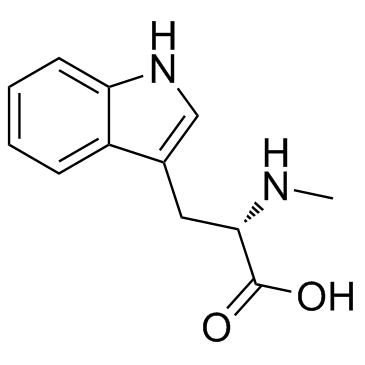
Cas No.: 526-31-8
Sample solution is provided at 25 µL, 10mM.
_1-3.$$$39978408@51.jpg');)
_1-9.$$$38538795@65.jpg');)
_1-9.$$$39112701@51.jpg');)
_1-7.$$$37316672@70.jpg');)
_366-372.$$$36198801@70.jpg');)
.$$$38565142@65.jpg');)
_1867-1883.$$$33248023@67.jpg');)
_eads6055.$$$39977546@45.jpg');)
_eadm9805.$$$40080571@45.jpg');)
_eadj3020.$$$39666821@45.jpg');)
_1-20.$$$39757301@28.jpg');)
_1-24.$$$38898113@28.jpg');)
_273-287.$$$36806353@46.jpg');)
_1-16.$$$37156877@44.jpg');)
_1-19.$$$37460805@44.jpg');)
_1291-1307.$$$34518654@46.jpg');)
L-(+)-Abrine, a lethal albumin found in Abrus precatorius seeds, is an acute toxic alkaloid and chemical marker for abrin.
L-(+)-Abrine is a marker for abrin poisoning. A strong indication for abrin poisoning is the presence of the chemical maker L-(+)-Abrine, which can survive metabolism in significant amounts making it detectable in human urine[1].
Abrin is a toxic protein found in the jequirity seed. L-(+)-Abrine (L-Abrine) is also found in the jequirity seed and can be used as a biomarker for abrin exposure. An animal study is designed to monitor the excretion and recovery of L-(+)-Abrine in 20 rats. The animals are exposed to one of three concentrations of L-(+)-Abrine, a single high concentration of L-tryptophan, or no agent (control). The low L-(+)-Abrine dose corresponds to 0.63 LD50 i.p. abrin in mice, assuming a concentration ratio of 1:4 of abrin to L-(+)-Abrine and an LD50 for abrin of 20 μg/kg. The mid and high L-(+)-Abrine (250 and 400 μg/kg) doses are included to ensure that the target analyte can be detected and tracked over the course of the experiment[2].
[1]. Cho H, et al. A portable and chromogenic enzyme-based sensor for detection of abrin poisoning. Biosens Bioelectron. 2014 Apr 15;54:667-73. [2]. Johnson RC, et al. Quantification of L-abrine in human and rat urine: a biomarker for the toxin abrin. J Anal Toxicol. 2009 Mar;33(2):77-84.
|
Animal experiment: |
Rats[2]Twenty male Wistar rats, approximately 6-7 weeks of age and weighing approximately 175-200 g upon receipt, are used. A total of 12 rats are dosed intramuscularly with L-(+)-Abrine at 0.63, 3.13, and 5 times the expected Abrin LD50 of 20 μg/kg. Although no toxin is used here, the concentration of the biomarker is increased by a factor of 4 to estimate an equivalent level of toxin, assuming that Labrine is present in rosary peas at a concentration four times greater that the toxin abrin. A total of 12 rats are dosed intramuscularly with L-(+)-Abrine: four at approximately 50 μg/kg body weight (bw), four at 250 μg/kg bw, and four at 400 μg/kg bw. Four control rats are dosed with water, which is the vehicle for all dosing experiments. Another four rats are dosed intraperitoneally with 20,000 μg/kg L-tryptophan to verify that endogenous L-tryptophan is not metabolized to L-(+)-Abrine[2]. |
|
References: [1]. Cho H, et al. A portable and chromogenic enzyme-based sensor for detection of abrin poisoning. Biosens Bioelectron. 2014 Apr 15;54:667-73. |
|
| Cas No. | 526-31-8 | SDF | |
| Canonical SMILES | O=C(O)[C@H](CC1=CNC2=CC=CC=C12)NC | ||
| Formula | C12H14N2O2 | M.Wt | 218.25 |
| Solubility | Water: 2 mg/mL (9.16 mM; ultrasonic and adjust pH to 10 with NaOH) | Storage | Store at -20°C |
| General tips | Please select the appropriate solvent to prepare the stock solution according to the
solubility of the product in different solvents; once the solution is prepared, please store it in
separate packages to avoid product failure caused by repeated freezing and thawing.Storage method
and period of the stock solution: When stored at -80°C, please use it within 6 months; when stored
at -20°C, please use it within 1 month. To increase solubility, heat the tube to 37°C and then oscillate in an ultrasonic bath for some time. |
||
| Shipping Condition | Evaluation sample solution: shipped with blue ice. All other sizes available: with RT, or with Blue Ice upon request. | ||
| Prepare stock solution | |||

|
1 mg | 5 mg | 10 mg |
| 1 mM | 4.5819 mL | 22.9095 mL | 45.819 mL |
| 5 mM | 916.4 μL | 4.5819 mL | 9.1638 mL |
| 10 mM | 458.2 μL | 2.291 mL | 4.5819 mL |
Step 1: Enter information below (Recommended: An additional animal making an allowance for loss during the experiment)
 g
μL
g
μL
Step 2: Enter the in vivo formulation (This is only the calculator, not formulation. Please contact us first if there is no in vivo formulation at the solubility Section.)
Calculation results:
Working concentration: mg/ml;
Method for preparing DMSO master liquid: mg drug pre-dissolved in μL DMSO ( Master liquid concentration mg/mL, Please contact us first if the concentration exceeds the DMSO solubility of the batch of drug. )
Method for preparing in vivo formulation: Take μL DMSO master liquid, next addμL PEG300, mix and clarify, next addμL Tween 80, mix and clarify, next add μL saline, mix and clarify.
Method for preparing in vivo formulation: Take μL DMSO master liquid, next add μL Corn oil, mix and clarify.
Note: 1. Please make sure the liquid is clear before adding the next solvent.
2. Be sure to add the solvent(s) in order. You must ensure that the solution obtained, in the previous addition, is a clear solution before proceeding to add the next solvent. Physical methods such as vortex, ultrasound or hot water bath can be used to aid dissolving.
3. All of the above co-solvents are available for purchase on the GlpBio website.
Quality Control & SDS
- View current batch:
- Purity: >98.00% Appearance: A solid
- COA (Certificate of Analysis)
- SDS (Safety Data Sheet)
- Datasheet
Average Rating: 5 (Based on Reviews and 35 reference(s) in Google Scholar.)