

Lauric Acid (Synonyms: C12:0, NSC 5026) |
Catalog No.GC15993
 One-Click Copy Product Info
|

saturated medium-chain fatty acid
Products are for research use only. Not for human use. We do not sell to patients.
Cas No.: 143-07-7
Sample solution is provided at 25 µL, 10mM.
_1-3.$$$39978408@51.jpg');)
_1-9.$$$38538795@65.jpg');)
_1-9.$$$39112701@51.jpg');)
_1-7.$$$37316672@70.jpg');)
_366-372.$$$36198801@70.jpg');)
.$$$38565142@65.jpg');)
_1867-1883.$$$33248023@67.jpg');)
_eads6055.$$$39977546@45.jpg');)
_eadm9805.$$$40080571@45.jpg');)
_eadj3020.$$$39666821@45.jpg');)
_1-20.$$$39757301@28.jpg');)
_1-24.$$$38898113@28.jpg');)
_273-287.$$$36806353@46.jpg');)
_1-16.$$$37156877@44.jpg');)
_1-19.$$$37460805@44.jpg');)
_1291-1307.$$$34518654@46.jpg');)
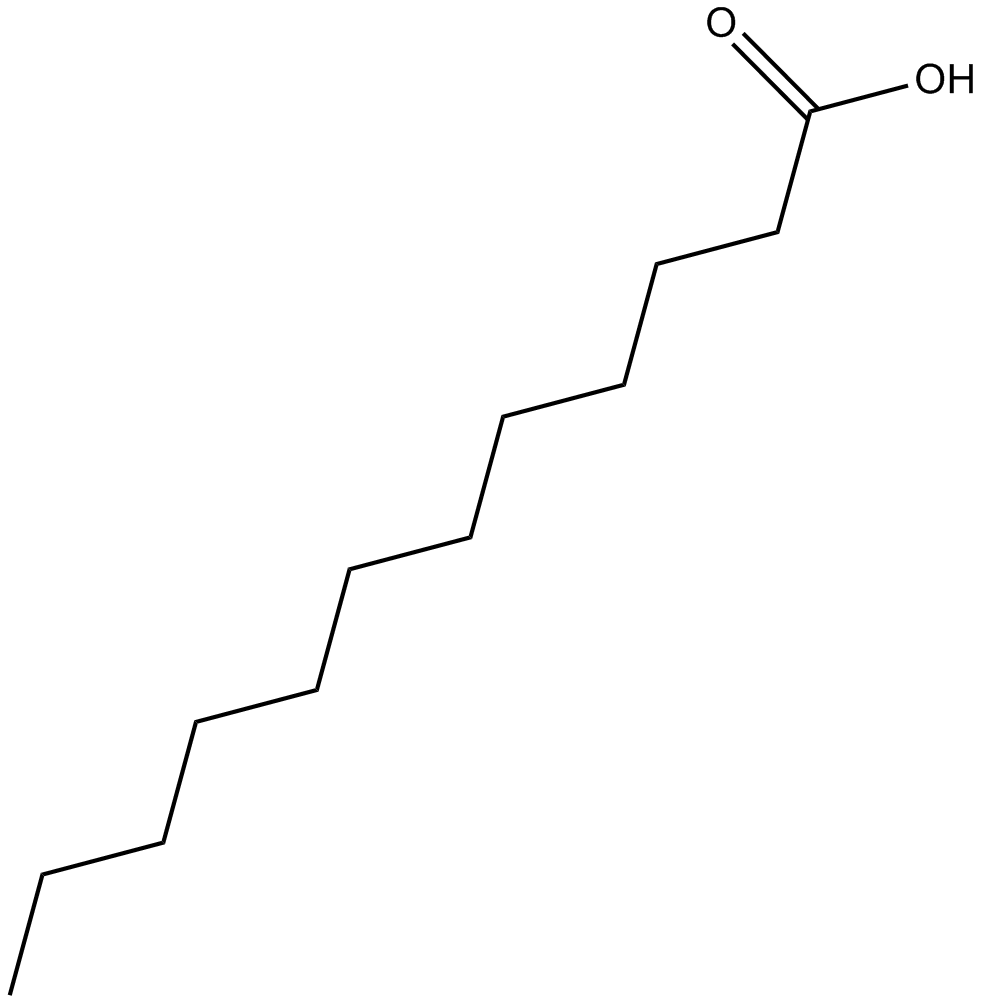
Lauric acid, a saturated medium-chain fatty acid with a 12-carbon backbone, is naturally found in various plant and animal fats and oils, which is a major component of palm kernel oil and coconut oil.
In vitro: Previous study showed that lauric acid could induce apoptosis in both Caco-2 and IEC-6 cells when compared to butyrate. Moreover, lauric acid reduced GSH availability and generated ROS in Caco-2 cells. Mechanistic study indicated that lauric acid reduced Caco-2 and IEC-6 cells in G0/G1and arrested cells in the S and G2/M phases. In addition, it was found that butyrate protected IEC-6 cells from ROS-induced damage, while lauric acid induced higher levels of ROS when compared with butyrate [1].
In vivo: Mouse in vivo study found that both epicutaneous application and intradermal injection of lauric acid could decrease the number of P. acnes colonized in mouse ears effectively, thus relieving P. acnes-induced granulomatous inflammation and ear swelling [2].
Clinical trial: Previous clinical study showed that lauric acid ingestion did not induce nausea or bloating. There was no effect of lauric acid on energy intake at breakfast, energy intake at lunch was reduced significantly after ingestion of lauric acid. In addition, it was observed that the total energy intake (breakfast+lunch+lauric acid dose) was less following ingestion of 6 g of lauric acid compared with control [3].
References:
[1] Fauser JK,Matthews GM,Cummins AG,Howarth GS. Induction of apoptosis by the medium-chain length fatty acid lauric acid in colon cancer cells due to induction of oxidative stress. Chemotherapy.2013;59(3):214-24.
[2] Nakatsuji T,Kao MC,Fang JY,Zouboulis CC,Zhang L,Gallo RL,Huang CM. Antimicrobial property of lauric acid against Propionibacterium acnes: its therapeutic potential for inflammatory acne vulgaris. J Invest Dermatol.2009 Oct;129(10):2480-8.
[3] Kate L. Feltrin et al. Acute oral administration of lauric acid reduces energy intake in healthy males. e-SPEN Journal. 2014 April; 9 (2): e69–e75
| Cas No. | 143-07-7 | SDF | |
| Synonyms | C12:0, NSC 5026 | ||
| Chemical Name | dodecanoic acid | ||
| Canonical SMILES | CCCCCCCCCCCC(O)=O | ||
| Formula | C12H24O2 | M.Wt | 200.32 |
| Solubility | ≥ 40.2 mg/mL in DMSO, ≥ 40.4 mg/mL in EtOH | Storage | 4°C, protect from light |
| General tips | Please select the appropriate solvent to prepare the stock solution according to the
solubility of the product in different solvents; once the solution is prepared, please store it in
separate packages to avoid product failure caused by repeated freezing and thawing.Storage method
and period of the stock solution: When stored at -80°C, please use it within 6 months; when stored
at -20°C, please use it within 1 month. To increase solubility, heat the tube to 37°C and then oscillate in an ultrasonic bath for some time. |
||
| Shipping Condition | Evaluation sample solution: shipped with blue ice. All other sizes available: with RT, or with Blue Ice upon request. | ||
| Prepare stock solution | |||

|
1 mg | 5 mg | 10 mg |
| 1 mM | 4.992 mL | 24.9601 mL | 49.9201 mL |
| 5 mM | 998.4 μL | 4.992 mL | 9.984 mL |
| 10 mM | 499.2 μL | 2.496 mL | 4.992 mL |
Step 1: Enter information below (Recommended: An additional animal making an allowance for loss during the experiment)
 g
μL
g
μL
Step 2: Enter the in vivo formulation (This is only the calculator, not formulation. Please contact us first if there is no in vivo formulation at the solubility Section.)
Calculation results:
Working concentration: mg/ml;
Method for preparing DMSO master liquid: mg drug pre-dissolved in μL DMSO ( Master liquid concentration mg/mL, Please contact us first if the concentration exceeds the DMSO solubility of the batch of drug. )
Method for preparing in vivo formulation: Take μL DMSO master liquid, next addμL PEG300, mix and clarify, next addμL Tween 80, mix and clarify, next add μL saline, mix and clarify.
Method for preparing in vivo formulation: Take μL DMSO master liquid, next add μL Corn oil, mix and clarify.
Note: 1. Please make sure the liquid is clear before adding the next solvent.
2. Be sure to add the solvent(s) in order. You must ensure that the solution obtained, in the previous addition, is a clear solution before proceeding to add the next solvent. Physical methods such as vortex, ultrasound or hot water bath can be used to aid dissolving.
3. All of the above co-solvents are available for purchase on the GlpBio website.
Quality Control & SDS
- View current batch:
- Purity: >98.00% Appearance: A solid
- COA (Certificate of Analysis)
- SDS (Safety Data Sheet)
- Datasheet
Average Rating: 5 (Based on Reviews and 28 reference(s) in Google Scholar.)