

Lifitegrast (Synonyms: SAR 1118) |
Catalog No.GC19222
 One-Click Copy Product Info
|

Lifitegrast is an effective integrin antagonist that blocks the binding of LFA-1 to ICAM-1 (IC50=2.98nM) and inhibits Jurkat T cell activation.
Products are for research use only. Not for human use. We do not sell to patients.
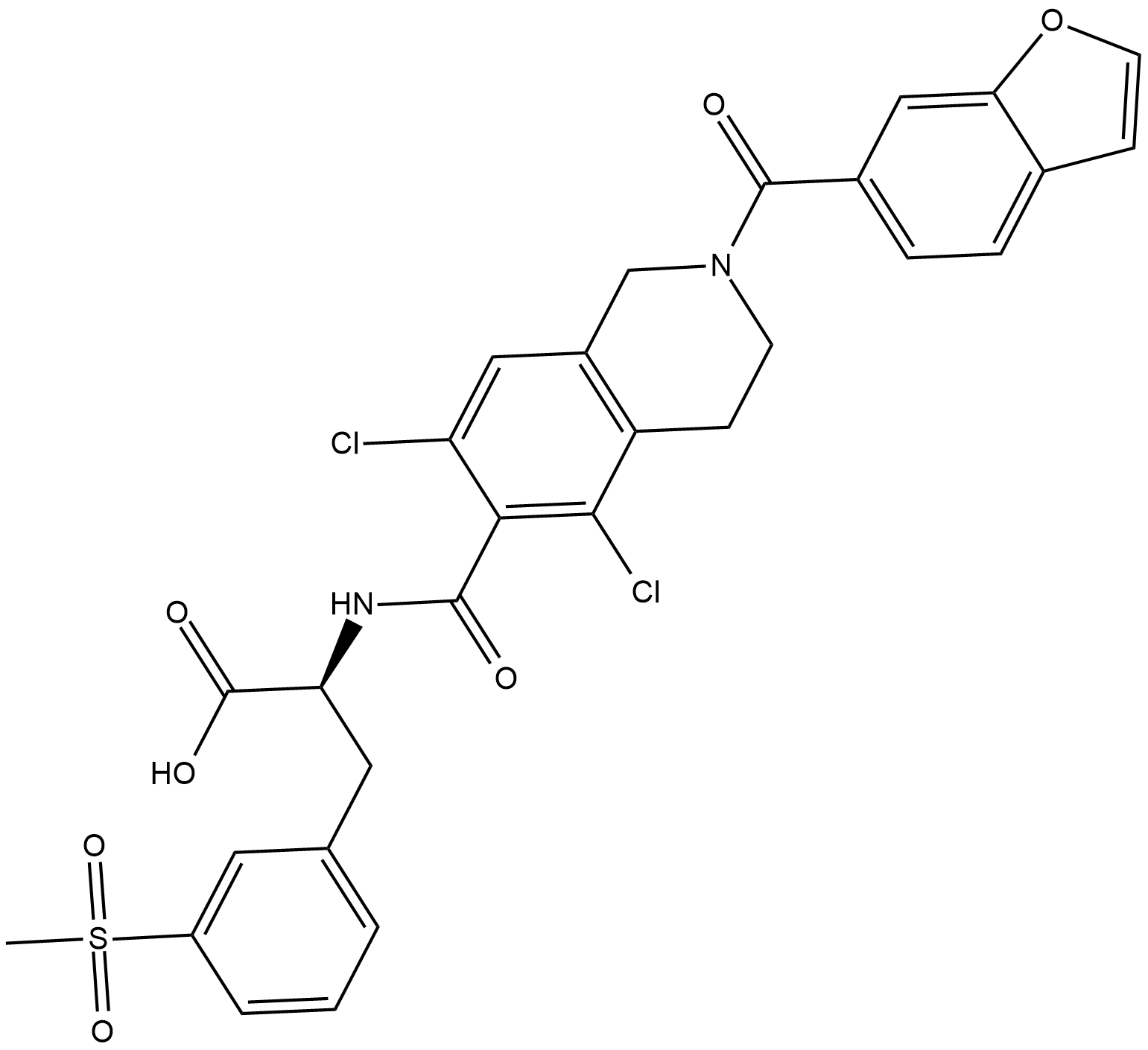
Cas No.: 1025967-78-5
Sample solution is provided at 25 µL, 10mM.
_1-3.$$$39978408@51.jpg');)
_1-9.$$$38538795@65.jpg');)
_1-9.$$$39112701@51.jpg');)
_1-7.$$$37316672@70.jpg');)
_366-372.$$$36198801@70.jpg');)
.$$$38565142@65.jpg');)
_1867-1883.$$$33248023@67.jpg');)
_eads6055.$$$39977546@45.jpg');)
_eadm9805.$$$40080571@45.jpg');)
_eadj3020.$$$39666821@45.jpg');)
_1-20.$$$39757301@28.jpg');)
_1-24.$$$38898113@28.jpg');)
_273-287.$$$36806353@46.jpg');)
_1-16.$$$37156877@44.jpg');)
_1-19.$$$37460805@44.jpg');)
_1291-1307.$$$34518654@46.jpg');)
Lifitegrast is an effective integrin antagonist that blocks the binding of LFA-1 to ICAM-1 (IC50=2.98nM) and inhibits Jurkat T cell activation. Lifitegrast can be used in research related to dry eye disease, psoriasis, and ocular graft-versus-host disease (oGVHD)[1-4].
In vitro, Vero-E6 cells were treated with Lifitegrast (10-1000μM) for 24 hours. Lifitegrast inhibited SARS-CoV-2 virus infection[5]. After pretreatment with 1-methyl-4-phenylpyridinium (1mM) for 24 hours, SH-SY5Y cells were incubated with Lifitegrast (1μM for 24 hours; 250μM for 4 hours). Lifitegrast interacted with the LNK SH2 domain in cells and attenuated LNK-associated signaling[6].
In vivo, MRL/lpr mice were intraperitoneally injected with Lifitegrast (15mg/kg; once weekly) for 5 consecutive weeks. Lifitegrast inhibited Itgam protein expression, reduced urinary protein and serum levels of anti-dsDNA antibodies, IL-12p70, and TNF-α, decreased spleen index, double-negative T cells, T follicular helper cells, and plasma cells, alleviated kidney injury and immune complex deposition, and mitigated renal inflammatory cell infiltration and pathological scores[7]. Down syndrome C57BL/6J mice received topical ocular administration of Lifitegrast (5%; 2μl; twice daily) for 5 days. Lifitegrast significantly reduced the expression of interferon-γ and CXCL9 in the cornea, decreased corneal barrier disruption, and increased the number and area of conjunctival goblet cells[8].
References:
[1] Perez VL, Pflugfelder SC, Zhang S, et al. Lifitegrast, a Novel Integrin Antagonist for Treatment of Dry Eye Disease. Ocul Surf. 2016 Apr;14(2):207-15.
[2] Sun Y, Zhang R, Gadek TR, et al. Corneal inflammation is inhibited by the LFA-1 antagonist, lifitegrast (SAR 1118). J Ocul Pharmacol Ther. 2013 May;29(4):395-402.
[3] Rao VR, Prescott E, Shelke NB, et al. Delivery of SAR 1118 to the retina via ophthalmic drops and its effectiveness in a rat streptozotocin (STZ) model of diabetic retinopathy (DR). Invest Ophthalmol Vis Sci. 2010 Oct;51(10):5198-204.
[4] Shen W, Zhang X, Du R, et al. ICAM3 mediates tumor metastasis via a LFA-1-ICAM3-ERM dependent manner. Biochim Biophys Acta Mol Basis Dis. 2018 Aug;1864(8):2566-2578.
[5] Day CJ, Bailly B, Guillon P, et al. Multidisciplinary Approaches Identify Compounds that Bind to Human ACE2 or SARS-CoV-2 Spike Protein as Candidates to Block SARS-CoV-2-ACE2 Receptor Interactions. mBio. 2021 Mar 30;12(2):e03681-20.
[6] Liu Z, Wang R, Shen M, et al. A LNK-CBL-HNRPA2B1-GPX4 signaling axis mediates dopaminergic neuron vulnerability to ferroptosis in Parkinson's disease. Redox Biol. 2026 Mar;90:104039.
[7] Qiu Y, Zhang Q, Yang X, et al. Exposure to Dietary Nitrite Exacerbates Lupus in MRL/lpr Mice by Enhancing Integrin Alpha M. Inflammation. 2025 Dec;48(6):4564-4578.
[8] Guimaraes de Souza R, Yu Z, Stern ME, et al. Suppression of Th1-Mediated Keratoconjunctivitis Sicca by Lifitegrast. J Ocul Pharmacol Ther. 2018 Sep;34(7):543-549.
| Cell experiment [1]: | |
Cell lines | SH-SY5Y cells (human neuroblastoma cell line) |
Preparation Method | SH-SY5Y cells were maintained in high-glucose Dulbecco's Modified Eagle Medium supplemented with 10% fetal bovine serum and 1% penicillin-streptomycin. SH-SY5Y cells were first subjected to neurotoxic stress by treatment with 1mM 1-methyl-4-phenylpyridinium for 24 hours, followed by incubation with 1μM Lifitegrast for an additional 24 hours. Alternatively, SH-SY5Y cells were incubated with 250μM Lifitegrast for 4 hours. |
Reaction Conditions | 1μM or 250μM; 24h or 4h |
Applications | Lifitegrast interacts with the LNK SH2 domain and attenuates LNK-associated signaling in cellular assays. |
| Animal experiment [2]: | |
Animal models | MRL/lpr mice |
Preparation Method | MRL/lpr mice were divided into three groups. The Lifitegrast group received free access to a 0.3g/L sodium nitrite solution, and from 16 to 20 weeks of age, mice were administered an intraperitoneal injection of Lifitegrast at a dose of 15mg/kg once weekly. The experiment lasted 12 weeks. |
Dosage form | 15mg/kg; i.p.; once weekly for 5 weeks |
Applications | Lifitegrast inhibited Itgam protein expression, reduced urinary protein and serum levels of anti-dsDNA antibodies, IL-12p70, and TNF-α, decreased spleen index, reduced double negative T cells, T follicular helper cells, and plasma cells in the spleen, alleviated kidney injury and immune complex deposition, and mitigated renal inflammatory cell infiltration and pathological scores. |
References: | |
| Cas No. | 1025967-78-5 | SDF | |
| Synonyms | SAR 1118 | ||
| Canonical SMILES | O=C(O)[C@H](CC1=CC=CC(S(=O)(C)=O)=C1)NC(C2=C(Cl)C3=C(CN(C(C4=CC=C5C=COC5=C4)=O)CC3)C=C2Cl)=O | ||
| Formula | C29H24Cl2N2O7S | M.Wt | 615.48 |
| Solubility | DMSO : ≥ 29 mg/mL (47.12 mM) | Storage | Store at -20°C |
| General tips | Please select the appropriate solvent to prepare the stock solution according to the
solubility of the product in different solvents; once the solution is prepared, please store it in
separate packages to avoid product failure caused by repeated freezing and thawing.Storage method
and period of the stock solution: When stored at -80°C, please use it within 6 months; when stored
at -20°C, please use it within 1 month. To increase solubility, heat the tube to 37°C and then oscillate in an ultrasonic bath for some time. |
||
| Shipping Condition | Evaluation sample solution: shipped with blue ice. All other sizes available: with RT, or with Blue Ice upon request. | ||
| Prepare stock solution | |||

|
1 mg | 5 mg | 10 mg |
| 1 mM | 1.6247 mL | 8.1237 mL | 16.2475 mL |
| 5 mM | 324.9 μL | 1.6247 mL | 3.2495 mL |
| 10 mM | 162.5 μL | 812.4 μL | 1.6247 mL |
Step 1: Enter information below (Recommended: An additional animal making an allowance for loss during the experiment)
 g
μL
g
μL
Step 2: Enter the in vivo formulation (This is only the calculator, not formulation. Please contact us first if there is no in vivo formulation at the solubility Section.)
Calculation results:
Working concentration: mg/ml;
Method for preparing DMSO master liquid: mg drug pre-dissolved in μL DMSO ( Master liquid concentration mg/mL, Please contact us first if the concentration exceeds the DMSO solubility of the batch of drug. )
Method for preparing in vivo formulation: Take μL DMSO master liquid, next addμL PEG300, mix and clarify, next addμL Tween 80, mix and clarify, next add μL saline, mix and clarify.
Method for preparing in vivo formulation: Take μL DMSO master liquid, next add μL Corn oil, mix and clarify.
Note: 1. Please make sure the liquid is clear before adding the next solvent.
2. Be sure to add the solvent(s) in order. You must ensure that the solution obtained, in the previous addition, is a clear solution before proceeding to add the next solvent. Physical methods such as vortex, ultrasound or hot water bath can be used to aid dissolving.
3. All of the above co-solvents are available for purchase on the GlpBio website.
Quality Control & SDS
- View current batch:
- Purity: >98.00% Appearance: A solid
- COA (Certificate of Analysis)
- SDS (Safety Data Sheet)
- Datasheet
Average Rating: 5 (Based on Reviews and 14 reference(s) in Google Scholar.)