

Lipoxin A4 (Synonyms: LXA4, 5(S),6(R),15(S)-TriHETE) |
Catalog No.GC18552
 One-Click Copy Product Info
|

A trihydroxy fatty acid containing a conjugated tetraene
Products are for research use only. Not for human use. We do not sell to patients.
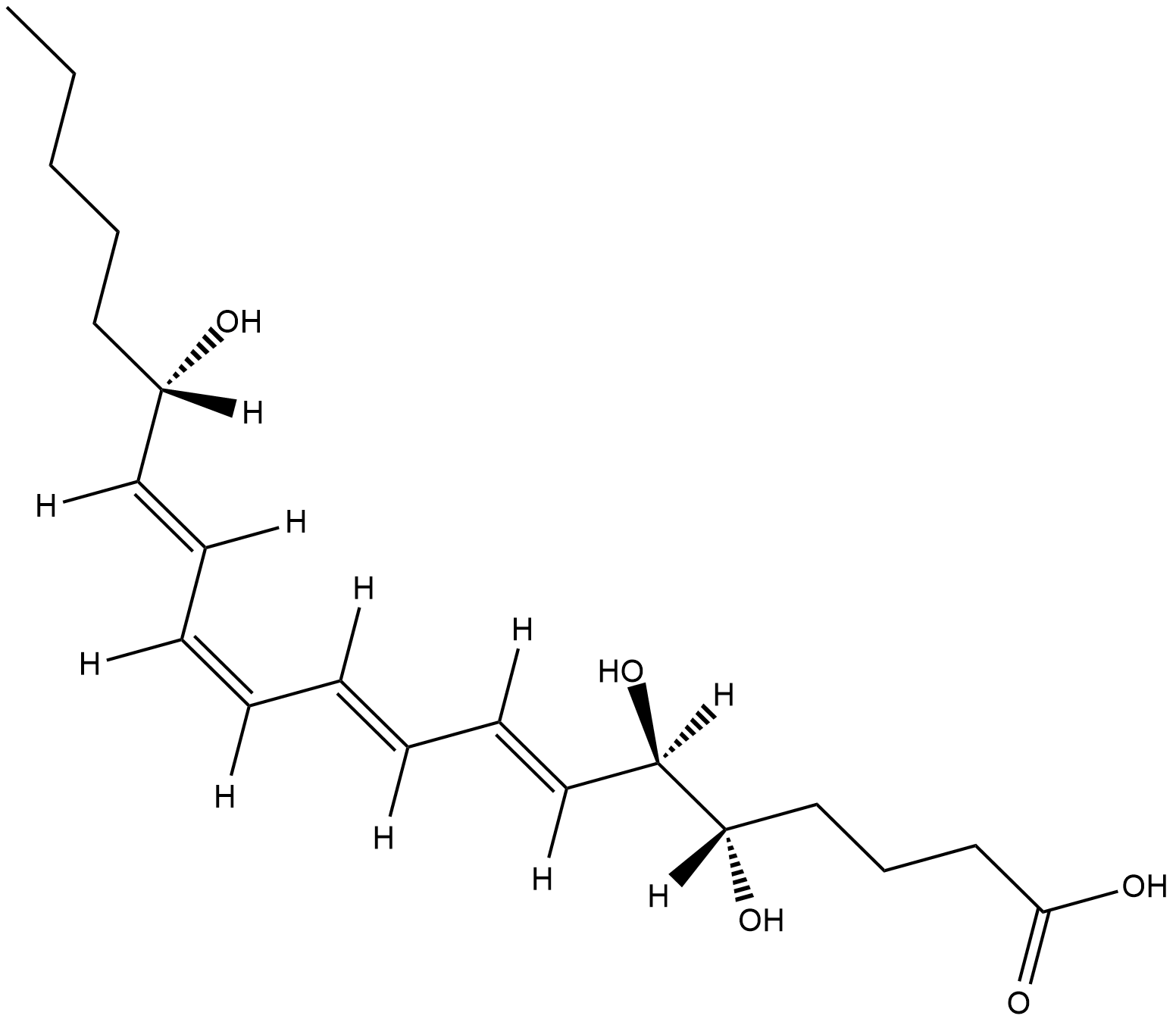
Cas No.: 89663-86-5
Sample solution is provided at 25 µL, 10mM.
Lipoxin A4 (LXA4) is a trihydroxy fatty acid containing a conjugated tetraene, produced by the metabolism of (±)15-HETE or 15-HpETE with human leukocytes.[1] LXA4 is equipotent to leukotriene B4 in inducing superoxide generation in human neutrophils at 0.1 µM.2 LXA4 is associated with several other biological functions including leukocyte activation, chemotaxis effects, natural killer cell inhibition, and monocyte migration and adhesion.[2],[3],[4] Analytical and biological comparisons of synthetic LXA4 with endogenously derived LXA4 have confirmed its identity as matching the natural product.[5]
Reference:
[1]. Serhan, C.N., Nicolaou, K.C., Webber, S.E., et al. Lipoxin A. Stereochemistry and biosynthesis. J. Biol. Chem. 261(35), 16340-16345 (1986).
[2]. Serhan, C.N., Hamberg, M., and Samuelsson, B. Lipoxins: Novel series of biologically active compounds formed from arachidonic acid in human leukocytes. Proc. Natl. Acad. Sci. U.S.A. 81(17), 5335-5339 (1984).
[3]. Ramstedt, U., Serhan, C.N., Nicolaou, K.C., et al. Lipoxin A-induced inhibition of human natural killer cell cytotoxicity: Studies on stereospecificity of inhibition and mode of action. J. Immunol. 138(1), 266-270 (1987).
[4]. Maddox, J.F., and Serhan, C.N. Lipoxin A4 and B4 are potent stimuli for human monocyte migration and adhesion: Selective inactivation by dehydrogenation and reduction. J. Exp. Med. 183(1), 137-146 (1996).
[5]. Serhan, C. . (2007).
| Cas No. | 89663-86-5 | SDF | |
| Synonyms | LXA4, 5(S),6(R),15(S)-TriHETE | ||
| Chemical Name | 5S,6R,15S-trihydroxy-7E,9E,11Z,13E-eicosatetraenoic acid | ||
| Canonical SMILES | CCCCC[C@H](O)/C=C/C=C\C=C\C=C\[C@@H](O)[C@@H](O)CCCC(O)=O | ||
| Formula | C20H32O5 | M.Wt | 352.5 |
| Solubility | DMF: 50 mg/mL; Ethanol: 50 mg/mL; PBS pH 7.2: 1 mg/mL | Storage | Store at -80°C, protect from light |
| General tips | Please select the appropriate solvent to prepare the stock solution according to the
solubility of the product in different solvents; once the solution is prepared, please store it in
separate packages to avoid product failure caused by repeated freezing and thawing.Storage method
and period of the stock solution: When stored at -80°C, please use it within 6 months; when stored
at -20°C, please use it within 1 month. To increase solubility, heat the tube to 37°C and then oscillate in an ultrasonic bath for some time. |
||
| Shipping Condition | Evaluation sample solution: shipped with blue ice. All other sizes available: with RT, or with Blue Ice upon request. | ||
| Prepare stock solution | |||

|
1 mg | 5 mg | 10 mg |
| 1 mM | 2.8369 mL | 14.1844 mL | 28.3688 mL |
| 5 mM | 567.4 μL | 2.8369 mL | 5.6738 mL |
| 10 mM | 283.7 μL | 1.4184 mL | 2.8369 mL |
Step 1: Enter information below (Recommended: An additional animal making an allowance for loss during the experiment)
 g
μL
g
μL
Step 2: Enter the in vivo formulation (This is only the calculator, not formulation. Please contact us first if there is no in vivo formulation at the solubility Section.)
Calculation results:
Working concentration: mg/ml;
Method for preparing DMSO master liquid: mg drug pre-dissolved in μL DMSO ( Master liquid concentration mg/mL, Please contact us first if the concentration exceeds the DMSO solubility of the batch of drug. )
Method for preparing in vivo formulation: Take μL DMSO master liquid, next addμL PEG300, mix and clarify, next addμL Tween 80, mix and clarify, next add μL saline, mix and clarify.
Method for preparing in vivo formulation: Take μL DMSO master liquid, next add μL Corn oil, mix and clarify.
Note: 1. Please make sure the liquid is clear before adding the next solvent.
2. Be sure to add the solvent(s) in order. You must ensure that the solution obtained, in the previous addition, is a clear solution before proceeding to add the next solvent. Physical methods such as vortex, ultrasound or hot water bath can be used to aid dissolving.
3. All of the above co-solvents are available for purchase on the GlpBio website.
Quality Control & SDS
- View current batch:
- Purity: >95.00% Appearance: A solution in ethanol
- COA (Certificate of Analysis)
- SDS (Safety Data Sheet)
- Datasheet
-
Related Biological Data

LXA4 Attenuated Septic AKI via Inhibition of PPAR-g/NF-kB Pathway.As shown in Figure 6B, LXA4 pretreatment significantly inhibited the activation of NFkB p65 (p-p65), p53, and p21, and the changes were reversed by GW9662.
To further explore the renoprotective effect of LXA4 on AKI induced by sepsis, rats were pretreated with LXA4(GlpBio) (100 μg/kg, i.v.) prior to CLP surgery.
Front Immunol 12 (2021) PMID: 33936050 IF: 7.562 -
Related Biological Data

LXA4 was relatively insufficient for the inflammatory response in patients with acute gout.The levels of IL-1b, TNF-a, and LXA4 in the serum of patients with acute gout (n=39), patients with intercritical gout (n=27), and healthy controls (n=30) detected by ELISA.
Moreover, THP-1 macrophages primed with LPS were pretreated with 150 nM LXA4(GlpBio) and tBHQ or auranofin for 1 h, followed by 100 ug/ml MSU stimulation for 24 h.
Front Immunol 13 (2022): 1060441 PMID: 36569930 IF: 7.3 -
Related Biological Data

LXA4 treatment alleviated the increase in body weight and fat mass of mice caused by HFD.LXA4 treatment notably reduced the body weight of mice with HFD (p<0.001, figure 1A), but exerted few effects on food intake (figure 1B) of mice with HFD and the body weight and food intake of normally reared mice (figure 1A-B).
Control + LXA4 group, mice were injected intraperitoneally with 5 ng/g/day LXA4(GlpBio) solution for 3 consecutive days, and then mice subsequently were fed with normal diet for 9 weeks.
bioRxiv (2024): 2024-02
Average Rating: 5 (Based on Reviews and 20 reference(s) in Google Scholar.)