

Luzopeptin A (Synonyms: BBM-928A) |
Catalog No.GC11740
 One-Click Copy Product Info
|

cyclic depsipeptide antibiotic
Products are for research use only. Not for human use. We do not sell to patients.
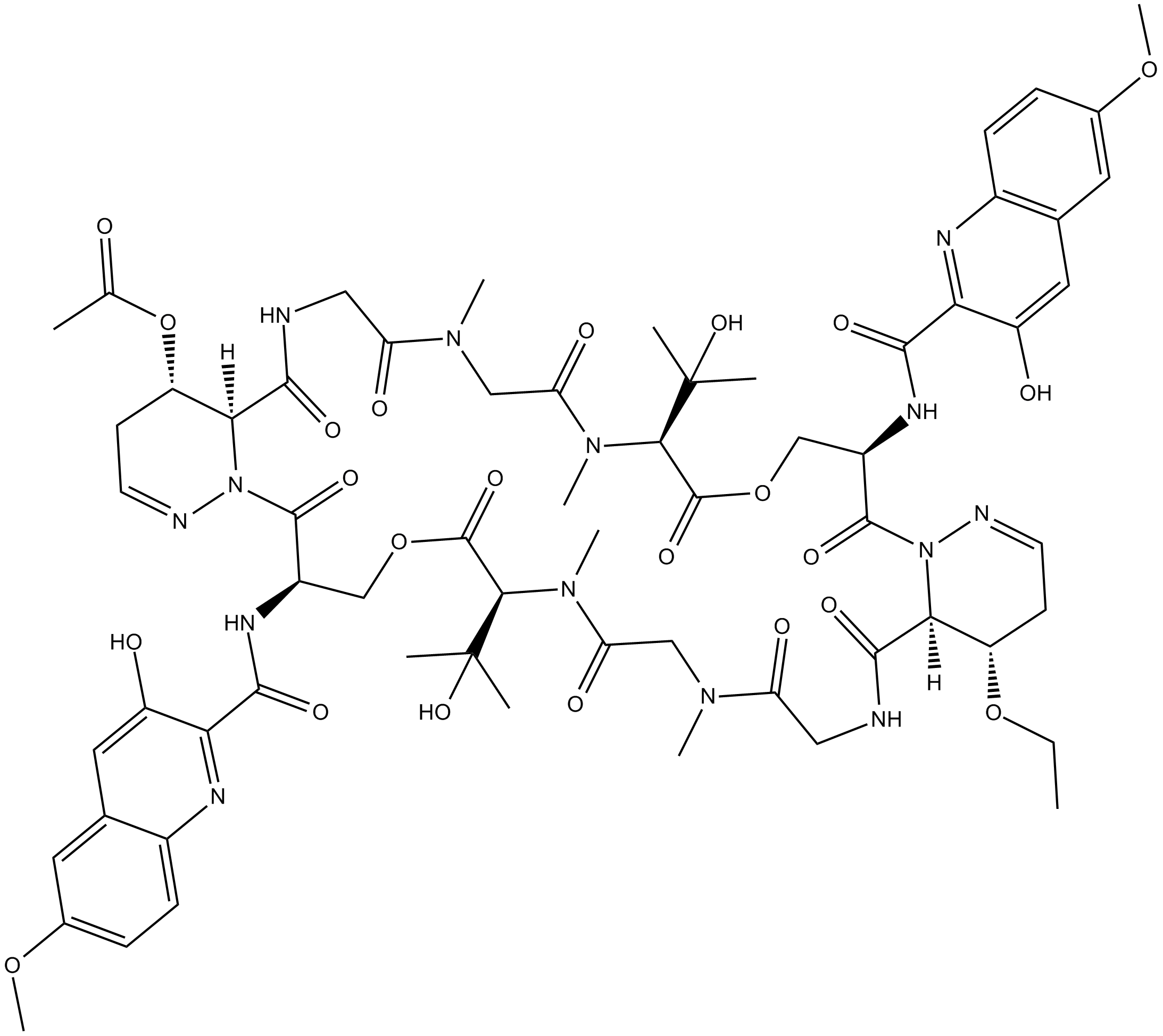
Cas No.: 75580-37-9
Sample solution is provided at 25 µL, 10mM.
_1-3.$$$39978408@51.jpg');)
_1-9.$$$38538795@65.jpg');)
_1-9.$$$39112701@51.jpg');)
_1-7.$$$37316672@70.jpg');)
_366-372.$$$36198801@70.jpg');)
.$$$38565142@65.jpg');)
_1867-1883.$$$33248023@67.jpg');)
_eads6055.$$$39977546@45.jpg');)
_eadm9805.$$$40080571@45.jpg');)
_eadj3020.$$$39666821@45.jpg');)
_1-20.$$$39757301@28.jpg');)
_1-24.$$$38898113@28.jpg');)
_273-287.$$$36806353@46.jpg');)
_1-16.$$$37156877@44.jpg');)
_1-19.$$$37460805@44.jpg');)
_1291-1307.$$$34518654@46.jpg');)
Luzopeptin A is a cyclic depsipeptide antibiotic.
A depsipeptide is a peptide in which one or more of its amide groups are replaced by the corresponding ester, or more generally, is a molecule that has both peptide and ester linkages in proximity in the same amino acid-containing small molecule or chain.
In vitro: Previous study found that luzopeptin A treatment could produce additional DNA bands which were the products of type II biintercalation. The types of restriction fragments involved were identified. Maximal type II biintercalation occurred at a luzopeptin A/DNA range of 0.14 to 0.18, at which more than 50% of the total DNA molecules were involved. Type II products were gradually converted to type I products upon prolonged incubation at 37 degrees, maybe due to the tendency for intermolecular bonds to disrupt. Echinomycin treatment failed to produce type II products, probably because of a DNA-binding affinity weaker than that of luzopeptin A [1].
In vivo: Animal study showed that when administered as a suspension in 0.9% NaCl solution, luzopeptin A demonstrated good activity against i.p. B16 melanoma and i.p. P388 leukemia and weak activity versus i.v. P388, i.p. L1210 leukemia, Lewis lung, and Madison 109 lung carcinomas. In terms of tumor cell kill, luzopeptin A induced net reductions in the body burdens of L1210 and P388 leukemias following single-drug injections but failed to yield net reductions following multiple-injection therapies [2].
Clinical trial: So far, no clinical study has been conducted.
References:
[1] Huang, C. H.,Mirabelli, C.K.,Mong, S., et al. Intermolecular cross-linking of DNA through bifunctional intercalation of an antitumor antibiotic, luzopeptin A (BBM-928A). Cancer Research 43, 2718-2724 (1983).
[2] Rose WC, Schurig JE, Huftalen JB, Bradner WT. Experimental antitumor activity and toxicity of a new chemotherapeutic agent, BBM 928A. Cancer Res. 1983 Apr;43(4):1504-10.
| Cas No. | 75580-37-9 | SDF | |
| Synonyms | BBM-928A | ||
| Chemical Name | Luzopeptin A | ||
| Canonical SMILES | CC(O[C@@H]1[C@@](N2N=CC1)([H])C(NCC(N(C)CC(N(C)[C@@H](C(O)(C)C)C(OC[C@@H](NC(C3=NC4=CC=C(OC)C=C4C=C3O)=O)C(N5[C@]([C@@H](OC(C)=O)CC=N5)([H])C(NCC(N(C)CC(N(C)[C@@H](C(O)(C)C)C(OC[C@@H](NC(C6=NC(C=CC(OC)=C7)=C7C=C6O)=O)C2=O)=O)=O)=O)=O)=O)=O)=O)=O)=O)= | ||
| Formula | C64H78N14O24 | M.Wt | 1427.4 |
| Solubility | Soluble in DMSO;Soluble in dimethyl formamide | Storage | Store at -20°C |
| General tips | Please select the appropriate solvent to prepare the stock solution according to the
solubility of the product in different solvents; once the solution is prepared, please store it in
separate packages to avoid product failure caused by repeated freezing and thawing.Storage method
and period of the stock solution: When stored at -80°C, please use it within 6 months; when stored
at -20°C, please use it within 1 month. To increase solubility, heat the tube to 37°C and then oscillate in an ultrasonic bath for some time. |
||
| Shipping Condition | Evaluation sample solution: shipped with blue ice. All other sizes available: with RT, or with Blue Ice upon request. | ||
| Prepare stock solution | |||

|
1 mg | 5 mg | 10 mg |
| 1 mM | 700.6 μL | 3.5029 mL | 7.0057 mL |
| 5 mM | 140.1 μL | 700.6 μL | 1.4011 mL |
| 10 mM | 70.1 μL | 350.3 μL | 700.6 μL |
Step 1: Enter information below (Recommended: An additional animal making an allowance for loss during the experiment)
 g
μL
g
μL
Step 2: Enter the in vivo formulation (This is only the calculator, not formulation. Please contact us first if there is no in vivo formulation at the solubility Section.)
Calculation results:
Working concentration: mg/ml;
Method for preparing DMSO master liquid: mg drug pre-dissolved in μL DMSO ( Master liquid concentration mg/mL, Please contact us first if the concentration exceeds the DMSO solubility of the batch of drug. )
Method for preparing in vivo formulation: Take μL DMSO master liquid, next addμL PEG300, mix and clarify, next addμL Tween 80, mix and clarify, next add μL saline, mix and clarify.
Method for preparing in vivo formulation: Take μL DMSO master liquid, next add μL Corn oil, mix and clarify.
Note: 1. Please make sure the liquid is clear before adding the next solvent.
2. Be sure to add the solvent(s) in order. You must ensure that the solution obtained, in the previous addition, is a clear solution before proceeding to add the next solvent. Physical methods such as vortex, ultrasound or hot water bath can be used to aid dissolving.
3. All of the above co-solvents are available for purchase on the GlpBio website.
Quality Control & SDS
- View current batch:
- Purity: >98.00% Appearance: A solid
- COA (Certificate of Analysis)
- SDS (Safety Data Sheet)
- Datasheet
Average Rating: 5 (Based on Reviews and 10 reference(s) in Google Scholar.)