

LY 225910 |
Catalog No.GC11305
 One-Click Copy Product Info
|

LY 225910 is a potent and selective cholecystokinin receptor antagonist that specifically blocks the CCK2 receptor and influences neurotransmitter release.
Products are for research use only. Not for human use. We do not sell to patients.
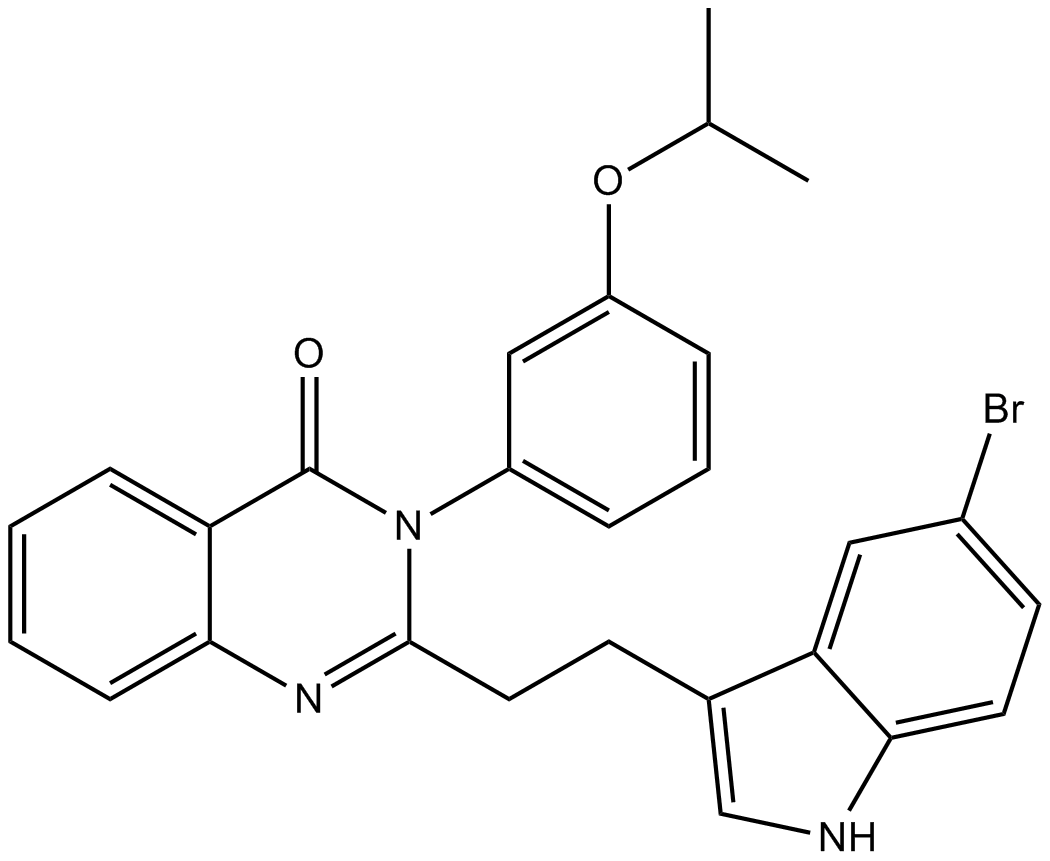
Cas No.: 133040-77-4
Sample solution is provided at 25 µL, 10mM.
LY 225910 is a potent and selective cholecystokinin receptor antagonist that specifically blocks the CCK2 receptor and influences neurotransmitter release[1-2]. LY 225910 is utilized to investigate the role of the CCK2 receptor in brain processes such as emotion, anxiety, and pain, as well as its modulation of GABAergic neurotransmission[3-4].
In vivo, LY 225910 (25ng; single injection) administered intrathecally in a rat model of lipopolysaccharide-induced central nervous system inflammation enhances the analgesic effects of morphine[5]. LY 225910 (0.1mg/kg) was administered as a single intraperitoneal injection to male Sprague-Dawley rats. LY 225910 exhibited anxiolytic-like effects within 24 hours, but at 24 hours post-administration, LY 225910 impaired the rats' novel object recognition and spatial recognition abilities[6].
References:
[1] Crosby KM, Baimoukhametova DV, Bains JS, et al. Postsynaptic Depolarization Enhances GABA Drive to Dorsomedial Hypothalamic Neurons through Somatodendritic Cholecystokinin Release. J Neurosci. 2015 Sep 23;35(38):13160-70.
[2] Rust VA, Crosby KM. Cholecystokinin acts in the dorsomedial hypothalamus of young male rats to suppress appetite in a nitric oxide-dependent manner. Neurosci Lett. 2021 Nov 1;764:136295.
[3] Lee JH, Kim SY, Kwon YK, et al. Characteristics of the cholecystokinin-induced depolarization of pacemaking activity in cultured interstitial cells of Cajal from murine small intestine. Cell Physiol Biochem. 2013;31(4-5):542-54.
[4] Soltani N, Roohbakhsh A, Allahtavakoli M, et al. Heterogeneous effects of cholecystokinin on neuronal response properties in deep layers of rat barrel cortex. Somatosens Mot Res. 2018 Jun;35(2):131-138.
[5] Xanthos DN, Kumar N, Theodorsson E, et al. The roles of nerve growth factor and cholecystokinin in the enhancement of morphine analgesia in a rodent model of central nervous system inflammation. Neuropharmacology. 2009 Mar;56(3):684-91.
[6] Ballaz SJ, Bourin M, Akil H, et al. Blockade of the cholecystokinin CCK-2 receptor prevents the normalization of anxiety levels in the rat. Prog Neuropsychopharmacol Biol Psychiatry. 2020 Jan 10;96:109761.
| Animal experiment [1]: | |
Animal models | Sprague-Dawley rats |
Preparation Method | Rats were intraperitoneally administered a single dose of LY 225910 (0.1mg/kg) and behavioral tests (Elevated Plus Maze, Novel Object Recognition) were conducted at acute and 24-hour time points. |
Dosage form | 0.1mg/kg; i.p.; Single injection. |
Applications | LY 225910 exhibited anxiolytic-like effects within 24 hours, but at 24 hours post-administration, LY 225910 impaired the rats' novel object recognition and spatial recognition abilities. |
References: | |
| Cas No. | 133040-77-4 | SDF | |
| Chemical Name | 2-(2-(5-bromo-1H-indol-3-yl)ethyl)-3-(3-isopropoxyphenyl)quinazolin-4(3H)-one | ||
| Canonical SMILES | BrC1=CC=C2NC=C(C2=C1)CCC(N3C4=CC=CC(OC(C)C)=C4)=NC5=CC=CC=C5C3=O | ||
| Formula | C27H24BrN3O2 | M.Wt | 502.41 |
| Solubility | Soluble to 100 mM in DMSO | Storage | Desiccate at -20°C |
| General tips | Please select the appropriate solvent to prepare the stock solution according to the
solubility of the product in different solvents; once the solution is prepared, please store it in
separate packages to avoid product failure caused by repeated freezing and thawing.Storage method
and period of the stock solution: When stored at -80°C, please use it within 6 months; when stored
at -20°C, please use it within 1 month. To increase solubility, heat the tube to 37°C and then oscillate in an ultrasonic bath for some time. |
||
| Shipping Condition | Evaluation sample solution: shipped with blue ice. All other sizes available: with RT, or with Blue Ice upon request. | ||
| Prepare stock solution | |||

|
1 mg | 5 mg | 10 mg |
| 1 mM | 1.9904 mL | 9.952 mL | 19.9041 mL |
| 5 mM | 398.1 μL | 1.9904 mL | 3.9808 mL |
| 10 mM | 199 μL | 995.2 μL | 1.9904 mL |
Step 1: Enter information below (Recommended: An additional animal making an allowance for loss during the experiment)
 g
μL
g
μL
Step 2: Enter the in vivo formulation (This is only the calculator, not formulation. Please contact us first if there is no in vivo formulation at the solubility Section.)
Calculation results:
Working concentration: mg/ml;
Method for preparing DMSO master liquid: mg drug pre-dissolved in μL DMSO ( Master liquid concentration mg/mL, Please contact us first if the concentration exceeds the DMSO solubility of the batch of drug. )
Method for preparing in vivo formulation: Take μL DMSO master liquid, next addμL PEG300, mix and clarify, next addμL Tween 80, mix and clarify, next add μL saline, mix and clarify.
Method for preparing in vivo formulation: Take μL DMSO master liquid, next add μL Corn oil, mix and clarify.
Note: 1. Please make sure the liquid is clear before adding the next solvent.
2. Be sure to add the solvent(s) in order. You must ensure that the solution obtained, in the previous addition, is a clear solution before proceeding to add the next solvent. Physical methods such as vortex, ultrasound or hot water bath can be used to aid dissolving.
3. All of the above co-solvents are available for purchase on the GlpBio website.
Quality Control & SDS
- View current batch:
- Purity: >98.00% Appearance: A solid
- COA (Certificate of Analysis)
- SDS (Safety Data Sheet)
- Datasheet
Average Rating: 5 (Based on Reviews and 7 reference(s) in Google Scholar.)