

MLN120B |
Catalog No.GC14989
 One-Click Copy Product Info
|

An IKKβ inhibitor
Products are for research use only. Not for human use. We do not sell to patients.
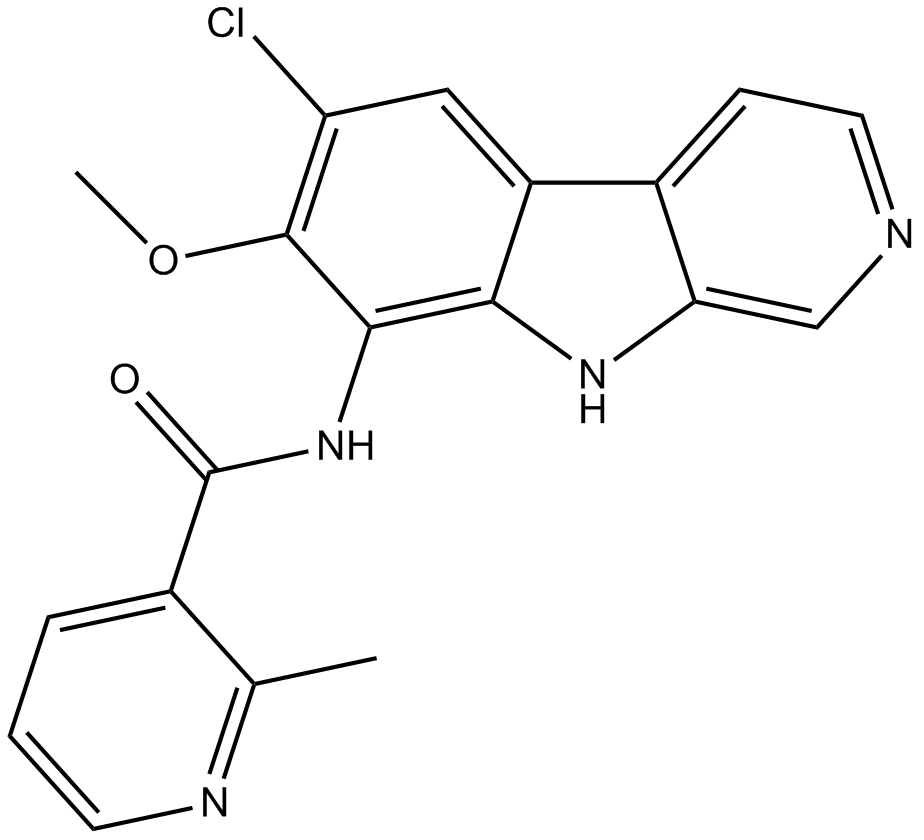
Cas No.: 783348-36-7
Sample solution is provided at 25 µL, 10mM.
_1-3.$$$39978408@51.jpg');)
_1-9.$$$38538795@65.jpg');)
_1-9.$$$39112701@51.jpg');)
_1-7.$$$37316672@70.jpg');)
_366-372.$$$36198801@70.jpg');)
.$$$38565142@65.jpg');)
_1867-1883.$$$33248023@67.jpg');)
_eads6055.$$$39977546@45.jpg');)
_eadm9805.$$$40080571@45.jpg');)
_eadj3020.$$$39666821@45.jpg');)
_1-20.$$$39757301@28.jpg');)
_1-24.$$$38898113@28.jpg');)
_273-287.$$$36806353@46.jpg');)
_1-16.$$$37156877@44.jpg');)
_1-19.$$$37460805@44.jpg');)
_1291-1307.$$$34518654@46.jpg');)
MLN120B is a potent and effective inhibitor of IκB kinase beta subunit (IKKβ) with IC50 value of 20 μM [1].
IKK is an enzyme complex which is a part of the upstream of NF-κB signal transduction cascade. It is composed of three subunits, including IKKα, IKKβ and IKKγ. The IKKβ subunit is able to phosphorylate IκBα protein. Normally, IκBα protein inactivate NF-κB transcription factors and keep them sequestering in inactive state in the cytoplasm. However, once IκBα protein is phosphorylated by IKKβ subunit, the IκBα protein will be dissociated from NF-κB transcription factor and thus remove the inactivation effect. Therefore, the transcription of NF-κB will be activated. This signaling pathway is involved in many immune and inflammatory processes.
In multiple myeloma cell line RPMI 8226 and INA 6, treatment of MLN120B resulted in the dose-dependent inhibition of IKKβ-induced IκBα protein phosphorylation and subsequent NF-κB activation. Additionally, it was observed that MLN120B was able to block TNF-α-induced NF-κB activation in MM.1S cell line. These observations suggested the inhibitory action of MLN120B on IKKβ. [1].
In mouse model, polyarthritis was introduced in footpads, where IKKβ-induced NF-κB activation might result in a serial of advert effects. Oral administration of MLN120B (12 mg/kg twice daily) inhibited paw swelling in a dose-dependent manner, and offered protection against arthritis-induced weight loss. Therefore, it could be implied that MLN120B was able to inhibit IKKβ-induced NF-κB activation [2].
References:
[1]. Hideshima T, Neri P, Tassone P. MLN120B, a novel IkappaB kinase beta inhibitor, blocks multiple myeloma cell growth in vitro and in vivo. Clin Cancer Res. 2006, 12(19): 5887-5894.
[2]. Schopf L, Savinainen A, Anderson K. IKKbeta inhibition protects against bone and cartilage destruction in a rat model of rheumatoid arthritis. Arthritis Rheum. 2006, 54(10): 3163-3173.
| Cell experiment [1]: | |
|
Cell lines |
RPMI 8226 and U266 human multiple myeloma cells |
|
Preparation method |
The solubility of this compound in DMSO is >13.2mg/mL. General tips for obtaining a higher concentration: Please warm the tube at 37℃ for 10 minutes and/or shake it in the ultrasonic bath for a while. Stock solution can be stored below -20℃ for several months. |
|
Reacting condition |
1.25-20μmol/L for 90 minutes |
|
Applications |
In RPMI 8226 and U266 human multiple myeloma cells, TNF-α (tumor necrosis factor-a)-induced phosphorylation and degradation of IκBα were completely abrogated by MLN120B in a dose dependent fashion. Phosphorylation of p65 NF-κB (Nuclear factor-κB) induced by TNF-α was also blocked by MLN120B. Importantly, MLN120B inhibited both IL-6 secretion from BMSCs (bone marrow stromal cells) triggered by multiple myeloma cell adhesion and proliferation of multiple myeloma cells adherent to BMSCs. MLN120B triggered 25% to 90% growth inhibition in a dose-dependent fashion in multiple myeloma cell lines, which is not overcome by growth and antiapoptotic factors (IL-6 or IGF-I). |
| Animal experiment [2]: | |
|
Animal models |
Rat adjuvant-induced arthritis model (Two-month-old female Lewis rats) |
|
Dosage form |
orally as a suspension delivered via a gavage needle, at 30 mg/kg, 10 mg/kg, 3 mg/kg |
|
Application |
In Lewis rats, Animals receiving MLN120B showed a dose-dependent reduction of arthritis development, as measured by paw swelling, compared with vehicle-treated controls. Administration of MLN120B at a dosage of 30 mg/kg twice daily offered significant protection against weight loss compared with arthritic controls. These results indicated bone and cartilage destruction and pannus development were the features most improved with MLN120B administration. |
|
Other notes |
Please test the solubility of all compounds indoor, and the actual solubility may slightly differ with the theoretical value. This is caused by an experimental system error and it is normal. |
|
References: [1]. Hideshima T, Neri P, Tassone P. MLN120B., et al. a novel IkappaB kinase beta inhibitor, blocks multiple myeloma cell growth in vitro and in vivo. Clin Cancer Res. 2006, 12(19): 5887-5894. [2]. Schopf L, Savinainen A, Anderson K., et al. IKKbeta inhibition protects against bone and cartilage destruction in a rat model of rheumatoid arthritis. Arthritis Rheum. 2006, 54(10): 3163-3173. | |
| Cas No. | 783348-36-7 | SDF | |
| Chemical Name | N-(6-chloro-7-methoxy-9H-pyrido[3,4-b]indol-8-yl)-2-methylpyridine-3-carboxamide | ||
| Canonical SMILES | CC1=C(C=CC=N1)C(=O)NC2=C3C(=CC(=C2OC)Cl)C4=C(N3)C=NC=C4 | ||
| Formula | C19H15ClN4O2 | M.Wt | 366.8 |
| Solubility | ≥ 13.2 mg/mL in DMSO, ≥ 8.53 mg/mL in EtOH with ultrasonic and warming | Storage | Store at -20°C |
| General tips | Please select the appropriate solvent to prepare the stock solution according to the
solubility of the product in different solvents; once the solution is prepared, please store it in
separate packages to avoid product failure caused by repeated freezing and thawing.Storage method
and period of the stock solution: When stored at -80°C, please use it within 6 months; when stored
at -20°C, please use it within 1 month. To increase solubility, heat the tube to 37°C and then oscillate in an ultrasonic bath for some time. |
||
| Shipping Condition | Evaluation sample solution: shipped with blue ice. All other sizes available: with RT, or with Blue Ice upon request. | ||
| Prepare stock solution | |||

|
1 mg | 5 mg | 10 mg |
| 1 mM | 2.7263 mL | 13.6314 mL | 27.2628 mL |
| 5 mM | 545.3 μL | 2.7263 mL | 5.4526 mL |
| 10 mM | 272.6 μL | 1.3631 mL | 2.7263 mL |
Step 1: Enter information below (Recommended: An additional animal making an allowance for loss during the experiment)
 g
μL
g
μL
Step 2: Enter the in vivo formulation (This is only the calculator, not formulation. Please contact us first if there is no in vivo formulation at the solubility Section.)
Calculation results:
Working concentration: mg/ml;
Method for preparing DMSO master liquid: mg drug pre-dissolved in μL DMSO ( Master liquid concentration mg/mL, Please contact us first if the concentration exceeds the DMSO solubility of the batch of drug. )
Method for preparing in vivo formulation: Take μL DMSO master liquid, next addμL PEG300, mix and clarify, next addμL Tween 80, mix and clarify, next add μL saline, mix and clarify.
Method for preparing in vivo formulation: Take μL DMSO master liquid, next add μL Corn oil, mix and clarify.
Note: 1. Please make sure the liquid is clear before adding the next solvent.
2. Be sure to add the solvent(s) in order. You must ensure that the solution obtained, in the previous addition, is a clear solution before proceeding to add the next solvent. Physical methods such as vortex, ultrasound or hot water bath can be used to aid dissolving.
3. All of the above co-solvents are available for purchase on the GlpBio website.
Quality Control & SDS
- View current batch:
- Purity: >99.50% Appearance: A solid
- COA (Certificate of Analysis)
- SDS (Safety Data Sheet)
- Datasheet
Average Rating: 5 (Based on Reviews and 30 reference(s) in Google Scholar.)