

N-acetyl-D-Glucosamine (Synonyms: GlcNAc, Marine Sweet, NAG, NSC 524344) |
Catalog No.GC41283
 One-Click Copy Product Info
|

N-acetyl-D-Glucosamine (GlcNAc) is a monosaccharide derivative of glucose with antitumor and anti-inflammatory activities.
Products are for research use only. Not for human use. We do not sell to patients.
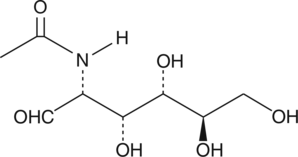
Cas No.: 7512-17-6
Sample solution is provided at 25 µL, 10mM.
N-acetyl-D-Glucosamine (GlcNAc) is a monosaccharide derivative of glucose with antitumor and anti-inflammatory activities[1]. N-acetyl-D-Glucosamine is the D-isomer of N-acetylglucosamine and a basic structural unit for many key macromolecules in organisms[2]. N-acetyl-D-Glucosamine is a bacterial metabolite found in Escherichia coli[3]. As a monomer of chitin, N-acetyl-D-Glucosamine provides structural support for arthropods and fungi[4].
In vitro, treatment of peripheral blood mononuclear cells (PBMCs) with N-acetyl-D-Glucosamine (300μg/mL) for 48h or 96h induced cell proliferation, inhibited apoptosis, and increased the proportion of PBMCs expressing CD3-CD4, CD3-CD8, and CD3-CD56 antibodies[5].
In vivo, N-acetyl-D-Glucosamine (100, 300mg/kg) significantly inhibited tumor growth in Sarcoma 180 cell xenograft mice after oral treatment for 15 days and suppressed the expression of vascular endothelial growth factor (VEGF) mRNA in tumor tissue[5]. N-acetyl-D-Glucosamine (400mg/kg) significantly promoted the healing of cartilage lesions in rabbits after oral treatment for 3 weeks, especially the recovery of trochlear groove lesions[6].
References:
[1] Wang B, Mao J, Ma Y, et al. Synthesis, O-GlcNAc Modification, and Potential Applications of N-Acetylglucosamine Derivatives[J]. Natural Product Communications, 2024, 19(11): 1934578X241298913.
[2] Konopka J B. N‐acetylglucosamine functions in cell signaling[J]. Scientifica, 2012, 2012(1): 489208.
[3] Riemann L, Azam F. Widespread N-acetyl-D-glucosamine uptake among pelagic marine bacteria and its ecological implications[J]. Applied and environmental microbiology, 2002, 68(11): 5554-5562.
[4] Ahmedd S. Polysaccharides: Chitin and Chitosan[J]. Chitin and Chitosan: Physical and Chemical Properties, 2025, 1.
[5] Xu W, Jiang C, Kong X, et al. Chitooligosaccharides and N-acetyl-D-glucosamine stimulate peripheral blood mononuclear cell-mediated antitumor immune responses[J]. Molecular Medicine Reports, 2012, 6(2): 385-390.
[6] Tamai Y, Miyatake K, Okamoto Y, et al. Enhanced healing of cartilaginous injuries by N-acetyl-d-glucosamine and glucuronic acid[J]. Carbohydrate Polymers, 2003, 54(2): 251-262.
| Cell experiment [1]: | |
|
Cell lines |
Peripheral blood mononuclear cells (PBMCs) |
|
Preparation Method |
The PBMCs were placed in 96-well plates at a concentration of 106 cells/mL (100μL per well). Chitooligosaccharides (COS) or N-acetyl-D-Glucosamine (NAG) were added to the medium to obtain concentrations of 500, 300, 100 or 50μg/mL. The PBMCs cultured with normal medium were the positive controls. The cells were observed under a microscope and imaged. To assess the effect of various concentrations of COS and NAG on the proliferation and viability of the PBMCs, the samples were analyzed with the MTT method on the 2nd and the 4th day from the beginning of the treatments. |
|
Reaction Conditions |
50, 100, 300, 500μg/mL; 48h, 96h |
|
Applications |
Chitooligosaccharides (COS) and N-acetyl-D-Glucosamine (NAG) induce PBMC proliferation. |
| Animal experiment [1]: | |
|
Animal models |
Sarcoma 180-bearing mice |
|
Preparation Method |
Sarcoma 180 cells were injected into the peritoneal cavity of the sarcoma 180-bearing mice. They were harvested from the peritoneal cavity of the tumor-bearing mice 7-9 days after inoculation, and suspended in an air-saturated phosphate buffer solution. The cells were then collected by centrifugation and resuspended in PBS at a concentration of 107 cells/ml and were subcutaneously transplanted into the right oxter region of the mice to obtain solid tumors. At day 1 post-inoculation, 80 mice were randomly divided into 8 groups. Chitooligosaccharides (COS) and N-acetyl-D-Glucosamine (NAG) solutions at the doses of 100, 300 and 500mg/kg, were administered by gavage every 2 days over a period of 15 days. The negative control group received 0.9% normal saline. The positive control group received cyclophosphamide (300mg/kg). At day 16 after subcutaneous transplantation, the mice were weighed and sacrificed. The solid tumor, thymus and spleen were weighed. |
|
Dosage form |
100, 300, 500mg/kg; 15 days; p.o. |
|
Applications |
The tumor inhibition rates of the groups administered with 100mg/kg Chitooligosaccharides and 100 or 300mg/kg N-acetyl-D-Glucosamine were significantly higher than those of the normal control group. |
|
References: |
|
| Cas No. | 7512-17-6 | SDF | |
| Synonyms | GlcNAc, Marine Sweet, NAG, NSC 524344 | ||
| Canonical SMILES | O=CC(NC(=O)C)C(O)C(O)[C@H](O)CO | ||
| Formula | C8H15NO6 | M.Wt | 221.2 |
| Solubility | ≤10mg/ml in DMSO;0.25mg/ml in dimethyl formamide | Storage | Store at -20°C, stored under nitrogen |
| General tips | Please select the appropriate solvent to prepare the stock solution according to the
solubility of the product in different solvents; once the solution is prepared, please store it in
separate packages to avoid product failure caused by repeated freezing and thawing.Storage method
and period of the stock solution: When stored at -80°C, please use it within 6 months; when stored
at -20°C, please use it within 1 month. To increase solubility, heat the tube to 37°C and then oscillate in an ultrasonic bath for some time. |
||
| Shipping Condition | Evaluation sample solution: shipped with blue ice. All other sizes available: with RT, or with Blue Ice upon request. | ||
| Prepare stock solution | |||

|
1 mg | 5 mg | 10 mg |
| 1 mM | 4.5208 mL | 22.604 mL | 45.208 mL |
| 5 mM | 904.2 μL | 4.5208 mL | 9.0416 mL |
| 10 mM | 452.1 μL | 2.2604 mL | 4.5208 mL |
Step 1: Enter information below (Recommended: An additional animal making an allowance for loss during the experiment)
 g
μL
g
μL
Step 2: Enter the in vivo formulation (This is only the calculator, not formulation. Please contact us first if there is no in vivo formulation at the solubility Section.)
Calculation results:
Working concentration: mg/ml;
Method for preparing DMSO master liquid: mg drug pre-dissolved in μL DMSO ( Master liquid concentration mg/mL, Please contact us first if the concentration exceeds the DMSO solubility of the batch of drug. )
Method for preparing in vivo formulation: Take μL DMSO master liquid, next addμL PEG300, mix and clarify, next addμL Tween 80, mix and clarify, next add μL saline, mix and clarify.
Method for preparing in vivo formulation: Take μL DMSO master liquid, next add μL Corn oil, mix and clarify.
Note: 1. Please make sure the liquid is clear before adding the next solvent.
2. Be sure to add the solvent(s) in order. You must ensure that the solution obtained, in the previous addition, is a clear solution before proceeding to add the next solvent. Physical methods such as vortex, ultrasound or hot water bath can be used to aid dissolving.
3. All of the above co-solvents are available for purchase on the GlpBio website.
Quality Control & SDS
- View current batch:
- Purity: >99.50% Appearance: A solid
- COA (Certificate of Analysis)
- SDS (Safety Data Sheet)
- Datasheet
Average Rating: 5 (Based on Reviews and 32 reference(s) in Google Scholar.)