

NCX 1000 |
Catalog No.GC30334
 One-Click Copy Product Info
|

NCX 1000 is a liver-specific NO donor compound derived from ursodeoxycholic acid (UDCA).
Products are for research use only. Not for human use. We do not sell to patients.
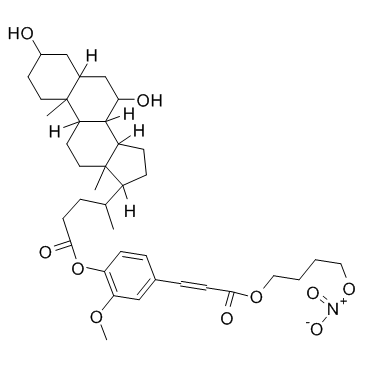
Cas No.: 401519-96-8
Sample solution is provided at 25 µL, 10mM.
_1-3.$$$39978408@51.jpg');)
_1-9.$$$38538795@65.jpg');)
_1-9.$$$39112701@51.jpg');)
_1-7.$$$37316672@70.jpg');)
_366-372.$$$36198801@70.jpg');)
.$$$38565142@65.jpg');)
_1867-1883.$$$33248023@67.jpg');)
_eads6055.$$$39977546@45.jpg');)
_eadm9805.$$$40080571@45.jpg');)
_eadj3020.$$$39666821@45.jpg');)
_1-20.$$$39757301@28.jpg');)
_1-24.$$$38898113@28.jpg');)
_273-287.$$$36806353@46.jpg');)
_1-16.$$$37156877@44.jpg');)
_1-19.$$$37460805@44.jpg');)
_1291-1307.$$$34518654@46.jpg');)
NCX 1000 is a liver-specific NO donor compound derived from ursodeoxycholic acid (UDCA).
NCX-1000 (15 mg/kg, p.o.) prevents ascite formation, reduces collagen deposition in CCl4-treated rats. NCX-1000 administration almost completely reverts portal hypertension induced by CCl4, and reduces portal pressure in cirrhotic rats. NCX-1000 reverts HSC contraction induced by FCS, and also inhibits MCP-1 release from HSCs stimulated with TNF-α and IFN-γ[1]. NCX-1000 (28 mg/kg, p.o.) decreases portal pressure without affecting mean arterial pressure and heart rate in rats. NCX-1000 also reduces vasoconstriction by 60% caused by 30 μM NE in rats. Administration of NCX-1000 to BDL and sham operated rats results in a similar increase of nitrite/nitrate and cGMP concentrations in the liver[2].
[1]. Fiorucci S, et al. NCX-1000, a NO-releasing derivative of ursodeoxycholic acid, selectively delivers NO to the liver and protects against development of portal hypertension. Proc Natl Acad Sci U S A. 2001 Jul 17;98(15):8897-902. Epub 2001 Jul 10. [2]. Fiorucci S, et al. NCX-1000, a nitric oxide-releasing derivative of ursodeoxycholic acid, ameliorates portal hypertension and lowers norepinephrine-induced intrahepatic resistance in the isolated and perfused rat liver. J Hepatol. 2003 Dec;39(6):932-9.
Animal experiment: | Rats: On the first protocol, 54 rats, 12 animals/group unless specified, are randomly allocated to receive one of the following treatments: group 1 has phenobarbital induction and no further treatment; group 2 (16 animals) is treated with CCl4 twice a week for 8 weeks; group 3 has CCl4 twice a week plus UDCA (15 mg/kg); and group 4 has CCl4 twice a week plus NCX-1000 (15 mg/kg). NCX-1000 and UDCA are dissolved in carboxymethyl cellulose and administered daily by gavage. Animal weight is monitored daily through the study period, and the dosage of CCl4 is adjusted accordingly to the animal weight. At the end of the treatment surviving animals are killed by an overdose of uretane, and blood, ascitic fluid, and livers are collected. A portion of each liver is fixed in 10% formalin for histological evaluation. The remaining tissue is partitioned and immediately stored under frozen liquid nitrogen at -80°C until used. On the second protocol, 74 rats are randomly allocated to receive the same treatments as protocol 1. At the end of the study, surviving animals are tested for portal and arterial pressure measurement. |
References: [1]. Fiorucci S, et al. NCX-1000, a NO-releasing derivative of ursodeoxycholic acid, selectively delivers NO to the liver and protects against development of portal hypertension. Proc Natl Acad Sci U S A. 2001 Jul 17;98(15):8897-902. Epub 2001 Jul 10. | |
| Cas No. | 401519-96-8 | SDF | |
| Canonical SMILES | CC1(C2([H])C(C)CCC(OC(C=CC(C=CC(OCCCCO[N+]([O-])=O)=O)=C3)=C3OC)=O)C(CC2)([H])C(C(CC4([H])CC(O)CC5)O)([H])C(C45C)([H])CC1 | ||
| Formula | C38H55NO10 | M.Wt | 685.84 |
| Solubility | Soluble in DMSO | Storage | Store at -20°C |
| General tips | Please select the appropriate solvent to prepare the stock solution according to the
solubility of the product in different solvents; once the solution is prepared, please store it in
separate packages to avoid product failure caused by repeated freezing and thawing.Storage method
and period of the stock solution: When stored at -80°C, please use it within 6 months; when stored
at -20°C, please use it within 1 month. To increase solubility, heat the tube to 37°C and then oscillate in an ultrasonic bath for some time. |
||
| Shipping Condition | Evaluation sample solution: shipped with blue ice. All other sizes available: with RT, or with Blue Ice upon request. | ||
| Prepare stock solution | |||

|
1 mg | 5 mg | 10 mg |
| 1 mM | 1.4581 mL | 7.2903 mL | 14.5807 mL |
| 5 mM | 291.6 μL | 1.4581 mL | 2.9161 mL |
| 10 mM | 145.8 μL | 729 μL | 1.4581 mL |
Step 1: Enter information below (Recommended: An additional animal making an allowance for loss during the experiment)
 g
μL
g
μL
Step 2: Enter the in vivo formulation (This is only the calculator, not formulation. Please contact us first if there is no in vivo formulation at the solubility Section.)
Calculation results:
Working concentration: mg/ml;
Method for preparing DMSO master liquid: mg drug pre-dissolved in μL DMSO ( Master liquid concentration mg/mL, Please contact us first if the concentration exceeds the DMSO solubility of the batch of drug. )
Method for preparing in vivo formulation: Take μL DMSO master liquid, next addμL PEG300, mix and clarify, next addμL Tween 80, mix and clarify, next add μL saline, mix and clarify.
Method for preparing in vivo formulation: Take μL DMSO master liquid, next add μL Corn oil, mix and clarify.
Note: 1. Please make sure the liquid is clear before adding the next solvent.
2. Be sure to add the solvent(s) in order. You must ensure that the solution obtained, in the previous addition, is a clear solution before proceeding to add the next solvent. Physical methods such as vortex, ultrasound or hot water bath can be used to aid dissolving.
3. All of the above co-solvents are available for purchase on the GlpBio website.
Quality Control & SDS
- View current batch:
- Purity: >98.00% Appearance: A solid
- COA (Certificate of Analysis)
- SDS (Safety Data Sheet)
- Datasheet
Average Rating: 5 (Based on Reviews and 19 reference(s) in Google Scholar.)