

NVX-207 |
Catalog No.GC33132
 One-Click Copy Product Info
|

NVX-207, a Betulinic acid-derived anti-cancer compound, shows anti-tumor activity (mean IC50=3.5 μM) against various human and canine cell lines. NVX-207-induced apoptosis is associated with activation of the intrinsic apoptotic pathway via cleavage of caspases -9, -3, -7 and of PARP.
Products are for research use only. Not for human use. We do not sell to patients.
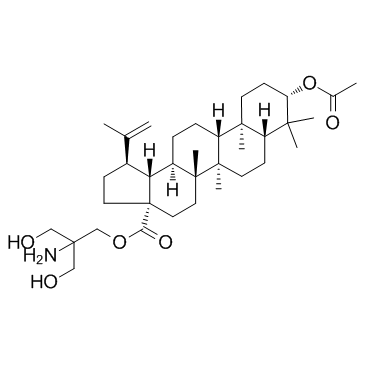
Cas No.: 745020-66-0
Sample solution is provided at 25 µL, 10mM.
_1-3.$$$39978408@51.jpg');)
_1-9.$$$38538795@65.jpg');)
_1-9.$$$39112701@51.jpg');)
_1-7.$$$37316672@70.jpg');)
_366-372.$$$36198801@70.jpg');)
.$$$38565142@65.jpg');)
_1867-1883.$$$33248023@67.jpg');)
_eads6055.$$$39977546@45.jpg');)
_eadm9805.$$$40080571@45.jpg');)
_eadj3020.$$$39666821@45.jpg');)
_1-20.$$$39757301@28.jpg');)
_1-24.$$$38898113@28.jpg');)
_273-287.$$$36806353@46.jpg');)
_1-16.$$$37156877@44.jpg');)
_1-19.$$$37460805@44.jpg');)
_1291-1307.$$$34518654@46.jpg');)
NVX-207 is a derivative of betulinic acid with anti-cancer activity.
NVX-207 shows anti-tumour activity (mean IC50 = 3.5 μM) against various human and canine cell lines. NVX-207-induced apoptosis is associated with activation of the intrinsic apoptotic pathway via cleavage of caspases -9, -3, -7 and of poly (ADP-ribose) polymerase (PARP). NVX-207 induces cell death via apoptosis[1]. NVX-207 has a high cytotoxicity with IC50 values ranging from 7.6-8.5 µM, in the three analyzed malignant glioma cell lines. NVX-207 leads to PARP cleavage and to a decrease in Survivin expression levels under normoxic and hypoxic conditions. NVX-207 (20 µM) causes a significantly high rate of necrosis of glioma cell lines[2].
Intravenous application of NVX-207 in mice is well tolerated[1].
[1]. Willmann M, et al. Characterization of NVX-207, a novel betulinic acid-derived anti-cancer compound. Eur J Clin Invest. 2009 May;39(5):384-94. [2]. Bache M, et al. Betulinic acid derivatives NVX-207 and B10 for treatment of glioblastoma--an in vitro study of cytotoxicity and radiosensitization. Int J Mol Sci. 2014 Oct 30;15(11):19777-90.
Cell experiment: | Cytotoxic activities are evaluated using the Sulforhodamine-B (SRB) assay. Exponentially growing cells are seeded into 96-well plates at cell densities to prevent confluence for 96 h. After 24 h, the cells are treated using a dilution series of the compounds for 72 h under normoxic or hypoxic conditions. After treatment, the adherent cells are fixed using 10% TCA at 4°C for 1 h; the cells are washed with ice-cold water and are dyed using 100 µL of 4.4% SRB solution for 10 min. After staining, the plates are washed with 1% acetic acid and air-dried overnight. Three hundred microliters of 20 mM Tris base solution is added, and the absorbance is measured at 540 nm using a 96-well plate reader. The IC50 values indicate the concentrations of the compound that cause 50% cell inhibition. The data are obtained in three independent experiments. |
References: [1]. Willmann M, et al. Characterization of NVX-207, a novel betulinic acid-derived anti-cancer compound. Eur J Clin Invest. 2009 May;39(5):384-94. | |
| Cas No. | 745020-66-0 | SDF | |
| Canonical SMILES | O=C([C@]1(CC[C@H]2C(C)=C)[C@@]2([H])[C@](CC[C@@]3([H])[C@]4(CC[C@]5([H])[C@@]3(CC[C@H](OC(C)=O)C5(C)C)C)C)([H])[C@@]4(C)CC1)OCC(CO)(N)CO | ||
| Formula | C36H59NO6 | M.Wt | 601.86 |
| Solubility | DMSO : 125 mg/mL (207.69 mM) | Storage | Store at -20°C |
| General tips | Please select the appropriate solvent to prepare the stock solution according to the
solubility of the product in different solvents; once the solution is prepared, please store it in
separate packages to avoid product failure caused by repeated freezing and thawing.Storage method
and period of the stock solution: When stored at -80°C, please use it within 6 months; when stored
at -20°C, please use it within 1 month. To increase solubility, heat the tube to 37°C and then oscillate in an ultrasonic bath for some time. |
||
| Shipping Condition | Evaluation sample solution: shipped with blue ice. All other sizes available: with RT, or with Blue Ice upon request. | ||
| Prepare stock solution | |||

|
1 mg | 5 mg | 10 mg |
| 1 mM | 1.6615 mL | 8.3076 mL | 16.6152 mL |
| 5 mM | 332.3 μL | 1.6615 mL | 3.323 mL |
| 10 mM | 166.2 μL | 830.8 μL | 1.6615 mL |
Step 1: Enter information below (Recommended: An additional animal making an allowance for loss during the experiment)
 g
μL
g
μL
Step 2: Enter the in vivo formulation (This is only the calculator, not formulation. Please contact us first if there is no in vivo formulation at the solubility Section.)
Calculation results:
Working concentration: mg/ml;
Method for preparing DMSO master liquid: mg drug pre-dissolved in μL DMSO ( Master liquid concentration mg/mL, Please contact us first if the concentration exceeds the DMSO solubility of the batch of drug. )
Method for preparing in vivo formulation: Take μL DMSO master liquid, next addμL PEG300, mix and clarify, next addμL Tween 80, mix and clarify, next add μL saline, mix and clarify.
Method for preparing in vivo formulation: Take μL DMSO master liquid, next add μL Corn oil, mix and clarify.
Note: 1. Please make sure the liquid is clear before adding the next solvent.
2. Be sure to add the solvent(s) in order. You must ensure that the solution obtained, in the previous addition, is a clear solution before proceeding to add the next solvent. Physical methods such as vortex, ultrasound or hot water bath can be used to aid dissolving.
3. All of the above co-solvents are available for purchase on the GlpBio website.
Quality Control & SDS
- View current batch:
- Purity: >98.00% Appearance: A solid
- COA (Certificate of Analysis)
- SDS (Safety Data Sheet)
- Datasheet
Average Rating: 5 (Based on Reviews and 26 reference(s) in Google Scholar.)