

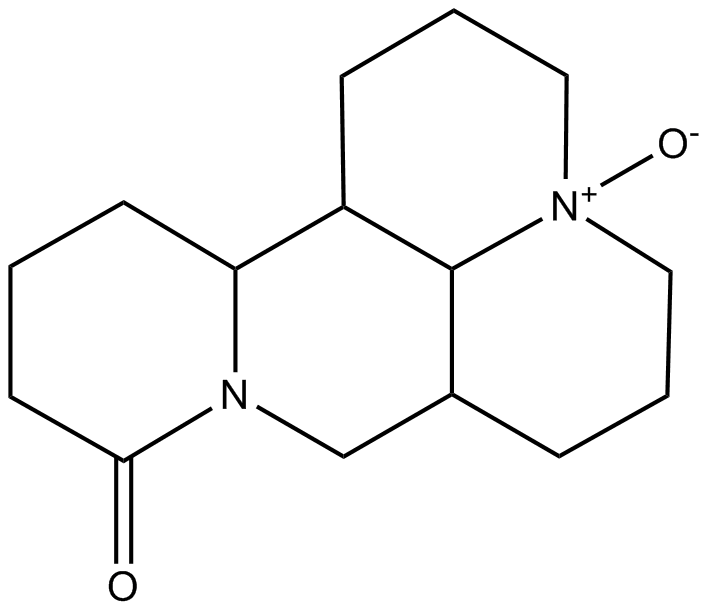
Oxymatrine (Synonyms: Matrine 1oxide) |
Catalog No.GN10378
 One-Click Copy Product Info
|

Oxymatrine is a quinolizidine alkaloid extracted from the roots of Sophora flavescens.
Products are for research use only. Not for human use. We do not sell to patients.
Cas No.: 16837-52-8
Sample solution is provided at 25 µL, 10mM.
_1-3.$$$39978408@51.jpg');)
_1-9.$$$38538795@65.jpg');)
_1-9.$$$39112701@51.jpg');)
_1-7.$$$37316672@70.jpg');)
_366-372.$$$36198801@70.jpg');)
.$$$38565142@65.jpg');)
_1867-1883.$$$33248023@67.jpg');)
_eads6055.$$$39977546@45.jpg');)
_eadm9805.$$$40080571@45.jpg');)
_eadj3020.$$$39666821@45.jpg');)
_1-20.$$$39757301@28.jpg');)
_1-24.$$$38898113@28.jpg');)
_273-287.$$$36806353@46.jpg');)
_1-16.$$$37156877@44.jpg');)
_1-19.$$$37460805@44.jpg');)
_1291-1307.$$$34518654@46.jpg');)
Oxymatrine is a quinolizidine alkaloid extracted from the roots of Sophora flavescens[1]. Oxymatrine possesses a wide range of pharmacological activities and exerts anti-inflammatory, anti-fibrotic, and anti-tumor effects mainly by inhibiting iNOS expression and regulating signaling pathways such as TGF-β/Smad and TLR4[2]. Oxymatrine is commonly used in research on liver fibrosis, neuroprotection, and the proliferation and apoptosis mechanisms of various tumor cells[3,4].
In vitro, pretreatment of HUVEC cells with Oxymatrine (2, 4, 8μM) for 1h, followed by continued treatment with oxidized low-density lipoprotein (ox-LDL, 100μg/mL) for 24h, significantly reversed the ox-LDL-induced decrease in cell viability[5]. Treatment of high glucose (55mM glucose)-induced HepG2 cells with Oxymatrine (0.1, 1μM) for 24h dose-dependently reduced glucose production[6].
In vivo, intraperitoneal injection of Oxymatrine (25, 50, 100mg/kg; once daily) for 30 days in C57BL/6J mice infected with Echinococcus multilocularis significantly reduced the wet weight of abdominal cysts[7]. Administration of Oxymatrine (30, 60, 120mg/kg; i.p.) once at 1h before and once at 12h after LPS induction in mice with LPS-induced mastitis significantly reduced the LPS-induced increase in myeloperoxidase (MPO) activity and distribution in mammary tissue at 24h[8].
References:[1] Chen X, Yi C, Yang X, et al. Liquid chromatography of active principles in Sophora flavescens root[J]. Journal of Chromatography B, 2004, 812(1-2): 149-163.
[2] Wang Y, Hua C, Zhang H, et al. Alkaloids as emerging therapeutics against pulmonary fibrosis: classification, mechanisms, and translational potential[J]. Chemistry & Biodiversity, 2025, 22(12): e01495.
[3] Chai N L, Fu Q, Shi H, et al. Oxymatrine liposome attenuates hepatic fibrosis via targeting hepatic stellate cells[J]. World Journal of Gastroenterology: WJG, 2012, 18(31): 4199.
[4] Dhurandhar Y, Tomar S, Das A, et al. Unlocking the potential of oxymatrine: a comprehensive review of its neuroprotective mechanisms and therapeutic prospects in neurological disorders[J]. ACS Chemical Neuroscience, 2024, 15(23): 4245-4257.
[5] Jin X, Fu W, Zhou J, et al. Oxymatrine attenuates oxidized low-density lipoprotein-induced HUVEC injury by inhibiting NLRP3 inflammasome-mediated pyroptosis via the activation of the SIRT1/Nrf2 signaling pathway[J]. International journal of molecular medicine, 2021, 48(4): 187.
[6] Zhu Y X, Hu H Q, Zuo M L, et al. Effect of oxymatrine on liver gluconeogenesis is associated with the regulation of PEPCK and G6Pase expression and AKT phosphorylation[J]. Biomedical reports, 2021, 15(1): 56.
[7] Zhu Y, Wu P, Wen R, et al. Oxymatrine alleviates Echinococcus multilocularis infection by remodeling the liver immune microenvironment and intestinal flora homeostasis[J]. Frontiers in Cellular and Infection Microbiology, 2025, 15: 1658336.
[8] Yang Z, Yin R, Cong Y, et al. Oxymatrine lightened the inflammatory response of LPS-induced mastitis in mice through affecting NF-κB and MAPKs signaling pathways[J]. Inflammation, 2014, 37(6): 2047-2055.
| Cell experiment [1]: | |
|
Cell lines |
HUVEC cells |
|
Preparation Method |
HUVECs were pre-treated with oxymatrine (2, 4 and 8μM) for 1h prior to ox-LDL (100μg/mL) challenge for 24h at 37℃. Cell viability was measured by CCK-8 assay. |
|
Reaction Conditions |
2, 4, and 8μM; 1h and additional 24h |
|
Applications |
Oxymatrine (2, 4 and 8μM) significantly reversed the ox-LDL-induced decrease in cell viability. Oxymatrine (4μM) obviously increased the viability of HUVECs treated with ox-LDL, which was selected as an optimal dose for interference with HUVECs treated with ox-LDL. |
| Animal experiment [2]: | |
|
Animal models |
C57BL/6J mice infected with E. multilocularis |
|
Preparation Method |
Mice were intraperitoneally injected with 2000 E. multilocularis protoscoleces. Three months after infection, mice were treated with Oxymatrine by intraperitoneal injection once daily for 30 consecutive days. After administration, mice were weighed, and abdominal cyst tissues were separated and weighed to calculate cyst wet weight. |
|
Dosage form |
25, 50, 100mg/kg; once daily; 30 days; i.p. |
|
Applications |
Oxymatrine (25-100mg/kg) significantly reduced abdominal cyst wet weight in E. multilocularis-infected mice. |
| References: [1] Jin X, Fu W, Zhou J, et al. Oxymatrine attenuates oxidized low-density lipoprotein-induced HUVEC injury by inhibiting NLRP3 inflammasome-mediated pyroptosis via the activation of the SIRT1/Nrf2 signaling pathway[J]. International journal of molecular medicine, 2021, 48(4): 187. [2] Zhu Y, Wu P, Wen R, et al. Oxymatrine alleviates Echinococcus multilocularis infection by remodeling the liver immune microenvironment and intestinal flora homeostasis[J]. Frontiers in Cellular and Infection Microbiology, 2025, 15: 1658336. | |
| Cas No. | 16837-52-8 | SDF | |
| Synonyms | Matrine 1oxide | ||
| Chemical Name | (41S,7aS,13aR,13bR)-10-oxohexadecahydrodipyrido[2,1-f:3',2',1'-ij][1,6]naphthyridine 4-oxide | ||
| Canonical SMILES | [O-][N+]12[C@]3([H])[C@@](C([H])([H])C([H])([H])C2([H])[H])([H])[C@](C([H])([H])C([H])([H])C([H])([H])C4=O)([H])N4C([H])([H])[C@]3([H])C([H])([H])C([H])([H])C1([H])[H] | ||
| Formula | C15H24N2O2 | M.Wt | 264.36 |
| Solubility | DMF: 10 mg/ml,DMSO: 10 mg/ml,Ethanol: 33.3 mg/ml,PBS (pH 7.2): 10 mg/ml | Storage | Store at -20°C |
| Shipping Condition | Evaluation sample solution: shipped with blue ice. All other sizes available: with RT, or with Blue Ice upon request. | ||
| Prepare stock solution | |||

|
1 mg | 5 mg | 10 mg |
| 1 mM | 3.7827 mL | 18.9136 mL | 37.8272 mL |
| 5 mM | 756.5 μL | 3.7827 mL | 7.5654 mL |
| 10 mM | 378.3 μL | 1.8914 mL | 3.7827 mL |
Step 1: Enter information below (Recommended: An additional animal making an allowance for loss during the experiment)
 g
μL
g
μL
Step 2: Enter the in vivo formulation (This is only the calculator, not formulation. Please contact us first if there is no in vivo formulation at the solubility Section.)
Calculation results:
Working concentration: mg/ml;
Method for preparing DMSO master liquid: mg drug pre-dissolved in μL DMSO ( Master liquid concentration mg/mL, Please contact us first if the concentration exceeds the DMSO solubility of the batch of drug. )
Method for preparing in vivo formulation: Take μL DMSO master liquid, next addμL PEG300, mix and clarify, next addμL Tween 80, mix and clarify, next add μL saline, mix and clarify.
Method for preparing in vivo formulation: Take μL DMSO master liquid, next add μL Corn oil, mix and clarify.
Note: 1. Please make sure the liquid is clear before adding the next solvent.
2. Be sure to add the solvent(s) in order. You must ensure that the solution obtained, in the previous addition, is a clear solution before proceeding to add the next solvent. Physical methods such as vortex, ultrasound or hot water bath can be used to aid dissolving.
3. All of the above co-solvents are available for purchase on the GlpBio website.
Quality Control & SDS
- View current batch:
- Purity: >98.00% Appearance: A solid
- COA (Certificate of Analysis)
- SDS (Safety Data Sheet)
- Datasheet
Average Rating: 5 (Based on Reviews and 30 reference(s) in Google Scholar.)