

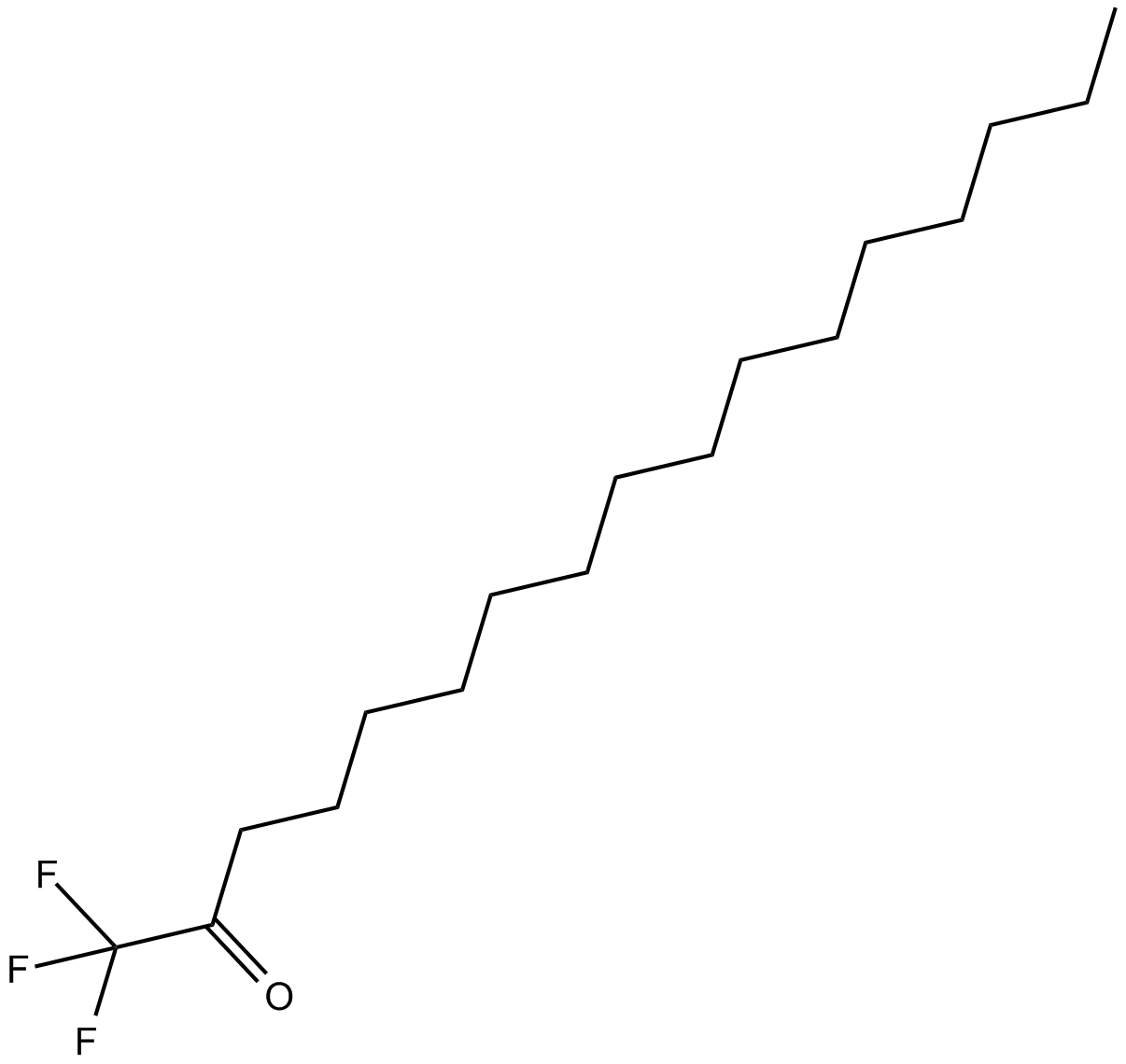
PACOCF3 (Synonyms: Pentadeca Trifluoromethyl Ketone, PTK) |
Catalog No.GC16714
 One-Click Copy Product Info
|

CPLA2 and iPLA2 inhibitor
Products are for research use only. Not for human use. We do not sell to patients.
Cas No.: 141022-99-3
Sample solution is provided at 25 µL, 10mM.
_1-3.$$$39978408@51.jpg');)
_1-9.$$$38538795@65.jpg');)
_1-9.$$$39112701@51.jpg');)
_1-7.$$$37316672@70.jpg');)
_366-372.$$$36198801@70.jpg');)
.$$$38565142@65.jpg');)
_1867-1883.$$$33248023@67.jpg');)
_eads6055.$$$39977546@45.jpg');)
_eadm9805.$$$40080571@45.jpg');)
_eadj3020.$$$39666821@45.jpg');)
_1-20.$$$39757301@28.jpg');)
_1-24.$$$38898113@28.jpg');)
_273-287.$$$36806353@46.jpg');)
_1-16.$$$37156877@44.jpg');)
_1-19.$$$37460805@44.jpg');)
_1291-1307.$$$34518654@46.jpg');)
PACOCF3 is a inhibitor of both Ca2+-dependent cytosolic cPLA2 and Ca2+-independent phospholipases A2 iPLA2 with IC50 values of 45 µM and 3.8 µM [1,2], which is an innovate and potential candidate drug for inflammation, atherosclerosis, diabetes mellitus, therapeutic shock, cancer therapyetc [3,4,5,6]. It has been reported that PACOCF3 can inhibit PLA2 and reduce the inflammatory response. PACOCF3 also can stimulate insulin release at basal glucose levels (2 mmol/l). Application of PACOCF3 can inhibit endogenous arachidonic acid generation which significantly decreased the amplitude of the insulin secretory response to 20 mmol/l glucose [7,8]. PACOCF3 have a dual protective role in diabetes which could minimize β-cell dysfunction while maintaining insulin secretory output through enhancing endogenous arachidonic acid levels.
References:
1. Murakami M et al.Emerging roles of secreted phospholipase A2 enzymes: The 3rd edition.Biochimie. 2014 Sep 16. pii: S0300-9084(14)00252-1.
2. Quach ND et al. Secretory phospholipase A2 enzymes as pharmacological targets for treatment of disease. Biochem Pharmacol. 2014 Aug 15;90(4):338-48.
3. Chalimoniuk M. Secretory phospholipase A2 and its role in oxidative stress and inflammation]. Postepy Biochem. 2012;58(2):204-8.
4. Persaud SJ.et al. The role of arachidonic acid and its metabolites in insulin secretion from human islets of langerhans. Diabetes. 2007 Jan;56(1):197-203.
5. Khakpour H et al. Lipoprotein-associated phospholipase A2: an independent predictor of cardiovascular risk and a novel target for immunomodulation therapy. Cardiol Rev. 2009 Sep-Oct;17(5):222-9.
6. Narendra Sharath Chandra JN1 et al. Chemistry and structural evaluation of different phospholipase A2 inhibitors in arachidonic acid pathway mediated inflammation and snake venom toxicity. Curr Top Med Chem. 2007;7(8):787-800.
7. Packard CJ. Lipoprotein-associated phospholipase A2 as a biomarker of coronary heart disease and a therapeutic target. Curr Opin Cardiol. 2009 Jul;24(4):358-63.
8. Lucas R et al. Synthesis and enzyme inhibitory activities of a series of lipidic diamine and aminoalcohol derivatives on cytosolic and secretory phospholipases A2. Bioorg Med Chem Lett. 2000 Feb 7;10(3):285-8.
| Cas No. | 141022-99-3 | SDF | |
| Synonyms | Pentadeca Trifluoromethyl Ketone, PTK | ||
| Chemical Name | 1,1,1-trifluoroheptadecan-2-one | ||
| Canonical SMILES | FC(F)(C(CCCCCCCCCCCCCCC)=O)F | ||
| Formula | C17H31F3O | M.Wt | 308.43 |
| Solubility | basic PBS: freely soluble,DMF: >50 mg/ml,DMSO: >30 mg/ml,Ethanol: >50 mg/ml,PBS pH 7.2: <50 µ g/ml (from ATK) | Storage | Desiccate at -20°C |
| General tips | Please select the appropriate solvent to prepare the stock solution according to the
solubility of the product in different solvents; once the solution is prepared, please store it in
separate packages to avoid product failure caused by repeated freezing and thawing.Storage method
and period of the stock solution: When stored at -80°C, please use it within 6 months; when stored
at -20°C, please use it within 1 month. To increase solubility, heat the tube to 37°C and then oscillate in an ultrasonic bath for some time. |
||
| Shipping Condition | Evaluation sample solution: shipped with blue ice. All other sizes available: with RT, or with Blue Ice upon request. | ||
| Prepare stock solution | |||

|
1 mg | 5 mg | 10 mg |
| 1 mM | 3.2422 mL | 16.2111 mL | 32.4223 mL |
| 5 mM | 648.4 μL | 3.2422 mL | 6.4845 mL |
| 10 mM | 324.2 μL | 1.6211 mL | 3.2422 mL |
Step 1: Enter information below (Recommended: An additional animal making an allowance for loss during the experiment)
 g
μL
g
μL
Step 2: Enter the in vivo formulation (This is only the calculator, not formulation. Please contact us first if there is no in vivo formulation at the solubility Section.)
Calculation results:
Working concentration: mg/ml;
Method for preparing DMSO master liquid: mg drug pre-dissolved in μL DMSO ( Master liquid concentration mg/mL, Please contact us first if the concentration exceeds the DMSO solubility of the batch of drug. )
Method for preparing in vivo formulation: Take μL DMSO master liquid, next addμL PEG300, mix and clarify, next addμL Tween 80, mix and clarify, next add μL saline, mix and clarify.
Method for preparing in vivo formulation: Take μL DMSO master liquid, next add μL Corn oil, mix and clarify.
Note: 1. Please make sure the liquid is clear before adding the next solvent.
2. Be sure to add the solvent(s) in order. You must ensure that the solution obtained, in the previous addition, is a clear solution before proceeding to add the next solvent. Physical methods such as vortex, ultrasound or hot water bath can be used to aid dissolving.
3. All of the above co-solvents are available for purchase on the GlpBio website.
Quality Control & SDS
- View current batch:
- Purity: >98.00% Appearance: A solution in ethanol
- COA (Certificate of Analysis)
- SDS (Safety Data Sheet)
- Datasheet
Average Rating: 5 (Based on Reviews and 3 reference(s) in Google Scholar.)