

PF-9363 (Synonyms: CTx-648) |
Catalog No.GC62247
 One-Click Copy Product Info
|

PF-9363 is a potent, selective, orally bioavailable KAT6A/B inhibitor with Ki values of 0.27nM and 2.4nM, respectively.
Products are for research use only. Not for human use. We do not sell to patients.
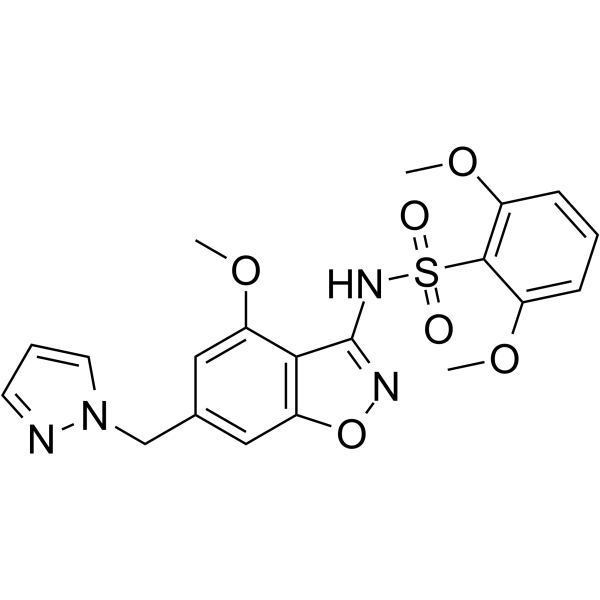
Cas No.: 2569009-58-9
Sample solution is provided at 25 µL, 10mM.
_1-3.$$$39978408@51.jpg');)
_1-9.$$$38538795@65.jpg');)
_1-9.$$$39112701@51.jpg');)
_1-7.$$$37316672@70.jpg');)
_366-372.$$$36198801@70.jpg');)
.$$$38565142@65.jpg');)
_1867-1883.$$$33248023@67.jpg');)
_eads6055.$$$39977546@45.jpg');)
_eadm9805.$$$40080571@45.jpg');)
_eadj3020.$$$39666821@45.jpg');)
_1-20.$$$39757301@28.jpg');)
_1-24.$$$38898113@28.jpg');)
_273-287.$$$36806353@46.jpg');)
_1-16.$$$37156877@44.jpg');)
_1-19.$$$37460805@44.jpg');)
_1291-1307.$$$34518654@46.jpg');)
PF-9363 is a potent, selective, orally bioavailable KAT6A/B inhibitor with Ki values of 0.27nM and 2.4nM, respectively [1]. PF-9363 targets KAT6A/B to cause the overall loss of H3K27ac and leads to the transcriptional downregulation of genes involved in the estrogen signaling pathway, cell cycle, E2F pathway, MYC signaling pathway, and epithelial-mesenchymal transition[2]. PF-9363 has been widely used to inhibit the growth of estrogen receptor positive (ER+) breast cancer cells and to prevent tumor progression in xenograft models[3].
In vitro, PF-9363 treatment (20μM) for 14 days significantly inhibited the growth of MOLM-13 cells and reduced the abundance of H3K23ac[4]. PF-9363 (1 μM) was applied to mouse ovarian tissues for 4 days, which significantly inhibited the activation of primordial follicles, reduced the number of primordial follicles, decreased the activity of the mTOR signaling pathway, and led to an increase in the accumulation of FOXO3a in the cell nucleus[5].
In vivo, PF-9363 treatment via daily intragastric administration at a dose of 5mg/kg for 28 days significantly inhibited the tumor volume in the neuroblastoma xenograft model of NSG mice[6]. Oral administration 1mg/kg of PF-9363 every day for 3 weeks significantly inhibited the growth of Phf6 mutant-driven leukemia cells in mice, and prolonged the survival time of mice that received transplanted Phf6R274X leukemia cells[7].
References:
[1] Sharma S, Chung C Y, Uryu S, et al. Discovery of a highly potent, selective, orally bioavailable inhibitor of KAT6A/B histone acetyltransferases with efficacy against KAT6A-high ER+ breast cancer[J]. Cell Chemical Biology, 2023, 30(10): 1191-1210. e20.
[2] Jeselsohn R, Polyak K. HATS off to KAT6A/B inhibitors: A new way to target estrogen-receptor-positive breast cancer[J]. Cell Chemical Biology, 2023, 30(10): 1183-1185.
[3] Sharma S, Chung J, Uryu S, et al. First-in-class KAT6A/KAT6B inhibitor CTx-648 (PF-9363) demonstrates potent anti-tumor activity in ER+ breast cancer with KAT6A dysregulation[J]. Cancer Res, 2021, 81(13_Supplement): 1130.
[4] Bishop T R, Subramanian C, Bilotta E M, et al. Acetyl-CoA biosynthesis drives resistance to histone acetyltransferase inhibition[J]. Nature chemical biology, 2023, 19(10): 1215-1222.
[5] Zhang Y, Nie X, Yang L, et al. The role of KAT6A in regulating primordial follicle activation in mouse ovary[J]. American Journal of Physiology-Cell Physiology, 2025, 329(1): C38-C49.
[6] Zimmerman M, Durbin A, Abraham B, et al. Abstract A020: Treatment of neuroblastoma with retinoic acid plus a KAT6A/B inhibitor induces sustained growth arrest and increases GD2 expression as a target for immunotherapy[J]. Cancer Research, 2025, 85(5_Supplement): A020-A020.
[7] Guo Y, Sui P, Yang H, et al. Phf6 truncating mutation drives leukemogenesis via disrupted epigenetic regulation in mice[J]. Leukemia, 2026: 1-15.
| Cell experiment [1]: | |
Cell lines | MOLM-13 cells |
Preparation Method | MOLM-13 cells were cultured in RPMI 1640 medium supplemented with 10% fetal bovine serum (FBS), 1% penicillin-streptomycin at 37℃ in the presence of 5% CO2. MOLM-13 cells were plated at a density of 2×10⁴ cells/well in 96-well plate with growth medium for 24h, and then were incubated with the different concentrations of PF-9363 (0, 5, 10 and 20µM) for 14 days, then analyzed the cell viability. |
Reaction Conditions | 0, 5, 10 and 20µM; 14 days |
Applications | PF-9363 treatment significantly reduced the cell viability of MOLM-13 cells in a concentration-dependent manner. |
| Animal experiment [2]: | |
Animal models | NSG mice |
Preparation Method | NSG mice were housed in temperature (23±2°C) and light-controlled (12:12-hour light-dark cycle) animal care facility with food and tap water ad libitum. HPB-ALL cells were cultured in RPMI-1640 medium and were xenografted into NSG mice by subcutaneous injection into the lower flank. When the tumors reached a volume of 200-250mm3, the mice were randomized into 2 groups that received either vehicle or 1mg/kg/day PF-9363 treatment by gavage. Tumor diameters were measured with digital calipers twice a week and the mice were sacrificed three-weeks after treatment. Tumor volume (mm3) was calculated using the formula: Volume = (width)2 × length/2. |
Dosage form | 1mg/kg/day for 3 weeks; p.o. |
Applications | PF-9363 treatment reduced the tumor size in HPB-ALL-bearing mice. |
References: | |
| Cas No. | 2569009-58-9 | SDF | |
| Synonyms | CTx-648 | ||
| Formula | C20H20N4O6S | M.Wt | 444.46 |
| Solubility | Storage | Store at -20°C | |
| General tips | Please select the appropriate solvent to prepare the stock solution according to the
solubility of the product in different solvents; once the solution is prepared, please store it in
separate packages to avoid product failure caused by repeated freezing and thawing.Storage method
and period of the stock solution: When stored at -80°C, please use it within 6 months; when stored
at -20°C, please use it within 1 month. To increase solubility, heat the tube to 37°C and then oscillate in an ultrasonic bath for some time. |
||
| Shipping Condition | Evaluation sample solution: shipped with blue ice. All other sizes available: with RT, or with Blue Ice upon request. | ||
| Prepare stock solution | |||

|
1 mg | 5 mg | 10 mg |
| 1 mM | 2.2499 mL | 11.2496 mL | 22.4992 mL |
| 5 mM | 450 μL | 2.2499 mL | 4.4998 mL |
| 10 mM | 225 μL | 1.125 mL | 2.2499 mL |
Step 1: Enter information below (Recommended: An additional animal making an allowance for loss during the experiment)
 g
μL
g
μL
Step 2: Enter the in vivo formulation (This is only the calculator, not formulation. Please contact us first if there is no in vivo formulation at the solubility Section.)
Calculation results:
Working concentration: mg/ml;
Method for preparing DMSO master liquid: mg drug pre-dissolved in μL DMSO ( Master liquid concentration mg/mL, Please contact us first if the concentration exceeds the DMSO solubility of the batch of drug. )
Method for preparing in vivo formulation: Take μL DMSO master liquid, next addμL PEG300, mix and clarify, next addμL Tween 80, mix and clarify, next add μL saline, mix and clarify.
Method for preparing in vivo formulation: Take μL DMSO master liquid, next add μL Corn oil, mix and clarify.
Note: 1. Please make sure the liquid is clear before adding the next solvent.
2. Be sure to add the solvent(s) in order. You must ensure that the solution obtained, in the previous addition, is a clear solution before proceeding to add the next solvent. Physical methods such as vortex, ultrasound or hot water bath can be used to aid dissolving.
3. All of the above co-solvents are available for purchase on the GlpBio website.
Quality Control & SDS
- View current batch:
- Purity: >98.00% Appearance: A solid
- COA (Certificate of Analysis)
- SDS (Safety Data Sheet)
- Datasheet
Average Rating: 5 (Based on Reviews and 36 reference(s) in Google Scholar.)