

Podophyllotoxin (Synonyms: NSC 24818, (-)-Podophyllotoxin, PPT) |
Catalog No.GC10521
 One-Click Copy Product Info
|

Podophyllotoxin is a naturally occurring lignan with important antineoplastic and antiviral properties.
Products are for research use only. Not for human use. We do not sell to patients.
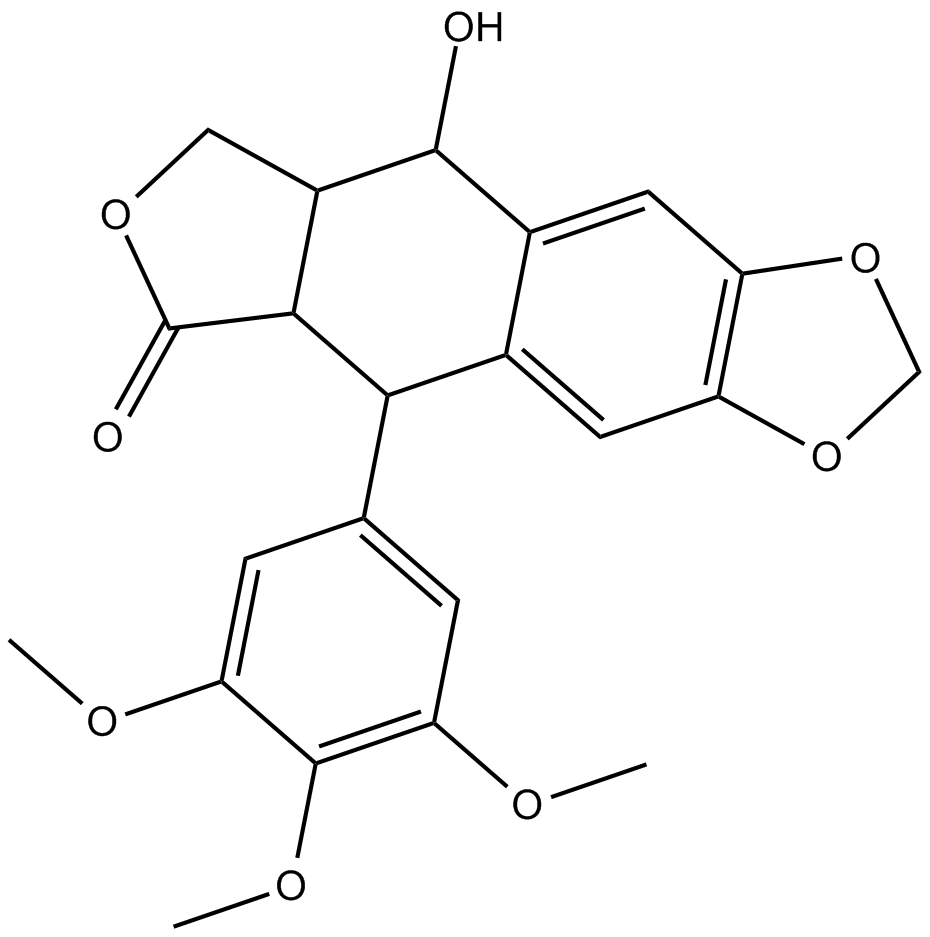
Cas No.: 518-28-5
Sample solution is provided at 25 µL, 10mM.
Podophyllotoxin is a naturally occurring lignan with important antineoplastic and antiviral properties [1]. Podophyllotoxin blocks cell proliferation by inhibiting the polymerisation of tubulin and arresting the cell cycle in metaphase [2]. Podophyllotoxin is used as a starting compound for the chemical synthesis of etoposide (VP16-213) and teniposide (VM-26), with antioxidant capacity [3]. Podophyllotoxin has been widely used to inhibit various cancer cells and regulate cell communication and signal transduction pathways[4].
In vitro, Podophyllotoxin treatment for 48 hours significantly inhibited the proliferation of A549 cells, A375 cells, and MCF-7 cells, with IC50 values of 3.75µM, 2.62 µM, and 1.18µM, respectively[5]. Treatment with 250nM Podophyllotoxin for 24 hours activated the DNA damage response, causing G2/M phase cell cycle arrest in HSC-3 cells and inducing cell apoptosis[6]. Treatment with 0.3µM Podophyllotoxin for 48 hours significantly inhibited the viability of HCT116 cells, upregulated the level of phosphorylated p38 mitogen-activated protein kinase (MAPK), and led to an increase in reactive oxygen species (ROS) production[7].
In vivo, Podophyllotoxin treatment via a single intraperitoneal injection at a dose of 45mg/kg for 24 hours can induce acute kidney injury (AKI) in SD rats, resulting in metabolic disorders of the kidneys and changes in protein expression in the rats, accompanied by elevated levels of serum creatinine and urea nitrogen[8].
References:
[1] Qian Liu Y, Yang L, Tian X. Podophyllotoxin: current perspectives[J]. Current Bioactive Compounds, 2007, 3(1): 37-66.
[2] Gordaliza M, Garcıa P A, Del Corral J M M, et al. Podophyllotoxin: distribution, sources, applications and new cytotoxic derivatives[J]. Toxicon, 2004, 44(4): 441-459.
[3] Li M, Zhou L, Yang D, et al. Biochemical composition and antioxidant capacity of extracts from Podophyllum hexandrum rhizome[J]. BMC complementary and alternative medicine, 2012, 12(1): 263.
[4] Guerram M, JIANG Z Z, Zhang L Y. Podophyllotoxin, a medicinal agent of plant origin: past, present and future[J]. Chinese Journal of Natural Medicines, 2012, 10(3): 161-169.
[5] Kamal A, Mallareddy A, Suresh P, et al. Synthesis and anticancer activity of 4β-alkylamidochalcone and 4β-cinnamido linked podophyllotoxins as apoptotic inducing agents[J]. European journal of medicinal chemistry, 2012, 47: 530-545.
[6] Choi S J, Kim J H, Kim H J, et al. Triggering mitotic catastrophe by podophyllotoxin induces apoptosis in oral squamous cell carcinoma[J]. Archives of Oral Biology, 2025: 106396.
[7] Lee S O, Joo S H, Kwak A W, et al. Podophyllotoxin induces ROS-mediated apoptosis and cell cycle arrest in human colorectal cancer cells via p38 MAPK signaling[J]. Biomolecules & Therapeutics, 2021, 29(6): 658.
[8] Zhang Y, Chen Z, He J, et al. Podophyllotoxin-induced acute kidney injury via the HMGB1/TLR4/MyD88/NF-κB axis in SD rats based on the toxicological evidence chain (TEC) concept via multiomic analysis[J]. International Immunopharmacology, 2025, 166: 115530.
| Cell experiment [1]: | |
Cell lines | A375 cells |
Preparation Method | A375 cells were grown in DMEM medium supplied with 10% fetal calf serum (FCS), 100U/ml penicillin, and 100μg/ml streptomycin at 37°C in 5% CO2/atmosphere. Cells (5×10³ cells/ml) were seeded in 96-well plates and allowed to adhere in a 5% CO2 incubator at 37°C overnight. Different concentrations of Podophyllotoxin (0, 0.1, 1, 5, 10, 20, 50, and 100μM) were treated for 48h, and the cell viability was analyzed. |
Reaction Conditions | 0, 0.1, 1, 5, 10, 20, 50, and 100μM; 48h |
Applications | Podophyllotoxin treatment significantly reduced the cell viability of A375 cells in a dose-dependent manner. |
| Animal experiment [2]: | |
Animal models | Male SD rats |
Preparation Method | Male SD rats had an average body weight of 200±10g and were kept under alternating 12-h light and dark cycles, an ambient temperature of 23±2°C, and a relative humidity of 55±5% with ad libitum access to water for 1 day. After 1 day, the rats were randomly divided into 3 groups (n=15): the blank control group (CON), the Podophyllotoxin group (45mg/kg), and the cisplatin-positive control group (10mg/kg). Podophyllotoxin was dissolved in dimethylsulfoxide and carboxymethylcellulose sodium, and the configured reagents were injected intraperitoneally. The kidneys of the rats were removed after 24 hours for analysis. |
Dosage form | 45mg/kg for once; i.p. |
Applications | Podophyllotoxin treatment induced AKI in rats and caused metabolic disruptions and alterations in protein expression within the kidneys of rats. |
References: | |
| Cas No. | 518-28-5 | SDF | |
| Synonyms | NSC 24818, (-)-Podophyllotoxin, PPT | ||
| Chemical Name | 9-hydroxy-5-(3,4,5-trimethoxyphenyl)-5,5a,8a,9-tetrahydrofuro[3',4':6,7]naphtho[2,3-d][1,3]dioxol-6(8H)-one | ||
| Canonical SMILES | COC1=CC(C2C3C(C(O)C4=CC5=C(OCO5)C=C24)COC3=O)=CC(OC)=C1OC | ||
| Formula | C22H22O8 | M.Wt | 414.41 |
| Solubility | DMF: 15 mg/ml,DMSO: 15 mg/ml,DMSO:PBS(pH 7.2) (1:3): 0.25 mg/ml,Ethanol: 0.14 mg/ml,PBS (pH 7.2): slightly soluble | Storage | Store at 2-8°C |
| General tips | Please select the appropriate solvent to prepare the stock solution according to the
solubility of the product in different solvents; once the solution is prepared, please store it in
separate packages to avoid product failure caused by repeated freezing and thawing.Storage method
and period of the stock solution: When stored at -80°C, please use it within 6 months; when stored
at -20°C, please use it within 1 month. To increase solubility, heat the tube to 37°C and then oscillate in an ultrasonic bath for some time. |
||
| Shipping Condition | Evaluation sample solution: shipped with blue ice. All other sizes available: with RT, or with Blue Ice upon request. | ||
| Prepare stock solution | |||

|
1 mg | 5 mg | 10 mg |
| 1 mM | 2.4131 mL | 12.0653 mL | 24.1307 mL |
| 5 mM | 482.6 μL | 2.4131 mL | 4.8261 mL |
| 10 mM | 241.3 μL | 1.2065 mL | 2.4131 mL |
Step 1: Enter information below (Recommended: An additional animal making an allowance for loss during the experiment)
 g
μL
g
μL
Step 2: Enter the in vivo formulation (This is only the calculator, not formulation. Please contact us first if there is no in vivo formulation at the solubility Section.)
Calculation results:
Working concentration: mg/ml;
Method for preparing DMSO master liquid: mg drug pre-dissolved in μL DMSO ( Master liquid concentration mg/mL, Please contact us first if the concentration exceeds the DMSO solubility of the batch of drug. )
Method for preparing in vivo formulation: Take μL DMSO master liquid, next addμL PEG300, mix and clarify, next addμL Tween 80, mix and clarify, next add μL saline, mix and clarify.
Method for preparing in vivo formulation: Take μL DMSO master liquid, next add μL Corn oil, mix and clarify.
Note: 1. Please make sure the liquid is clear before adding the next solvent.
2. Be sure to add the solvent(s) in order. You must ensure that the solution obtained, in the previous addition, is a clear solution before proceeding to add the next solvent. Physical methods such as vortex, ultrasound or hot water bath can be used to aid dissolving.
3. All of the above co-solvents are available for purchase on the GlpBio website.
Quality Control & SDS
- View current batch:
- Purity: >99.50% Appearance: A solid
- COA (Certificate of Analysis)
- SDS (Safety Data Sheet)
- Datasheet
Average Rating: 5 (Based on Reviews and 30 reference(s) in Google Scholar.)