

PRI-724 (Synonyms: Foscenvivint) |
Catalog No.GC61205
 One-Click Copy Product Info
|

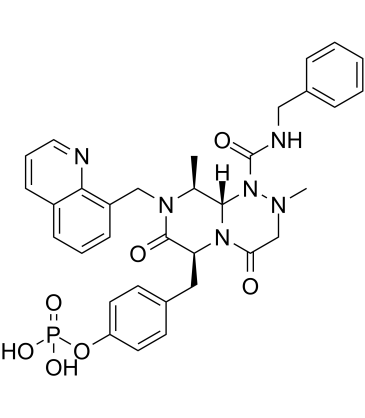
PRI-724 (C-82 prodrug, ICG-001 analog) is a first-in-class Wnt signaling modulator that inhibits the interaction between cAMP response element (CREB) binding protein and β-catenin.
Products are for research use only. Not for human use. We do not sell to patients.
Cas No.: 1422253-38-0
Sample solution is provided at 25 µL, 10mM.
_1-3.$$$39978408@51.jpg');)
_1-9.$$$38538795@65.jpg');)
_1-9.$$$39112701@51.jpg');)
_1-7.$$$37316672@70.jpg');)
_366-372.$$$36198801@70.jpg');)
.$$$38565142@65.jpg');)
_1867-1883.$$$33248023@67.jpg');)
_eads6055.$$$39977546@45.jpg');)
_eadm9805.$$$40080571@45.jpg');)
_eadj3020.$$$39666821@45.jpg');)
_1-20.$$$39757301@28.jpg');)
_1-24.$$$38898113@28.jpg');)
_273-287.$$$36806353@46.jpg');)
_1-16.$$$37156877@44.jpg');)
_1-19.$$$37460805@44.jpg');)
_1291-1307.$$$34518654@46.jpg');)
PRI-724 (C-82 prodrug, ICG-001 analog) is a first-in-class Wnt signaling modulator that inhibits the interaction between cAMP response element (CREB) binding protein and β-catenin[1]. The Wnt signaling pathway is a complex protein action network, whose functions are most commonly seen in embryonic development and cancer, but also involved in normal physiological processes in adult animals[2]. PRI-724 has anti-tumor and anti-fibrotic activities[3, 4].
In vitro, PRI-724 (25μM) treatment of human osteosarcoma cell line (SJSA-1 cells) for 24h significantly inhibited cell migration and invasion, and reduced the expression level of G1/S-specific cyclin D1 (Cyclind1)[5]. PRI-724 (0-40μM) treated head and neck squamous cell carcinoma (HNSCC) cell lines (Cal 27 and FADU cells) and significantly inhibited cell growth, with IC50 values of 8.3μM and 14.6μM for Cal 27 and FADU cells, respectively[6].
In vivo, PRI-724 (10mg/kg) was subcutaneously implanted via osmotic minipumps to treat mice with bleomycin-induced pulmonary fibrosis, which improved lung fibrosis, reduced the number of alveolar macrophages, and decreased the level of TGF-β1 in bronchoalveolar fluid (BALF)[7].
References:
[1] El-Khoueiry A B, Ning Y, Yang D, et al. A phase I first-in-human study of PRI-724 in patients (pts) with advanced solid tumors[J]. 2013.
[2] Anastas J N, Moon R T. WNT signalling pathways as therapeutic targets in cancer[J]. Nature Reviews Cancer, 2013, 13(1): 11-26.
[3] Gabata R, Harada K, Mizutani Y, et al. Anti-tumor activity of the small molecule inhibitor PRI-724 against β-catenin-activated hepatocellular carcinoma[J]. Anticancer research, 2020, 40(9): 5211-5219.
[4] Osawa Y, Oboki K, Imamura J, et al. Inhibition of cyclic adenosine monophosphate (cAMP)-response element-binding protein (CREB)-binding protein (CBP)/β-catenin reduces liver fibrosis in mice[J]. EBioMedicine, 2015, 2(11): 1751-1758.
[5] Fang F, VanCleave A, Helmuth R, et al. Targeting the Wnt/β-catenin pathway in human osteosarcoma cells[J]. Oncotarget, 2018, 9(95): 36780.
[6] Kleszcz R, Frąckowiak M, Dorna D, et al. Combinations of PRI-724 Wnt/β-Catenin Pathway Inhibitor with Vismodegib, Erlotinib, or HS-173 Synergistically Inhibit Head and Neck Squamous Cancer Cells[J]. International Journal of Molecular Sciences, 2023, 24(13): 10448.
[7] Okazaki H, Sato S, Koyama K, et al. The novel inhibitor PRI-724 for Wnt/β-catenin/CBP signaling ameliorates bleomycin-induced pulmonary fibrosis in mice[J]. Experimental lung research, 2019, 45(7): 188-199.
| Cell experiment [1]: | |
|
Cell lines |
SJSA-1 cells |
|
Preparation Method |
The in vitro migration and invasion assays were carried out using the 8μm pore-sized Transwell chamber system. Prior to loading the cells into the upper chamber, the lower chamber was filled with medium containing 10% FBS with 25μM PRI-724 or DMSO. Cells were starved overnight and added to serum-free medium containing 25μM PRI-724 or DMSO in the upper chamber at a concentration of 4×10⁴ cells per well. For invasion assays, membranes were coated with a layer of 0.2mg/mL Matrigel. After incubation for 24h, the cells on the upper surface of the well were removed completely by a Q-tip. The wells were fixed in 10% formalin and stained with Crystal violet. The plate with inserts were then imaged with an upright microscope and the relative number of cells that migrated through the Transwell pores was quantified using NIH ImageJ. |
|
Reaction Conditions |
25μM; 24h |
|
Applications |
PRI-724 significantly suppressed SJSA-1 cell migration by about 40% and invasion by about 30%, compared to control levels. |
| Animal experiment [2]: | |
|
Animal models |
C57BL/6 mice |
|
Preparation Method |
Bleomycin sulfate (mixture) was dissolved in sterile saline and injected via oropharyngeal aspiration at a dose of 1.25mg/kg of Bleomycin in a total volume of 50mL of saline. During the injection process, mice were anesthetized with 2.5% isoflurane delivered in a box. Mice were sus penned vertically on a stand for oropharyngeal aspiration. Osmotic minipumps containing PBS or 1 or 10mg/kg/day of PRI-724 were implanted subcutaneously. Alveolar macrophage isolation BAL was conducted for mice treated by Bleomycin 7 days after administration. BAL fluid (BALF) was collected on days 28 and 35 after Bleomycin injection, and centrifuged at 1000rpm for 10min. |
|
Dosage form |
10mg/kg; s.c. |
|
Applications |
The administration of PRI-724 ameliorated pulmonary fibrosis induced by Bleomycin in mice when administered with a late, but not an early, treatment schedule. Analysis of bronchoalveolar fluid (BALF) showed a decreased number of alveolar macrophages. In addition, the level of TGF-β1 in BALF was decreased in mice treated with PRI-724. PRI-724 also inhibited the production of TGF-β1 by alveolar macrophages. |
|
References: |
|
| Cas No. | 1422253-38-0 | SDF | |
| Synonyms | Foscenvivint | ||
| Canonical SMILES | O=C(N([C@]([C@H](C)N1CC2=C3N=CC=CC3=CC=C2)([H])N4[C@@H](CC5=CC=C(OP(O)(O)=O)C=C5)C1=O)N(C)CC4=O)NCC6=CC=CC=C6 | ||
| Formula | C33H35N6O7P | M.Wt | 658.64 |
| Solubility | Storage | 4°C, protect from light | |
| General tips | Please select the appropriate solvent to prepare the stock solution according to the
solubility of the product in different solvents; once the solution is prepared, please store it in
separate packages to avoid product failure caused by repeated freezing and thawing.Storage method
and period of the stock solution: When stored at -80°C, please use it within 6 months; when stored
at -20°C, please use it within 1 month. To increase solubility, heat the tube to 37°C and then oscillate in an ultrasonic bath for some time. |
||
| Shipping Condition | Evaluation sample solution: shipped with blue ice. All other sizes available: with RT, or with Blue Ice upon request. | ||
| Prepare stock solution | |||

|
1 mg | 5 mg | 10 mg |
| 1 mM | 1.5183 mL | 7.5914 mL | 15.1828 mL |
| 5 mM | 303.7 μL | 1.5183 mL | 3.0366 mL |
| 10 mM | 151.8 μL | 759.1 μL | 1.5183 mL |
Step 1: Enter information below (Recommended: An additional animal making an allowance for loss during the experiment)
 g
μL
g
μL
Step 2: Enter the in vivo formulation (This is only the calculator, not formulation. Please contact us first if there is no in vivo formulation at the solubility Section.)
Calculation results:
Working concentration: mg/ml;
Method for preparing DMSO master liquid: mg drug pre-dissolved in μL DMSO ( Master liquid concentration mg/mL, Please contact us first if the concentration exceeds the DMSO solubility of the batch of drug. )
Method for preparing in vivo formulation: Take μL DMSO master liquid, next addμL PEG300, mix and clarify, next addμL Tween 80, mix and clarify, next add μL saline, mix and clarify.
Method for preparing in vivo formulation: Take μL DMSO master liquid, next add μL Corn oil, mix and clarify.
Note: 1. Please make sure the liquid is clear before adding the next solvent.
2. Be sure to add the solvent(s) in order. You must ensure that the solution obtained, in the previous addition, is a clear solution before proceeding to add the next solvent. Physical methods such as vortex, ultrasound or hot water bath can be used to aid dissolving.
3. All of the above co-solvents are available for purchase on the GlpBio website.
Quality Control & SDS
- View current batch:
- Purity: >99.00% Appearance: A solid
- COA (Certificate of Analysis)
- SDS (Safety Data Sheet)
- Datasheet
Average Rating: 5 (Based on Reviews and 33 reference(s) in Google Scholar.)