

Rbin-1 (Synonyms: Ribozinoindole-1) |
Catalog No.GC15407
 One-Click Copy Product Info
|

eukaryotic ribosome assembly inhibitor
Products are for research use only. Not for human use. We do not sell to patients.
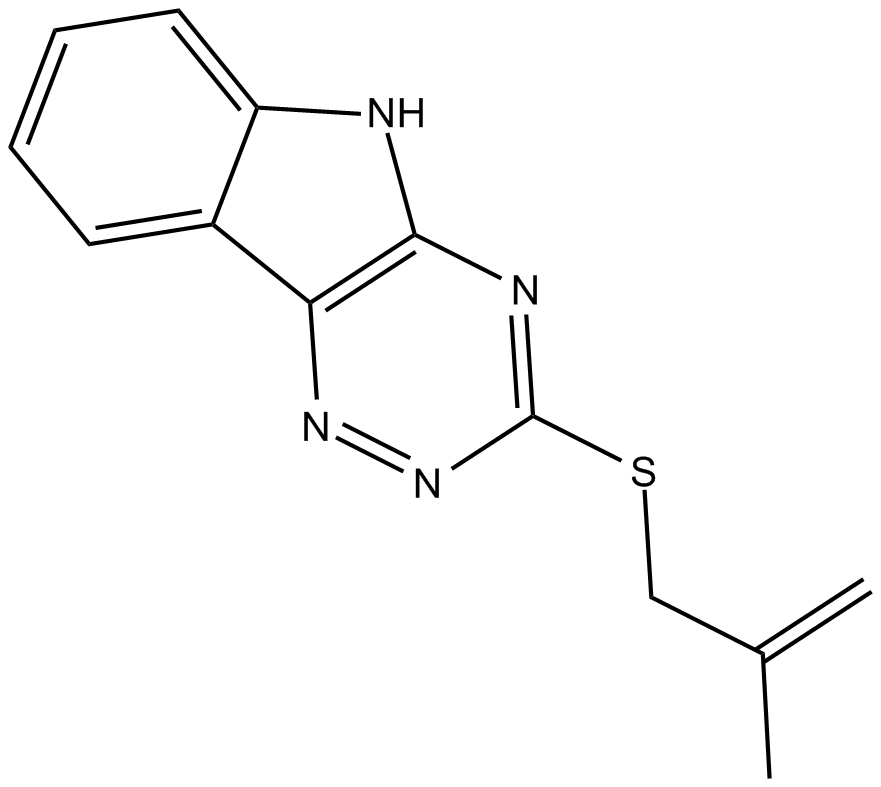
Cas No.: 328023-11-6
Sample solution is provided at 25 µL, 10mM.
_1-3.$$$39978408@51.jpg');)
_1-9.$$$38538795@65.jpg');)
_1-9.$$$39112701@51.jpg');)
_1-7.$$$37316672@70.jpg');)
_366-372.$$$36198801@70.jpg');)
.$$$38565142@65.jpg');)
_1867-1883.$$$33248023@67.jpg');)
_eads6055.$$$39977546@45.jpg');)
_eadm9805.$$$40080571@45.jpg');)
_eadj3020.$$$39666821@45.jpg');)
_1-20.$$$39757301@28.jpg');)
_1-24.$$$38898113@28.jpg');)
_273-287.$$$36806353@46.jpg');)
_1-16.$$$37156877@44.jpg');)
_1-19.$$$37460805@44.jpg');)
_1291-1307.$$$34518654@46.jpg');)
Rbin-1 is an eukaryotic ribosome assembly inhibitor.
All cellular proteins are synthesized by ribosomes, whose biogenesis is a complex multi-step process quickly completed in eukaryotes. Several chemical inhibitors of ribosome function are available, however, potent validated chemical probes are still lacking to analyze the dynamics of eukaryotic ribosome assembly.
In vitro: In the mode of action study of Rbin-1, the MDR-sup fission yeast cells was chemically mutagenized and the resistant clones that can grow in the presence of Rbin-1 were isolated. Results found that each of the 13 Rbin-1 resistant clones had one of five different point mutations in the mdn1 gene. It was further confirmed that, using overexpression on plasmids in MDR-sup cells and by replacement of endogenous mdn1 in wild-type cells, all the identified mutations were enough to confer resistance to Rbin-1. In addition, Rbin-1 at 1 μM was able to inhibit the ATPase activity by around 40%. Moreover, the nuclear export of the pre-40S subunits that were tracked using two different reporters, Rps3- GFP and Rps2-GFP, could not be blocked in Rbin-1-treated cells, suggesting that Mdn1 had specific roles in pre-60S ribosome assembly [1].
In vivo: So far, there is no animal in vivo data reported.
Clinical trial: Up to now, Rbin-1 is still in the preclinical development stage.
Reference:
[1] Kawashima SA, Chen Z, Aoi Y, Patgiri A, Kobayashi Y, Nurse P, Kapoor TM. Potent, Reversible, and Specific Chemical Inhibitors of Eukaryotic Ribosome Biogenesis. Cell. 2016 Oct 6;167(2):512-524.e14.
Kinase experiment: | Radioactive γ-P32-ATP is added to 600 mM MgATP (pH=7) solutions at volume ratios of 1:1000-1:300, depending on the lifetime of the radioactive reagent. The total volume of each reaction is 12 mL, including 6 ml of protein from size exclusion chromatography fractions (final concentration 0-50 nM for different fractions, peak fractions are used for Rbin-1 and AMPPNP inhibition), 4 mL FPLC SEC buffer with 0.6 mM Na2SO4 and 2 mL MgATP (final concentration=100 mM). The reactions are then incubated at room temperature for 30 or 60 min before quenching with 12 mL 0.2 M EDTA. 1 mL from each reaction mixture is spotted on to TLC PEI cellulose F plates. The TLC buffer contained 0.15 M formic acid and 0.15 M lithium chloride. The TLC plates are then imaged using the Typhoon Scanner 9400. ImageJ is used to calculate the densitometric ratio of the spots corresponding to radioactive free phosphate and ATP to determine the percent of ATP hydrolyzed[1]. |
References: [1]. Kawashima SA, et al. Potent, Reversible, and Specific Chemical Inhibitors of Eukaryotic Ribosome Biogenesis. Cell. 2016 Oct 6;167(2):512-524.e14. | |
| Cas No. | 328023-11-6 | SDF | |
| Synonyms | Ribozinoindole-1 | ||
| Chemical Name | 3-((2-methylallyl)thio)-5H-[1,2,4]triazino[5,6-b]indole | ||
| Canonical SMILES | C=C(C)CSC1=NC2=C(N=N1)C3=CC=CC=C3N2 | ||
| Formula | C13H12N4S | M.Wt | 256.33 |
| Solubility | DMF: 5 mg/ml,DMSO: 25 mg/ml | Storage | Store at -20°C |
| General tips | Please select the appropriate solvent to prepare the stock solution according to the
solubility of the product in different solvents; once the solution is prepared, please store it in
separate packages to avoid product failure caused by repeated freezing and thawing.Storage method
and period of the stock solution: When stored at -80°C, please use it within 6 months; when stored
at -20°C, please use it within 1 month. To increase solubility, heat the tube to 37°C and then oscillate in an ultrasonic bath for some time. |
||
| Shipping Condition | Evaluation sample solution: shipped with blue ice. All other sizes available: with RT, or with Blue Ice upon request. | ||
| Prepare stock solution | |||

|
1 mg | 5 mg | 10 mg |
| 1 mM | 3.9012 mL | 19.5061 mL | 39.0122 mL |
| 5 mM | 780.2 μL | 3.9012 mL | 7.8024 mL |
| 10 mM | 390.1 μL | 1.9506 mL | 3.9012 mL |
Step 1: Enter information below (Recommended: An additional animal making an allowance for loss during the experiment)
 g
μL
g
μL
Step 2: Enter the in vivo formulation (This is only the calculator, not formulation. Please contact us first if there is no in vivo formulation at the solubility Section.)
Calculation results:
Working concentration: mg/ml;
Method for preparing DMSO master liquid: mg drug pre-dissolved in μL DMSO ( Master liquid concentration mg/mL, Please contact us first if the concentration exceeds the DMSO solubility of the batch of drug. )
Method for preparing in vivo formulation: Take μL DMSO master liquid, next addμL PEG300, mix and clarify, next addμL Tween 80, mix and clarify, next add μL saline, mix and clarify.
Method for preparing in vivo formulation: Take μL DMSO master liquid, next add μL Corn oil, mix and clarify.
Note: 1. Please make sure the liquid is clear before adding the next solvent.
2. Be sure to add the solvent(s) in order. You must ensure that the solution obtained, in the previous addition, is a clear solution before proceeding to add the next solvent. Physical methods such as vortex, ultrasound or hot water bath can be used to aid dissolving.
3. All of the above co-solvents are available for purchase on the GlpBio website.
Quality Control & SDS
- View current batch:
- Purity: >99.50% Appearance: A solid
- COA (Certificate of Analysis)
- SDS (Safety Data Sheet)
- Datasheet
Average Rating: 5 (Based on Reviews and 7 reference(s) in Google Scholar.)