

UCPH-101 |
Catalog No.GC19365
 One-Click Copy Product Info
|

UCPH-101 is an inhibitor of Excitatory Amino Acid Transporter 1 (EAAT1), with an IC50 value of 0.66μM.
Products are for research use only. Not for human use. We do not sell to patients.
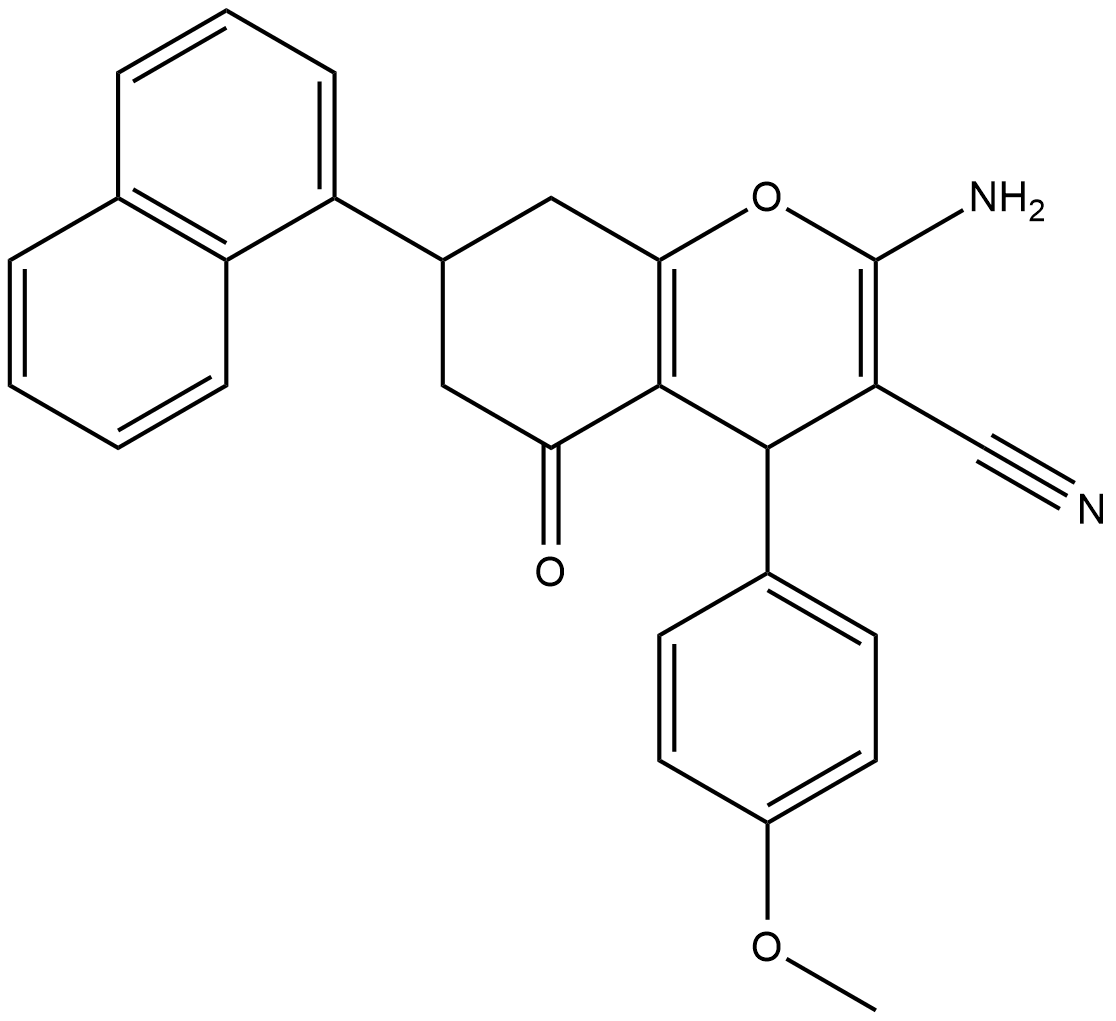
Cas No.: 1118460-77-7
Sample solution is provided at 25 µL, 10mM.
_1-3.$$$39978408@51.jpg');)
_1-9.$$$38538795@65.jpg');)
_1-9.$$$39112701@51.jpg');)
_1-7.$$$37316672@70.jpg');)
_366-372.$$$36198801@70.jpg');)
.$$$38565142@65.jpg');)
_1867-1883.$$$33248023@67.jpg');)
_eads6055.$$$39977546@45.jpg');)
_eadm9805.$$$40080571@45.jpg');)
_eadj3020.$$$39666821@45.jpg');)
_1-20.$$$39757301@28.jpg');)
_1-24.$$$38898113@28.jpg');)
_273-287.$$$36806353@46.jpg');)
_1-16.$$$37156877@44.jpg');)
_1-19.$$$37460805@44.jpg');)
_1291-1307.$$$34518654@46.jpg');)
UCPH-101 is an inhibitor of Excitatory Amino Acid Transporter 1 (EAAT1), with an IC50 value of 0.66μM[1]. UCPH-101 acts as a slow-binding, non-competitive EAAT1 inhibitor; it blocks the translocation step within the transport cycle rather than other partial reactions[2]. UCPH-101 is capable of blocking the neuroprotective effects of dexmedetomidine and guanfacine[3]. UCPH-101 induces glioblastoma cell death by promoting the intracellular accumulation of glutamate and has been shown to significantly improve survival in mouse models of glioma[4].
In vitro, treatment of murine MA9-1 cells and human U937 cells with UCPH-101 (20μM) for 6-24 hours significantly increased apoptotic levels in both cell lines, resulting in a decrease in cells in the G1 phase and a corresponding increase in cells in the S and G2/M phases[5]. Treatment of GL261-NS cells, GBM-NS cells, and astrocytes with UCPH-101 (10μM) significantly elevated apoptotic levels in the GL261-NS and GBM-NS cells, while having no effect on the apoptotic levels of the astrocytes[6].
In vivo, intracranial administration of UCPH-101 (10nmol/μL) to mice bearing glioma xenografts significantly improved survival rates. Furthermore, the treatment significantly disrupted the tissue architecture of the brain gliomas, significantly downregulated the expression levels of the glutamate-aspartate transporter (GLAST) within the tumor tissue, and significantly upregulated the expression levels of cleaved Caspase-3[6].
References:
[1] Huynh T H V, Abrahamsen B, Madsen K K, et al. Design, synthesis and pharmacological characterization of coumarin-based fluorescent analogs of excitatory amino acid transporter subtype 1 selective inhibitors, UCPH-101 and UCPH-102[J]. Bioorganic & medicinal chemistry, 2012, 20(23): 6831-6839.
[2] Dong Y. Functional Studies of Amino Acid Transporters from the Solute Carrier SLC1 and SLC38 Families[D]. State University of New York at Binghamton, 2024.
[3] Mei B, Xu X, Weng J, et al. Activating astrocytic α2A adrenoceptors in hippocampus reduces glutamate toxicity to attenuate sepsis-associated encephalopathy in mice[J]. Brain, Behavior, and Immunity, 2024, 117: 376-398.
[4] Corbetta C, Di Ianni N, Bruzzone M G, et al. Altered function of the glutamate aspartate transporter GLAST in glioblastoma[J]. bioRxiv, 2018: 287623.
[5] Tirado H A, Balasundaram N, Jacobs J, et al. The EAAT1 aspartate/glutamate transporter is dispensable for acute myeloid leukemia cell growth and response to therapy[J]. Plos one, 2026, 21(2): e0329048.
[6] Corbetta C, Di Ianni N, Bruzzone M G, et al. Altered function of the glutamate–aspartate transporter GLAST, a potential therapeutic target in glioblastoma[J]. International journal of cancer, 2019, 144(10): 2539-2554.
| Cell experiment [1]: | |
Cell lines | Mouse MA9-1 and human U937 cell line |
Preparation Method | Mouse MA9-1 cells and human U937 cells were cultured separately and subsequently treated with UCPH-101 at a final concentration of 20µM. After 24h of treatment, the cells were harvested, and apoptosis was detected via flow cytometry using Annexin V-FITC/PI double staining; a treatment group with 250µM TFB-TBOA was included as a control. An additional group of cells was treated with 20µM UCPH-101 for 6h, followed by fixation and PI staining, to analyze cell cycle distribution via flow cytometry. |
Reaction Conditions | 20µM; 6, 24h |
Applications | Following treatment with 20µM UCPH-101 for 24h, apoptosis increased in both murine MA9-1 cells and human U937 cells; conversely, treatment with 250µM TFB-TBOA did not affect cell viability. Cell cycle analysis revealed that UCPH-101 resulted in a decrease in cells in the G1 phase, accompanied by a corresponding increase in cells in the S and G2/M phases. |
| Animal experiment [2]: | |
Animal models | Female C57BL/6 N mice、CD1 nude mice |
Preparation Method | Five weeks-old female C57BL/6 N (n=10/group for survival studies) and CD1 nude (nude CD1 (HO): CD1-Foxn1nu) mice (n=7/group for survival studies) were intracranially injected with 1×10⁵ GL261-NS or GSCs respectively, in 2μL PBS 1×. The coordinates, with respect to the bregma, were 0.7mm post, 3mm left lateral, 3.5mm deep, and within the nucleus caudatum. Five weeks-old female CD1 nude mice (n=7/group for survival, n=3/group for histolog ical studies); were intracranially injected with 1×10⁵ scram bled or shGLAST GSCs. Five weeks-old female C57BL/6 N mice (n = 7/group for survival analysis; n=4 for histological studies) were injected with 1×10⁵ GL261-NS and treated with 10nmol/μL of UCPH-101 or DMSO as the negative control, 9 days after tumor implantation. For survival studies mice were monitored every day and when suf fering euthanized; for histological studies mice brains were collected and fixed in 4% paraformaldehyde. |
Dosage form | 10nmol/μL; intracranially injected |
Applications | In glioma-bearing mice, a single intratumoral injection of UCPH-101 significantly increased survival by decreasing GLAST expression and inducing apoptosis. |
References: | |
| Cas No. | 1118460-77-7 | SDF | |
| Canonical SMILES | O=C(C1)C2=C(OC(N)=C(C#N)C2C3=CC=C(OC)C=C3)CC1C4=CC=CC5=C4C=CC=C5 | ||
| Formula | C27H22N2O3 | M.Wt | 422.48 |
| Solubility | DMSO : ≥ 110 mg/mL (260.37 mM) | Storage | Store at -20°C |
| General tips | Please select the appropriate solvent to prepare the stock solution according to the
solubility of the product in different solvents; once the solution is prepared, please store it in
separate packages to avoid product failure caused by repeated freezing and thawing.Storage method
and period of the stock solution: When stored at -80°C, please use it within 6 months; when stored
at -20°C, please use it within 1 month. To increase solubility, heat the tube to 37°C and then oscillate in an ultrasonic bath for some time. |
||
| Shipping Condition | Evaluation sample solution: shipped with blue ice. All other sizes available: with RT, or with Blue Ice upon request. | ||
| Prepare stock solution | |||

|
1 mg | 5 mg | 10 mg |
| 1 mM | 2.367 mL | 11.8349 mL | 23.6698 mL |
| 5 mM | 473.4 μL | 2.367 mL | 4.734 mL |
| 10 mM | 236.7 μL | 1.1835 mL | 2.367 mL |
Step 1: Enter information below (Recommended: An additional animal making an allowance for loss during the experiment)
 g
μL
g
μL
Step 2: Enter the in vivo formulation (This is only the calculator, not formulation. Please contact us first if there is no in vivo formulation at the solubility Section.)
Calculation results:
Working concentration: mg/ml;
Method for preparing DMSO master liquid: mg drug pre-dissolved in μL DMSO ( Master liquid concentration mg/mL, Please contact us first if the concentration exceeds the DMSO solubility of the batch of drug. )
Method for preparing in vivo formulation: Take μL DMSO master liquid, next addμL PEG300, mix and clarify, next addμL Tween 80, mix and clarify, next add μL saline, mix and clarify.
Method for preparing in vivo formulation: Take μL DMSO master liquid, next add μL Corn oil, mix and clarify.
Note: 1. Please make sure the liquid is clear before adding the next solvent.
2. Be sure to add the solvent(s) in order. You must ensure that the solution obtained, in the previous addition, is a clear solution before proceeding to add the next solvent. Physical methods such as vortex, ultrasound or hot water bath can be used to aid dissolving.
3. All of the above co-solvents are available for purchase on the GlpBio website.
Quality Control & SDS
- View current batch:
- Purity: >98.50% Appearance: A solid
- COA (Certificate of Analysis)
- SDS (Safety Data Sheet)
- Datasheet
Average Rating: 5 (Based on Reviews and 8 reference(s) in Google Scholar.)