

Rhodamine B (Basic Violet 10) |
Catalog No.GC30172
 One-Click Copy Product Info
|

Rhodamine B (Basic Violet 10) is a fluorescent dye used as a tracer dye in water to determine the rate and direction of flow and transport, with excitation/emission maxima at 568/583nm.
Products are for research use only. Not for human use. We do not sell to patients.
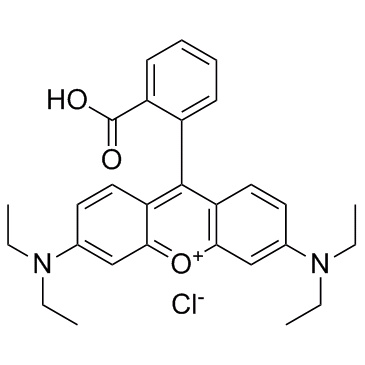
Cas No.: 81-88-9
Sample solution is provided at 25 µL, 10mM.
_1-3.$$$39978408@51.jpg');)
_1-9.$$$38538795@65.jpg');)
_1-9.$$$39112701@51.jpg');)
_1-7.$$$37316672@70.jpg');)
_366-372.$$$36198801@70.jpg');)
.$$$38565142@65.jpg');)
_1867-1883.$$$33248023@67.jpg');)
_eads6055.$$$39977546@45.jpg');)
_eadm9805.$$$40080571@45.jpg');)
_eadj3020.$$$39666821@45.jpg');)
_1-20.$$$39757301@28.jpg');)
_1-24.$$$38898113@28.jpg');)
_273-287.$$$36806353@46.jpg');)
_1-16.$$$37156877@44.jpg');)
_1-19.$$$37460805@44.jpg');)
_1291-1307.$$$34518654@46.jpg');)
Rhodamine B (Basic Violet 10) is a fluorescent dye used as a tracer dye in water to determine the rate and direction of flow and transport, with excitation/emission maxima at 568/583nm[1, 2]. Rhodamine B is commonly used in fluorescence microscopy, flow cytometry, fluorescence correlation spectroscopy and ELISA in biotechnology experiments. It can be used to label organelles or cell membranes, and can also be coupled to antibodies to detect the presence and quantity of specific proteins[3, 4]. Rhodamine B is commonly used in industry for dyeing textiles, paper, soap, leather, and pharmaceuticals[5].
References:
[1] Field M S, Wilhelm R G, Quinlan J F, et al. An assessment of the potential adverse properties of fluorescent tracer dyes used for groundwater tracing[J]. Environmental Monitoring and Assessment, 1995, 38: 75-96.
[2] Stobiecka M, Hepel M. Multimodal coupling of optical transitions and plasmonic oscillations in rhodamine B modified gold nanoparticles[J]. Physical Chemistry Chemical Physics, 2011, 13(3): 1131-1139.
[3] Brulikova L, Krupkova S, Labora M, et al. Synthesis and study of novel pH-independent fluorescent mitochondrial labels based on Rhodamine B[J]. RSC advances, 2016, 6(28): 23242-23251.
[4] Ullman E F, Schwarzberg M, Rubenstein K E. Fluorescent excitation transfer immunoassay. A general method for determination of antigens[J]. Journal of Biological Chemistry, 1976, 251(14): 4172-4178.
[5] Farhan A M, Zaghair A M, Abdullah H I. Adsorption Study of Rhodamine–B Dye on Plant (Citrus Leaves)[J]. Baghdad Science Journal, 2022, 19(4): 0838-0838.
This plan only provides a guide, please modify it to meet your specific needs.
1. Solution preparation
(1) Stock solution: Dissolve Rhodamine B in DMSO to prepare a stock solution with a concentration of 10mM.
Note: It is recommended that unused stock solution be stored at -20°C or -80°C in the dark after aliquoting to avoid repeated freezing and thawing.
(2) Working solution: Dilute the stock solution with experimental buffer to the required working concentration.
Note: Please adjust the optimal working concentration according to the actual situation or refer to the literature to set the gradient concentration by yourself. The working solution must be prepared and used immediately.
2. Cell suspension staining (taking 6-well plate as an example)
(1) Suspended cells are centrifuged at 1000g for 3-5min. Discard the supernatant and wash twice with PBS, each time for 5min.
(2) Adherent cells are washed twice with PBS, trypsin is added to digest the cells, and after digestion, they are centrifuged at 1000g for 3-5min.
(3) Add 1mL Rhodamine B working solution to resuspend the cells and incubate at room temperature in the dark for 5-30min. The optimal culture time varies for different cells.
(4) After incubation, centrifuge at 1000g for 5min, remove the supernatant, and wash with PBS 2-3 times, 5min each time.
(5) Resuspend the cells in serum-free cell culture medium or PBS and observe by fluorescence microscopy or flow cytometry.
3. Cell adhesion staining
(1) Culture adherent cells on sterile coverslips.
(2) Remove the coverslip from the culture medium, aspirate the excess culture medium, and place the coverslip in a humid environment.
(3) Add 100µL Rhodamine B working solution from one corner of the coverslip, gently shake to evenly cover all cells with the dye, and incubate at room temperature in the dark for 30-60min.
(4) Aspirate the dye working solution and wash the coverslip 2-3 times with culture medium, 5min each time. Observe by fluorescence microscopy.
4. Labeling of Antarctic Candida lipase B (CALB) with Rhodamine B Steps[1] (from the literature, for reference only)
(1) Prepare 5mg/mL Rhodamine B solution in DMSO and take 0.4mL.
(2) Prepare 5mg/mL CALB solution in Na2CO3-NaHCO3 buffer (50mM, pH 9) and take 4mL.
(3) Add 0.4mL of Rhodamine B solution to 4mL of CALB solution and stir the mixture at 4°C for 12h.
(4) Terminate the reaction with 50mM NH4Cl.
(5) Dialyze the reaction mixture against PBS (50mM, pH 7) at 4°C for 48h to remove unreacted dye.
References:
[1] Xu W, Fu Z, Chen G, et al. Graphene oxide enabled long-term enzymatic transesterification in an anhydrous gas flux[J]. Nature communications, 2019, 10(1): 2684.
| Cas No. | 81-88-9 | SDF | |
| Canonical SMILES | CCN(C1=CC2=[O+]C3=C(C=CC(N(CC)CC)=C3)C(C4=CC=CC=C4C(O)=O)=C2C=C1)CC.[Cl-] | ||
| Formula | C28H31ClN2O3 | M.Wt | 479.01 |
| Solubility | DMSO : 6 mg/mL (12.53 mM) | Storage | Store at 4°C, protect from light, stored under nitrogen |
| General tips | Please select the appropriate solvent to prepare the stock solution according to the
solubility of the product in different solvents; once the solution is prepared, please store it in
separate packages to avoid product failure caused by repeated freezing and thawing.Storage method
and period of the stock solution: When stored at -80°C, please use it within 6 months; when stored
at -20°C, please use it within 1 month. To increase solubility, heat the tube to 37°C and then oscillate in an ultrasonic bath for some time. |
||
| Shipping Condition | Evaluation sample solution: shipped with blue ice. All other sizes available: with RT, or with Blue Ice upon request. | ||
| Prepare stock solution | |||

|
1 mg | 5 mg | 10 mg |
| 1 mM | 2.0876 mL | 10.4382 mL | 20.8764 mL |
| 5 mM | 417.5 μL | 2.0876 mL | 4.1753 mL |
| 10 mM | 208.8 μL | 1.0438 mL | 2.0876 mL |
Step 1: Enter information below (Recommended: An additional animal making an allowance for loss during the experiment)
 g
μL
g
μL
Step 2: Enter the in vivo formulation (This is only the calculator, not formulation. Please contact us first if there is no in vivo formulation at the solubility Section.)
Calculation results:
Working concentration: mg/ml;
Method for preparing DMSO master liquid: mg drug pre-dissolved in μL DMSO ( Master liquid concentration mg/mL, Please contact us first if the concentration exceeds the DMSO solubility of the batch of drug. )
Method for preparing in vivo formulation: Take μL DMSO master liquid, next addμL PEG300, mix and clarify, next addμL Tween 80, mix and clarify, next add μL saline, mix and clarify.
Method for preparing in vivo formulation: Take μL DMSO master liquid, next add μL Corn oil, mix and clarify.
Note: 1. Please make sure the liquid is clear before adding the next solvent.
2. Be sure to add the solvent(s) in order. You must ensure that the solution obtained, in the previous addition, is a clear solution before proceeding to add the next solvent. Physical methods such as vortex, ultrasound or hot water bath can be used to aid dissolving.
3. All of the above co-solvents are available for purchase on the GlpBio website.
Quality Control & SDS
- View current batch:
- Purity: >98.00% Appearance: A solid
- COA (Certificate of Analysis)
- SDS (Safety Data Sheet)
- Datasheet
Average Rating: 5 (Based on Reviews and 12 reference(s) in Google Scholar.)