

PRIMA-1 (Synonyms: NSC-281668) |
Catalog No.GC12086
 One-Click Copy Product Info
|

A re-activator of the apoptotic function of mutant p53 proteins
Products are for research use only. Not for human use. We do not sell to patients.
Cas No.: 5608-24-2
Sample solution is provided at 25 µL, 10mM.
_1-3.$$$39978408@51.jpg');)
_1-9.$$$38538795@65.jpg');)
_1-9.$$$39112701@51.jpg');)
_1-7.$$$37316672@70.jpg');)
_366-372.$$$36198801@70.jpg');)
.$$$38565142@65.jpg');)
_1867-1883.$$$33248023@67.jpg');)
_eads6055.$$$39977546@45.jpg');)
_eadm9805.$$$40080571@45.jpg');)
_eadj3020.$$$39666821@45.jpg');)
_1-20.$$$39757301@28.jpg');)
_1-24.$$$38898113@28.jpg');)
_273-287.$$$36806353@46.jpg');)
_1-16.$$$37156877@44.jpg');)
_1-19.$$$37460805@44.jpg');)
_1291-1307.$$$34518654@46.jpg');)
IC50: The value varied among different tumor type. In Saos-2-His-273 cells, PRIMA-1 induced cell death with an IC50 of over 15 M.
PRIMA-1, a novel low molecular weight compound, rescues the tumor-suppressing function of mutant p53 proteins and shows anti-tumor activity in vivo. P53 severs as a crucial tumor suppressor and mutant p53 is expressed at high levels in many tumors. PRIMA-1 is considered as a lead compound for the development of anticancer drugs targeting mutant p53. [1]
In vitro: The substantial increase in Saos-2-His-273-cells death could be noticed after being treated with 125 μM PRIMA-1 for 48 hours. TUNEL staining revealed that such tumor-cell death was primarily triggered by apoptosis. PRIMA-1 could also restore the transcriptional transactivation function to mutant p53 in vitro. [2]
In vivo: To assess the effect of PRIMA-1 on human tumor xenografts, mice were inoculated with Saos-2-His-273 cells expressing mutant p53. The mice then received PRIMA-1 treatment at intra-tumor does of 20 mg/kg or i.v. doses of 20 and 100 mg/kg twice a day for three days. Compared with the control group, the average tumor volume decreased from 555.7 mm3 to 11.7 (100 mg/kg) and 53 (20 mg/kg) mm3 after i.v. injections of PRIMA-1. Intra-tumor injections of PRIMA-1 also decreased the average tumor volume to 5.3 mm3. [2]
Clinical trial: The methylated form of PRIMA-1, PRIMA-1MET was tested on 22 patients with hematologic malignancies and prostate cancer. Based on the clinical data, PRIMA-1MET was safe at predicted therapeutic dose, had a favorable pharmacokinetic profile and could lead to apoptosis of tumor cells in the p53–dependent manner. [3]
References:
[1] Bykov V, Issaeva N, Zache N, Shilov A, Hultcrantz M, Bergman J, Selivanova G, Wiman KG. Reactivation of mutant p53 and induction of apoptosis in human tumor cells by maleimide analogs. J Biol Chem. 2005 Aug; 280(34): 30384–91.
[2] Bykov V, Issaeva N, Shilov A, Hultcrantz M, Pugacheva E, Chumakov P, Bergman J, Wiman KG, Selivanova G. Restoration of the tumor suppressor function to mutant p53 by a low-molecular-weight compound. Nat Med. 2002 Mar; 8(3):282-8.
[3] Lehmann S, Bykov V, Ali D, Andren O, Cherif H, Tidefelt U, Uggla B, Yachnin J, Juliusson G, Moshfegh A, Paul C, Wiman KG, Andersson PO. Targeting p53 in vivo: A first-in-human study with p53-targeting compound APR-246 in refractory hematologic malignancies and prostate cancer. J Clin Oncol. 2012. DOI: 10.1200/JCO.2011.40.7783.
Cell experiment: | A cell viability assay using yellow tetrazolium salt3-(4,5-Dimethylthiazol-2-yl)-2,5-diphenyl-tetrazolium bromide or MTT is utilized to assess the effects of the p53 SMWC on growth of human carcinoma cell lines. Cells are plated in triplicate in 96-well plates at a density of 2.5×10³ cells/well in 100 μL of complete medium. After 24hr incubation in a humidified 5% atmosphere at 37°C, the cells are treated with increasing concentrations of SMWC for an additional 24 hr period and analyzed for cell growth using the MTT assay. Stock solutions (10 mM) of CP-31398 and PRIMA-1 in PBS are diluted in PBS immediately prior to use. The assay is performed as follows: a 12 mM MTT stock solution is prepared by adding 1 mL of sterile PBS to 5 mg MTT and mixing by vortex or sonication until dissolved. Once prepared, the MTT solution is stored for four weeks at 4°C protected from light.A 500 mL SDS-HCl solution consisting of 0.01 M HCl, 10% propanol and 5 gm SDS is prepared by mixing the solution gently by inversion until the SDS dissolved.100 μL of cell culture medium is removed from each well and 10 μL of the 12 mM MTT stock solution added. A negative control consisting of 10 μL of the MTT stock solution added to 100 μL of medium is prepared. The plates are incubated at 37°C for 4hr followed by the addition of 100 μL of the SDS-HCl solution to each well and mixing thoroughly using a pipette. The absorbance of each sample is read at 570 nm in an ELISA plate reader. The inhibitory concentration (IC40) doses are determined using standard procedure[2]. |
Animal experiment: | Mice[3]Female A/J mice at 6 weeks of age are used. At 6 weeks of age, mice are fed control irradiated AIN-76A modified diet. At 7 weeks of age, the mice intended for carcinogen treatment receive a single dose of 10 mol (2.07 mg) NNK/mouse by intraperitoneal injection. All mice are weighed once every 2 weeks until termination of the study. Three weeks after NNK treatment, groups of mice (25 mice/group) are fed control AIN-76A or experimental diets containing 50 or 100 ppm CP-31398 or 150 or 300 ppm PRIMA-1 until termination. Mice are killed by CO2 asphyxiation followed by cervical dislocation after 17 weeks (10 mice/group) or 34 weeks (15 mice/group) of exposure to test agents. At the time of sacrifice, lungs are lavaged, perfused, and fixed in phosphate-buffered formalin, transferred within 2 days to 70% alcohol, and evaluated under a dissecting microscope for the number of tumors and tumor size. Tumors on the lung surface are enumerated by at least two experienced readers, blinded to sample identifiers, using a dissecting microscope. Tumor diameters are measured using Fisher brand digital calipers. |
References: [1]. Cui B, et al. PRIMA-1, a mutant p53 reactivator, restores the sensitivity of TP53 mutant-type thyroid cancer cells to the histone methylation inhibitor 3-Deazaneplanocin A. J Clin Endocrinol Metab. 2014 Jun;99(6):E962-70. | |
| Cas No. | 5608-24-2 | SDF | |
| Synonyms | NSC-281668 | ||
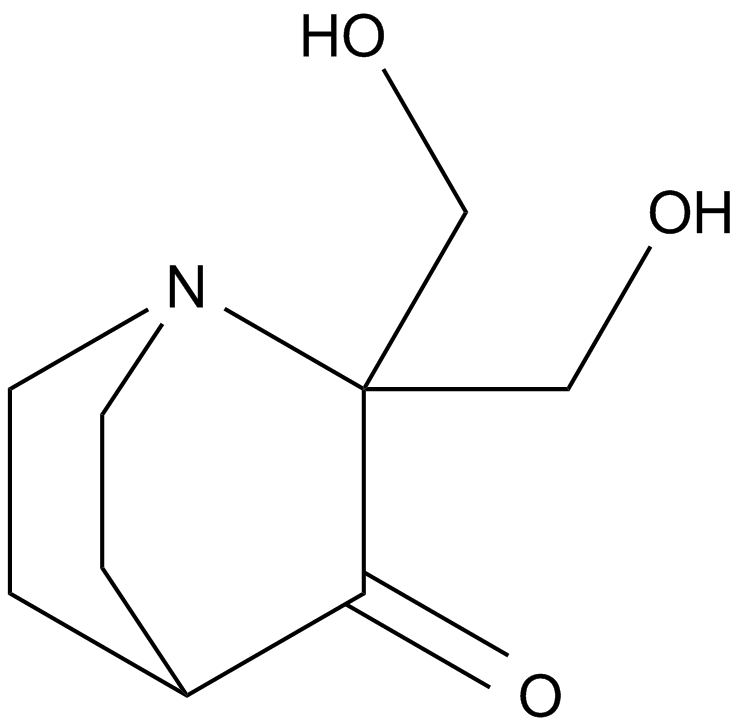
| Chemical Name | 2,2-bis(hydroxymethyl)-1-azabicyclo[2.2.2]octan-3-one | ||
| Canonical SMILES | C1CN2CCC1C(=O)C2(CO)CO | ||
| Formula | C9H15NO3 | M.Wt | 185.22 |
| Solubility | DMF: 30 mg/ml,DMSO: 30 mg/ml,Ethanol: 10 mg/ml,PBS (pH 7.2): 50 mg/ml | Storage | Store at 4°C |
| General tips | Please select the appropriate solvent to prepare the stock solution according to the
solubility of the product in different solvents; once the solution is prepared, please store it in
separate packages to avoid product failure caused by repeated freezing and thawing.Storage method
and period of the stock solution: When stored at -80°C, please use it within 6 months; when stored
at -20°C, please use it within 1 month. To increase solubility, heat the tube to 37°C and then oscillate in an ultrasonic bath for some time. |
||
| Shipping Condition | Evaluation sample solution: shipped with blue ice. All other sizes available: with RT, or with Blue Ice upon request. | ||
| Prepare stock solution | |||

|
1 mg | 5 mg | 10 mg |
| 1 mM | 5.399 mL | 26.9949 mL | 53.9898 mL |
| 5 mM | 1.0798 mL | 5.399 mL | 10.798 mL |
| 10 mM | 539.9 μL | 2.6995 mL | 5.399 mL |
Step 1: Enter information below (Recommended: An additional animal making an allowance for loss during the experiment)
 g
μL
g
μL
Step 2: Enter the in vivo formulation (This is only the calculator, not formulation. Please contact us first if there is no in vivo formulation at the solubility Section.)
Calculation results:
Working concentration: mg/ml;
Method for preparing DMSO master liquid: mg drug pre-dissolved in μL DMSO ( Master liquid concentration mg/mL, Please contact us first if the concentration exceeds the DMSO solubility of the batch of drug. )
Method for preparing in vivo formulation: Take μL DMSO master liquid, next addμL PEG300, mix and clarify, next addμL Tween 80, mix and clarify, next add μL saline, mix and clarify.
Method for preparing in vivo formulation: Take μL DMSO master liquid, next add μL Corn oil, mix and clarify.
Note: 1. Please make sure the liquid is clear before adding the next solvent.
2. Be sure to add the solvent(s) in order. You must ensure that the solution obtained, in the previous addition, is a clear solution before proceeding to add the next solvent. Physical methods such as vortex, ultrasound or hot water bath can be used to aid dissolving.
3. All of the above co-solvents are available for purchase on the GlpBio website.
Quality Control & SDS
- View current batch:
- Purity: >98.00% Appearance: A solid
- COA (Certificate of Analysis)
- SDS (Safety Data Sheet)
- Datasheet
Average Rating: 5 (Based on Reviews and 30 reference(s) in Google Scholar.)