

Sulpiride (Synonyms: rac-Sulpiride, RD 1403, (RS)-(±)-Sulpiride, (S)-Sulpiride) |
Catalog No.GC10349
 One-Click Copy Product Info
|

Sulpiride is a novel, orally active dopamine D2/D3 receptor antagonist, classified as a benzamide atypical antipsychotic drug.
Products are for research use only. Not for human use. We do not sell to patients.
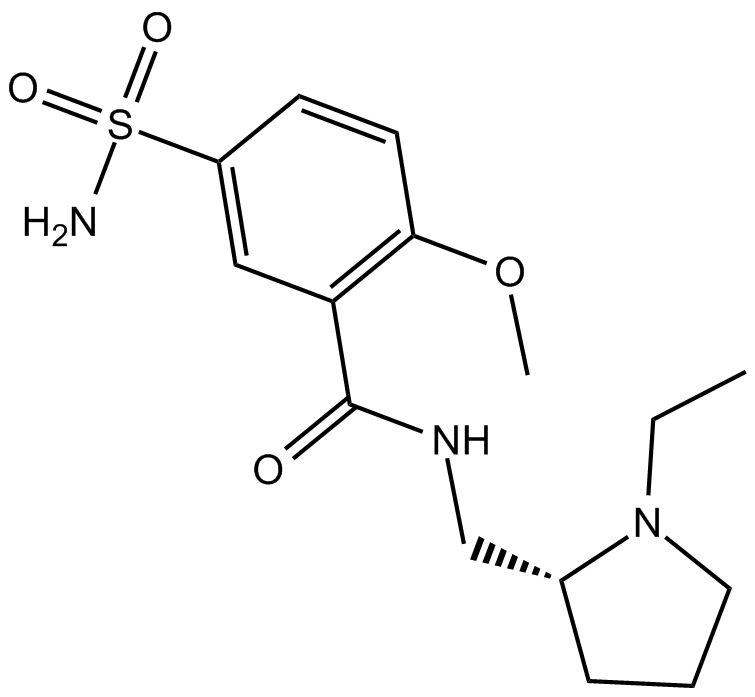
Cas No.: 15676-16-1
Sample solution is provided at 25 µL, 10mM.
Sulpiride is a novel, orally active dopamine D2/D3 receptor antagonist, classified as a benzamide atypical antipsychotic drug[1-2]. Sulpiride is primarily used in the treatment of schizophrenia. Sulpiride exerts its effects by selectively blocking dopamine D2 receptors in the mesolimbic system, with minimal impact on other neurotransmitter receptors, resulting in lower anticholinergic side effects[3-4].
In vitro, when mouse LMCAT fibroblasts were treated with Sulpiride (1-10μM) in combination with lipopolysaccharide (LPS; 1μg/mL) for 2 days, Sulpiride (5 and 10μM), Sulpiride significantly enhanced the inhibitory effect of LPS on corticosterone-induced chloramphenicol acetyltransferase (CAT) activity, aggravating the suppression of glucocorticoid receptor (GR) function under immune-activated conditions[5]. In human ARPE-19 retinal pigment epithelial cells treated with Sulpiride (14μg/mL) for 24 hours, Sulpiride significantly upregulated the mRNA and protein expression levels of DRD1 and TGF-β2, while inhibiting the transcriptional and translational activity of DRD2, YAP, and TEAD[6].
In vivo, in rats treated with Sulpiride (20, 40, or 100mg/kg via intraperitoneal injection) and observed from 5 to 20 minutes post-injection, Sulpiride rapidly modulated sensorimotor integration behavior by blocking D2 receptors, increasing the latency of head-turning movements induced by acoustic stimulation[7]. In 4T1 breast cancer xenograft mice treated orally with a combination of Sulpiride (50mg/kg/day) and dexamethasone (8mg/kg/day) for 2 weeks, Sulpiride significantly inhibited tumor growth and lung metastasis, reduced MMP-2 expression, and increased E-cadherin levels[8].
References:
[1] Caley CF, Weber SS. Sulpiride: an antipsychotic with selective dopaminergic antagonist properties. Ann Pharmacother. 1995 Feb;29(2):152-60.
[2] Bai M, Ma Z, Sun D, et al. Multiple drug transporters mediate the placental transport of sulpiride. Arch Toxicol. 2017 Dec;91(12):3873-3884.
[3] Costa E, Chen Y, Dong E, et al. GABAergic promoter hypermethylation as a model to study the neurochemistry of schizophrenia vulnerability. Expert Rev Neurother. 2009 Jan;9(1):87-98.
[4] Wang J, Sampson S. Sulpiride versus placebo for schizophrenia. Cochrane Database Syst Rev. 2014 Apr 11;2014(4):CD007811.
[5] Basta-Kaim A, Budziszewska B, Jaworska-Feil L, et al. Opposite effects of clozapine and sulpiride on the lipopolysaccharide-induced inhibition of the GR-mediated gene transcription in fibroblast cells. Pol J Pharmacol. 2003 Nov-Dec;55(6):1153-8.
[6] Fan J, Zhang Q, Zheng L, et al. Effect of dopamine on TGF-β2 secretion by human retinal pigment epithelial cells and the underlying mechanism. PLoS One. 2025 Nov 4;20(11):e0335526.
[7] Crescimanno G, Mannino M, Casarrubea M, et al. Effects of sulpiride on the orienting movement evoked By acoustic stimulation in the Rat. Pharmacol Biochem Behav. 2000 Aug;66(4):747-50.
[8] Li J, Yao QY, Xue JS, et al. Dopamine D2 receptor antagonist sulpiride enhances dexamethasone responses in the treatment of drug-resistant and metastatic breast cancer. Acta Pharmacol Sin. 2017 Sep;38(9):1282-1296.
| Cell experiment [1]: | |
Cell lines | LMCAT cells (mouse fibroblast cells stably transfected with MMTV-chloramphenicol acetyltransferase plasmid) |
Preparation Method | LMCAT cells were cultured in DMEM supplemented with 10% heat-inactivated fetal bovine serum and 0.02% geneticin at 37°C under 5% CO₂. Cells were treated with Sulpiride (1–10µM) alone or in combination with lipopolysaccharide (LPS; 1µg/mL) for 48 hours. Corticosterone (1µM) was added 2 hours before harvesting to induce glucocorticoid receptor (GR)-mediated gene transcription. |
Reaction Conditions | 1-10μM; 48h |
Applications | Sulpiride alone had no significant effect on GR-mediated chloramphenicol acetyltransferase (CAT) activity. However, when combined with LPS, Sulpiride (5–10µM) significantly enhanced the LPS-induced inhibition of CAT activity compared to LPS alone. |
| Animal experiment [2]: | |
Animal models | Wistar rats |
Preparation Method | Rats were intraperitoneally administered different doses of Sulpiride (20, 40, or 100mg/kg) and exposed to acoustic stimulation (300Hz, 2s) in a soundproof chamber. Head-turning (HT) movements were recorded via videocamera and analyzed frame-by-frame (50ms resolution) from 6 to 20 minutes post-injection. |
Dosage form | 20–100mg/kg; i.p.; Single injection. |
Applications | Sulpiride induced a dose-dependent increase in HT latency and duration, though only latency changes reached statistical significance. |
References: | |
| Cas No. | 15676-16-1 | SDF | |
| Synonyms | rac-Sulpiride, RD 1403, (RS)-(±)-Sulpiride, (S)-Sulpiride | ||
| Chemical Name | (R)-N-((1-ethylpyrrolidin-2-yl)methyl)-2-methoxy-5-sulfamoylbenzamide | ||
| Canonical SMILES | O=C(C(C=C1S(=O)(N)=O)=C(C=C1)OC)NC[C@@H]2N(CC)CCC2 | ||
| Formula | C15H23N3O4S | M.Wt | 341.42 |
| Solubility | DMSO : 68mg/mL | Storage | Store at 2-8°C |
| General tips | Please select the appropriate solvent to prepare the stock solution according to the
solubility of the product in different solvents; once the solution is prepared, please store it in
separate packages to avoid product failure caused by repeated freezing and thawing.Storage method
and period of the stock solution: When stored at -80°C, please use it within 6 months; when stored
at -20°C, please use it within 1 month. To increase solubility, heat the tube to 37°C and then oscillate in an ultrasonic bath for some time. |
||
| Shipping Condition | Evaluation sample solution: shipped with blue ice. All other sizes available: with RT, or with Blue Ice upon request. | ||
| Prepare stock solution | |||

|
1 mg | 5 mg | 10 mg |
| 1 mM | 2.9289 mL | 14.6447 mL | 29.2894 mL |
| 5 mM | 585.8 μL | 2.9289 mL | 5.8579 mL |
| 10 mM | 292.9 μL | 1.4645 mL | 2.9289 mL |
Step 1: Enter information below (Recommended: An additional animal making an allowance for loss during the experiment)
 g
μL
g
μL
Step 2: Enter the in vivo formulation (This is only the calculator, not formulation. Please contact us first if there is no in vivo formulation at the solubility Section.)
Calculation results:
Working concentration: mg/ml;
Method for preparing DMSO master liquid: mg drug pre-dissolved in μL DMSO ( Master liquid concentration mg/mL, Please contact us first if the concentration exceeds the DMSO solubility of the batch of drug. )
Method for preparing in vivo formulation: Take μL DMSO master liquid, next addμL PEG300, mix and clarify, next addμL Tween 80, mix and clarify, next add μL saline, mix and clarify.
Method for preparing in vivo formulation: Take μL DMSO master liquid, next add μL Corn oil, mix and clarify.
Note: 1. Please make sure the liquid is clear before adding the next solvent.
2. Be sure to add the solvent(s) in order. You must ensure that the solution obtained, in the previous addition, is a clear solution before proceeding to add the next solvent. Physical methods such as vortex, ultrasound or hot water bath can be used to aid dissolving.
3. All of the above co-solvents are available for purchase on the GlpBio website.
Quality Control & SDS
- View current batch:
- Purity: >99.50% Appearance: A solid
- COA (Certificate of Analysis)
- SDS (Safety Data Sheet)
- Datasheet
Average Rating: 5 (Based on Reviews and 12 reference(s) in Google Scholar.)