

Salinosporamide A (NPI-0052, Marizomib) (Synonyms: Marizomib, ML-858, NPI-0052) |
Catalog No.GC10486
 One-Click Copy Product Info
|

Salinosporamide A (NPI-0052, Marizomib) is a 20S proteasome inhibitor isolated from the obligate marine actinobacterium Salinispora tropica, exhibiting potent antitumor activity with an IC50 value of 1.3nM.
Products are for research use only. Not for human use. We do not sell to patients.
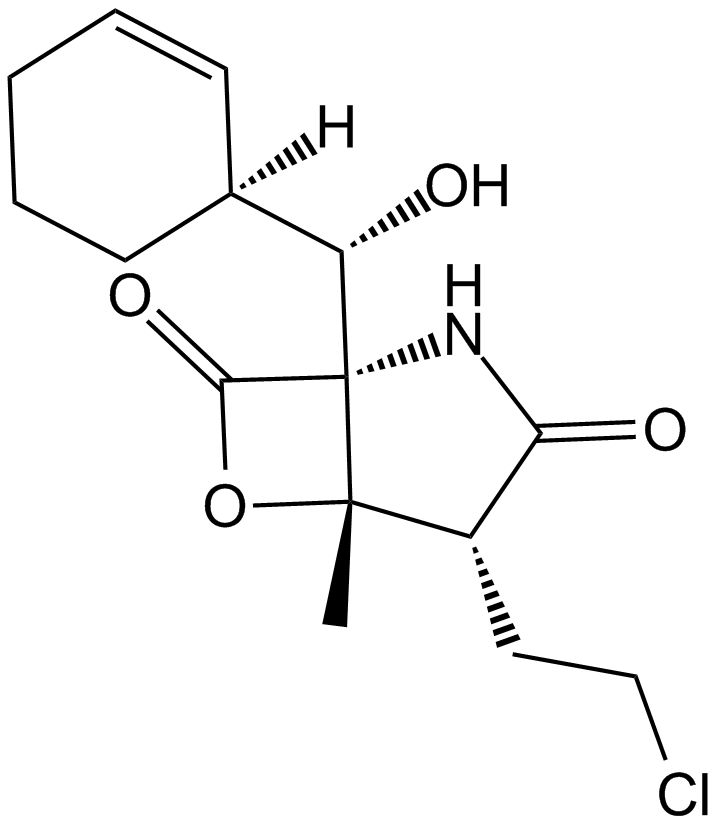
Cas No.: 437742-34-2
Sample solution is provided at 25 µL, 10mM.
_1-3.$$$39978408@51.jpg');)
_1-9.$$$38538795@65.jpg');)
_1-9.$$$39112701@51.jpg');)
_1-7.$$$37316672@70.jpg');)
_366-372.$$$36198801@70.jpg');)
.$$$38565142@65.jpg');)
_1867-1883.$$$33248023@67.jpg');)
_eads6055.$$$39977546@45.jpg');)
_eadm9805.$$$40080571@45.jpg');)
_eadj3020.$$$39666821@45.jpg');)
_1-20.$$$39757301@28.jpg');)
_1-24.$$$38898113@28.jpg');)
_273-287.$$$36806353@46.jpg');)
_1-16.$$$37156877@44.jpg');)
_1-19.$$$37460805@44.jpg');)
_1291-1307.$$$34518654@46.jpg');)
Salinosporamide A (NPI-0052, Marizomib) is a 20S proteasome inhibitor isolated from the obligate marine actinobacterium Salinispora tropica, exhibiting potent antitumor activity with an IC50 value of 1.3nM[1,2]. The 20S proteasome is an enzyme complex responsible for intracellular protein degradation, playing a crucial role in maintaining cellular proteostasis, including the clearance of abnormal proteins and the regulation of the cell cycle[3]. Salinosporamide A is commonly used in the treatment and research of glioblastoma and neurodegenerative diseases[4].
In vitro, treatment of Jurkat T cells with Salinosporamide A (10nM) for 24h significantly arrested the cell cycle at the G2/M phase and downregulated the expression of cyclinA and cyclinD1[5]. Pretreatment of human lung adenocarcinoma H1299 cells with Salinosporamide A (50nM) for 4h, followed by stimulation with 1nM tumor necrosis factor α (TNF) for 24h, inhibited TNF-induced tumor cell invasion. Pretreatment of mouse macrophage RAW 264.7 cells with Salinosporamide A (50nM) for 4h, followed by stimulation with 5nM receptor activator of nuclear factor κB ligand (RANKL) for 5 days, suppressed RANKL-induced osteoclastogenesis and differentiation[6].
In vivo, co-administration of Salinosporamide A (0.025mg/kg) with bortezomib (0.25mg/kg) via intraperitoneal injection twice weekly for 28 days in nude mice bearing pheochromocytoma (MTT-Luc) xenografts significantly reduced tumor cell proliferation and angiogenesis, while increasing apoptotic cell death[7]. In a Plasmodium yoelii-infected Swiss-Webster mouse model, subcutaneous injection of Salinosporamide A (130μg/kg) on days 1, 2, and 4 post-infection effectively inhibited active parasite replication and nearly cleared parasitemia[8].
References:
[1] FELING R H, BUCHANAN G O, MINCER T J, et al. Salinosporamide A: a highly cytotoxic proteasome inhibitor from a novel microbial source, a marine bacterium of the new genus Salinospora[J]. Angewandte Chemie International Edition, 2003, 42(3): 355-357.
[2] FENICAL W, JENSEN P R, PALLADINO M A, et al. Discovery and development of the anticancer agent salinosporamide A (NPI-0052)[J]. Bioorganic & Medicinal Chemistry, 2009, 17(6): 2175-2180.
[3] DESHMUKH S K, YAFFE D, OLSHINA M A, et al. The contribution of the 20S proteasome to proteostasis[J]. Biomolecules, 2019, 9(5): 190.
[4] MIR R H, MIR P A, UPPAL J, et al. Evolution of natural product scaffolds as potential proteasome inhibitors in developing cancer therapeutics[J]. Metabolites, 2023, 13(4): 509.
[5] LEE H S, JEONG G S. Salinosporamide A, a marine-derived proteasome inhibitor, inhibits T cell activation through regulating proliferation and the cell cycle[J]. Molecules, 2020, 25(21): 5031.
[6] AHN K S, SETHI G, CHAO T H, et al. Salinosporamide A (NPI-0052) potentiates apoptosis, suppresses osteoclastogenesis, and inhibits invasion through down-modulation of NF-κB–regulated gene products[J]. Blood, 2007, 110(7): 2286-2295.
[7] BULLOVA P, COUGNOUX A, MARZOUCA G, et al. Bortezomib alone and in combination with salinosporamid A induces apoptosis and promotes pheochromocytoma cell death in vitro and in female nude mice[J]. Endocrinology, 2017, 158(10): 3097-3108.
[8] PRUDHOMME J, MCDANIEL E, PONTS N, et al. Marine actinomycetes: a new source of compounds against the human malaria parasite[J]. PLoS One, 2008, 3(6): e2335.
| Cell experiment [1]: | |
Cell lines | Jurkat T cells |
Preparation Method | Jurkat T cells were treated with 10nM Salinosporamide A for 24h, and cell cycle distribution was analyzed by a PI staining assay using flow cytometry, while the expression levels of cyclinA and cyclinD1 were detected by western blotting. |
Reaction Conditions | 10nM; 24h |
Applications | The entry into G2/M phase in the cell cycle was significantly blocked and the expression of cyclinA and cyclinD1 was significantly downregulated by treatment with Salinosporamide A. |
| Animal experiment [2]: | |
Animal models | Swiss-Webster mice carrying Plasmodium yoelii parasites |
Preparation Method | Swiss-Webster female mice were inoculated intraperitoneal with 5×10⁶ P. yoelii parasites (day 1). Mice were challenge on days 1, 2 and 4 by subcutaneous injection of Salinosporamide A at 130µg/kg. Parasitemia was traced daily by light microscopic analysis of giemsa stained thin smears and confirmed by flow cytometry analysis. |
Dosage form | 130μg/kg; s.c. |
Applications | Mice treated by subcutaneous methods at 130µg/kg showed that parasites never managed to replicate actively when compared to the control group, and parasitemia was almost cleared. |
References: | |
| Cas No. | 437742-34-2 | SDF | |
| Synonyms | Marizomib, ML-858, NPI-0052 | ||
| Chemical Name | (1S,2R,5R)-2-(2-chloroethyl)-5-[(S)-[(1S)-cyclohex-2-en-1-yl]-hydroxymethyl]-1-methyl-7-oxa-4-azabicyclo[3.2.0]heptane-3,6-dione | ||
| Canonical SMILES | CC12C(C(=O)NC1(C(=O)O2)C(C3CCCC=C3)O)CCCl | ||
| Formula | C15H20ClNO4 | M.Wt | 313.78 |
| Solubility | Soluble in DMSO | Storage | Store at -20°C |
| General tips | Please select the appropriate solvent to prepare the stock solution according to the
solubility of the product in different solvents; once the solution is prepared, please store it in
separate packages to avoid product failure caused by repeated freezing and thawing.Storage method
and period of the stock solution: When stored at -80°C, please use it within 6 months; when stored
at -20°C, please use it within 1 month. To increase solubility, heat the tube to 37°C and then oscillate in an ultrasonic bath for some time. |
||
| Shipping Condition | Evaluation sample solution: shipped with blue ice. All other sizes available: with RT, or with Blue Ice upon request. | ||
| Prepare stock solution | |||

|
1 mg | 5 mg | 10 mg |
| 1 mM | 3.1869 mL | 15.9347 mL | 31.8695 mL |
| 5 mM | 637.4 μL | 3.1869 mL | 6.3739 mL |
| 10 mM | 318.7 μL | 1.5935 mL | 3.1869 mL |
Step 1: Enter information below (Recommended: An additional animal making an allowance for loss during the experiment)
 g
μL
g
μL
Step 2: Enter the in vivo formulation (This is only the calculator, not formulation. Please contact us first if there is no in vivo formulation at the solubility Section.)
Calculation results:
Working concentration: mg/ml;
Method for preparing DMSO master liquid: mg drug pre-dissolved in μL DMSO ( Master liquid concentration mg/mL, Please contact us first if the concentration exceeds the DMSO solubility of the batch of drug. )
Method for preparing in vivo formulation: Take μL DMSO master liquid, next addμL PEG300, mix and clarify, next addμL Tween 80, mix and clarify, next add μL saline, mix and clarify.
Method for preparing in vivo formulation: Take μL DMSO master liquid, next add μL Corn oil, mix and clarify.
Note: 1. Please make sure the liquid is clear before adding the next solvent.
2. Be sure to add the solvent(s) in order. You must ensure that the solution obtained, in the previous addition, is a clear solution before proceeding to add the next solvent. Physical methods such as vortex, ultrasound or hot water bath can be used to aid dissolving.
3. All of the above co-solvents are available for purchase on the GlpBio website.
Quality Control & SDS
- View current batch:
- Purity: >98.00% Appearance: A solid
- COA (Certificate of Analysis)
- SDS (Safety Data Sheet)
- Datasheet
Average Rating: 5 (Based on Reviews and 30 reference(s) in Google Scholar.)