

SB 216763 |
Catalog No.GC10463
 One-Click Copy Product Info
|

SB 216763 stands out as a powerful, selective, and ATP-competitive inhibitor of GSK-3, effectively targeting both GSK-3α and GSK-3β with an impressive IC50 of 34.3 nM[1-3].
Products are for research use only. Not for human use. We do not sell to patients.
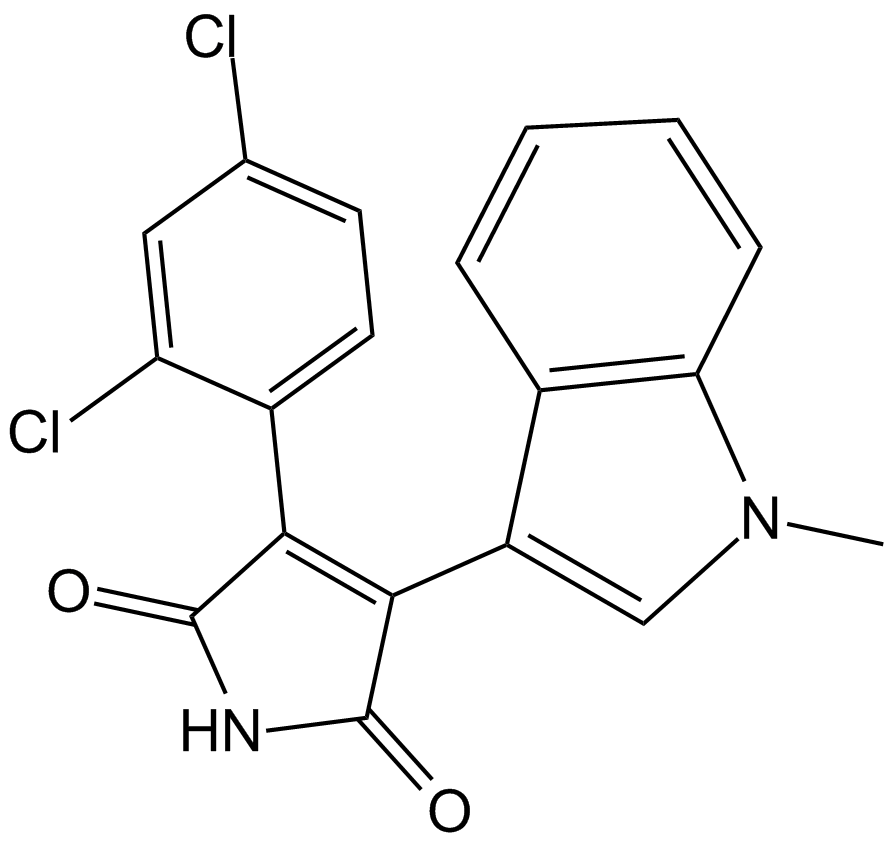
Cas No.: 280744-09-4
Sample solution is provided at 25 µL, 10mM.
_1-3.$$$39978408@51.jpg');)
_1-9.$$$38538795@65.jpg');)
_1-9.$$$39112701@51.jpg');)
_1-7.$$$37316672@70.jpg');)
_366-372.$$$36198801@70.jpg');)
.$$$38565142@65.jpg');)
_1867-1883.$$$33248023@67.jpg');)
_eads6055.$$$39977546@45.jpg');)
_eadm9805.$$$40080571@45.jpg');)
_eadj3020.$$$39666821@45.jpg');)
_1-20.$$$39757301@28.jpg');)
_1-24.$$$38898113@28.jpg');)
_273-287.$$$36806353@46.jpg');)
_1-16.$$$37156877@44.jpg');)
_1-19.$$$37460805@44.jpg');)
_1291-1307.$$$34518654@46.jpg');)
SB 216763 stands out as a powerful, selective, and ATP-competitive inhibitor of GSK-3, effectively targeting both GSK-3α and GSK-3β with an impressive IC50 of 34.3 nM[1-3].
SB 216763(1-20 µM; 24 hours) induces β-catenin mediated-transcription in a dose-dependent manner. Besides, SB 216763(10, 15 and 20 µM) can maintain mouse embryonic stem cells (mESCs) in a pluripotent state in the absence of exogenous leukemia inhibitory factor (LIF) when cultured on mouse embryonic fibroblasts (MEFs) [4]. SB 216763 enhances neurogenesis but does not alter cell cycle exit or cell survival[5].
SB 216763(1-1.5 mg/kg/day;4weeks;s.c) was able to reverse the increased expression levels of molecular markers of inflammation and fibrosis in the heart and kidneys induced by aldosterone (Aldo) injection. Additionally, SB 216763 effectively suppressed cardiac and renal inflammatory cytokine levels, including TNF-a, IL-1β, and MCP-1[6]. SB 216763(10 mg/kg;i.p;3weeks) can reduce delayed gastric emptying (DGE) in high-fat diet (HFD)-induced obese/Type 2 diabetes (T2D) female mice[7]. Pretreatment with SB 216763 (2.5-5 mg/kg, i.p.) prior to amphetamine (2 mg/kg, i.p.) significantly reduced amphetamineinduced ambulation and stereotypy[8].
|
Enzyme inhibition assay[1]: |
|
|
Preparation method |
GSK-3 kinase activity was measured, in the presence or absence of SB 216763, in a reaction mixture containing final concentrations of: 1 nM human GSK-3α or rabbit GSK3α; 50 mM MOPS pH 7.0; 0.2 mM EDTA; 10 mM Mg-acetate; 7.5 mM β-mercaptoethanol; 5% (w/v) glycerol; 0.01% (w/v) Tween-20; 10% (v/v) DMSO; 28 μM GS-2 peptide substrate. The GS-2 peptide sequence corresponds to a region of glycogen synthase that is phosphorylated by GSK-3 as previously described. The assay was initiated by the addition of 0.34 μCi [33P]γ-ATP (IC50 determinations) or 2.7 μCi [33P]γ-ATP (Ki determinations). The total ATP concentration was 10 μM (IC50 determinations) or ranged from 0 to 45 μM (Ki determinations). Following 30 min incubation at room temperature the assay was stopped by the addition of one third assay volume of 2.5% (v/v) H3PO4 containing 21 mM ATP. Samples were spotted onto P30 phosphocellulose mats and these were washed six times in 0.5% (v/v) H3PO4. The filter mats were sealed into sample bags containing Wallac betaplate scintillation fluid. 33P incorporation into the substrate peptide was determined by counting the mats in a Wallac microbeta scintillation counter. |
|
Applications |
SB 216763 inhibited human GSK-3α with IC50 of 34 nM, when assayed in the presence of 0.01 mM ATP. |
|
Cell experiment[2]: |
|
|
Cell lines |
HEK293 cells |
|
Preparation method |
Cells were electroporated with the Super TOPFlash and pGL4.73 Renilla luciferase reporters. The cells were treated in quadruplicate wells with a vehicle control (0.1% DMSO) or the indicated doses of SB 216763 for 24 hours. |
|
Reaction Conditions |
1–20 µM SB 216763;24 hours |
|
Applications |
SB 216763 induces β-catenin mediated-transcription in a dose-dependent manner. |
|
Animal experiment[3]: |
|
|
Animal models |
Adult male Wistar rats |
|
Preparation method |
The animals were divided into four groups (n = 9/group): (1) Vehicle infusion group treated with vehicle alone; (2) Aldo-salt group treated with an infusion of Aldo-salt (1 mg/kg/day diluted in sunflower oil and administered by subcutaneous injection); (3) Aldo-salt plus SB 216763 group treated with an infusion of Aldo-salt plus SB 216763 at 1.5 mg/kg/day; and (4) SB 216763 group. |
|
Dosage form |
1-1.5 mg/kg/day;4weeks;s.c |
|
Applications |
SB 216763 suppresses cardiac inflammation and fibrosis caused by Aldo-salt. |
|
References: [1]. Coghlan MP, Culbert AA, et,al. Selective small molecule inhibitors of glycogen synthase kinase-3 modulate glycogen metabolism and gene transcription. Chem Biol. 2000 Oct;7(10):793-803. doi: 10.1016/s1074-5521(00)00025-9. PMID: 11033082. [2]. Kirby LA, Schott JT, et,al. Glycogen synthase kinase 3 (GSK3) inhibitor, SB-216763, promotes pluripotency in mouse embryonic stem cells. PLoS One. 2012;7(6):e39329. doi: 10.1371/journal.pone.0039329. Epub 2012 Jun 26. PMID: 22745733; PMCID: PMC3383737. [3].Zhang YD, Ding XJ, et,al.SB-216763, a GSK-3β inhibitor, protects against aldosterone-induced cardiac, and renal injury by activating autophagy. J Cell Biochem. 2018 Jul;119(7):5934-5943. doi: 10.1002/jcb.26788. Epub 2018 Mar 30. PMID: 29600538; PMCID: PMC6001754. |
|
| Cas No. | 280744-09-4 | SDF | |
| Chemical Name | 3-(2,4-dichlorophenyl)-4-(1-methylindol-3-yl)pyrrole-2,5-dione | ||
| Canonical SMILES | CN1C=C(C2=CC=CC=C21)C3=C(C(=O)NC3=O)C4=C(C=C(C=C4)Cl)Cl | ||
| Formula | C19H12Cl2N2O2 | M.Wt | 371.22 |
| Solubility | ≥ 56.8mg/mL in DMSO | Storage | Store at -20°C |
| General tips | Please select the appropriate solvent to prepare the stock solution according to the
solubility of the product in different solvents; once the solution is prepared, please store it in
separate packages to avoid product failure caused by repeated freezing and thawing.Storage method
and period of the stock solution: When stored at -80°C, please use it within 6 months; when stored
at -20°C, please use it within 1 month. To increase solubility, heat the tube to 37°C and then oscillate in an ultrasonic bath for some time. |
||
| Shipping Condition | Evaluation sample solution: shipped with blue ice. All other sizes available: with RT, or with Blue Ice upon request. | ||
| Prepare stock solution | |||

|
1 mg | 5 mg | 10 mg |
| 1 mM | 2.6938 mL | 13.4691 mL | 26.9382 mL |
| 5 mM | 538.8 μL | 2.6938 mL | 5.3876 mL |
| 10 mM | 269.4 μL | 1.3469 mL | 2.6938 mL |
Step 1: Enter information below (Recommended: An additional animal making an allowance for loss during the experiment)
 g
μL
g
μL
Step 2: Enter the in vivo formulation (This is only the calculator, not formulation. Please contact us first if there is no in vivo formulation at the solubility Section.)
Calculation results:
Working concentration: mg/ml;
Method for preparing DMSO master liquid: mg drug pre-dissolved in μL DMSO ( Master liquid concentration mg/mL, Please contact us first if the concentration exceeds the DMSO solubility of the batch of drug. )
Method for preparing in vivo formulation: Take μL DMSO master liquid, next addμL PEG300, mix and clarify, next addμL Tween 80, mix and clarify, next add μL saline, mix and clarify.
Method for preparing in vivo formulation: Take μL DMSO master liquid, next add μL Corn oil, mix and clarify.
Note: 1. Please make sure the liquid is clear before adding the next solvent.
2. Be sure to add the solvent(s) in order. You must ensure that the solution obtained, in the previous addition, is a clear solution before proceeding to add the next solvent. Physical methods such as vortex, ultrasound or hot water bath can be used to aid dissolving.
3. All of the above co-solvents are available for purchase on the GlpBio website.
Quality Control & SDS
- View current batch:
- Purity: >99.00% Appearance: A solid
- COA (Certificate of Analysis)
- SDS (Safety Data Sheet)
- Datasheet
Average Rating: 5 (Based on Reviews and 30 reference(s) in Google Scholar.)