

Sphingomyelins (Synonyms: SMs (egg)) |
Catalog No.GC18328
 One-Click Copy Product Info
|

Sphingomyelins are a dominant sphingolipid in membranes of mammalian cells, and this lipid class is specifically enriched in the plasma membrane.
Products are for research use only. Not for human use. We do not sell to patients.
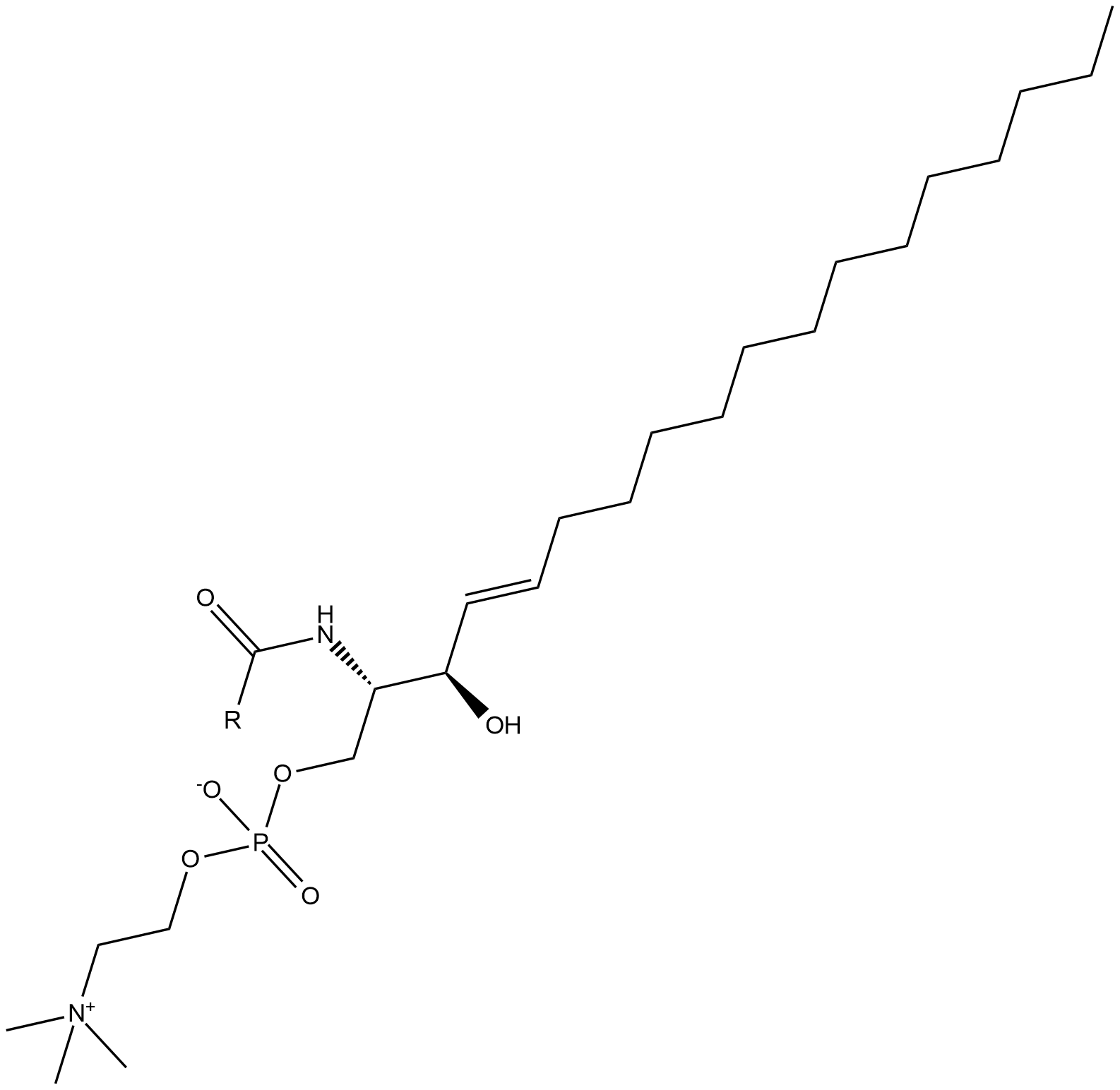
Cas No.: 383907-87-7
Sample solution is provided at 25 µL, 10mM.
_1-3.$$$39978408@51.jpg');)
_1-9.$$$38538795@65.jpg');)
_1-9.$$$39112701@51.jpg');)
_1-7.$$$37316672@70.jpg');)
_366-372.$$$36198801@70.jpg');)
.$$$38565142@65.jpg');)
_1867-1883.$$$33248023@67.jpg');)
_eads6055.$$$39977546@45.jpg');)
_eadm9805.$$$40080571@45.jpg');)
_eadj3020.$$$39666821@45.jpg');)
_1-20.$$$39757301@28.jpg');)
_1-24.$$$38898113@28.jpg');)
_273-287.$$$36806353@46.jpg');)
_1-16.$$$37156877@44.jpg');)
_1-19.$$$37460805@44.jpg');)
_1291-1307.$$$34518654@46.jpg');)
Sphingomyelins are a dominant sphingolipid in membranes of mammalian cells, and this lipid class is specifically enriched in the plasma membrane [1]. Sphingomyelins have a favorable interaction with cholesterol (and other sterols), regulating the distribution of cholesterol within the cell membrane and maintaining the cholesterol homeostasis [2]. Sphingomyelins have been widely used to regulate the lipid mobility of high-density lipoproteins (HDL) and the extracellular flow of cholesterol[3].
In vitro, Sphingomyelins treatment (50µM) for 1 hour significantly promoted the vacuolation in HeLa cells mediated by 10nM vacuolating cytotoxin (VacA)[4].
In vivo, Sphingomyelins treatment via oral administration at a dose of 8mg daily for 7 days aggravated the intestinal mucosal inflammation in a mouse model of colitis induced by dextran sulfate sodium (DSS), and impaired the intestinal mucosal function[5]. Oral administration of 0.05% Sphingomyelins in AIN76A diet for 45 weeks significantly inhibited the progression of colon tumors induced by 1,2-dimethylhydrazine (DMH) in mice[6].
References:
[1] Slotte J P. Biological functions of sphingomyelins[J]. Progress in lipid research, 2013, 52(4): 424-437.
[2] Slotte J P, Ramstedt B. The functional role of sphingomyelin in cell membranes[J]. European journal of lipid science and technology, 2007, 109(10): 977-981.
[3] Martínez-Beamonte R, Lou-Bonafonte J M, Martínez-Gracia M V, et al. Sphingomyelin in high-density lipoproteins: structural role and biological function[J]. International journal of molecular sciences, 2013, 14(4): 7716-7741.
[4] Gupta V R, Patel H K, Kostolansky S S, et al. Sphingomyelin functions as a novel receptor for Helicobacter pylori VacA[J]. PLoS pathogens, 2008, 4(5): e1000073.
[5] Fischbeck A, Leucht K, Frey-Wagner I, et al. Sphingomyelin induces cathepsin D-mediated apoptosis in intestinal epithelial cells and increases inflammation in DSS colitis[J]. Gut, 2011, 60(1): 55-65.
[6] Lemonnier L A, Dillehay D L, Vespremi M J, et al. Sphingomyelin in the suppression of colon tumors: prevention versus intervention[J]. Archives of biochemistry and biophysics, 2003, 419(2): 129-138.
| Cell experiment [1]: | |
Cell lines | HeLa cells |
Preparation Method | HeLa cells were grown in minimum essential medium (MEM) with 10% (v/v) fetal bovine serum (FBS), 100μg/ml streptomycin, and 100U/ml penicillin at 37°C in 5% CO2/atmosphere. HeLa cells were pretreated for 1h with different concentrations of Sphingomyelins (0,1 5, 10, 25, and 50µM) and were then further incubated at 37°C with 10nM VacA. After 24h, cells were evaluated by DIC microscopy or neutral red uptake assays. DIC images of cells stained with neutral red. |
Reaction Conditions | 0,1 5, 10, 25, and 50µM; 1h |
Applications | Sphingomyelins treatment significantly promoted VacA-mediated vacuolation in HeLa cells in a dose-dependent manner. |
| Animal experiment [2]: | |
Animal models | Female C57-BL/6J-Fue mice |
Preparation Method | Female C57-BL/6J-Fue mice were housed singly in a standard environment with food and water ad libitum. Acute colitis was induced in C57-BL/6 mice with 2.0% DSS over 7 days. 8mg of Sphingomyelins (calculated as 0.2% of the total daily food intake) was resuspended in drinking water and applied by oral gavage for 7 days. Assessment of colonoscopy and histological score in mice. |
Dosage form | 8mg/day for 7 days; p.o. |
Applications | Sphingomyelins treatment significantly aggravated the intestinal mucosal inflammation in mice with DSS-mediated colitis. |
References: | |
| Cas No. | 383907-87-7 | SDF | |
| Synonyms | SMs (egg) | ||
| Canonical SMILES | [R]C(N[C@@H](COP(OCC[N+](C)(C)C)([O-])=O)[C@H](O)/C=C/CCCCCCCCCCCCC)=O | ||
| Formula | C39H79N2O6P (for palmitoyl) | M.Wt | 703 |
| Solubility | Chloroform: Soluble,Ethanol: Warmed,Methanol: Soluble | Storage | Store at -20°C |
| General tips | Please select the appropriate solvent to prepare the stock solution according to the
solubility of the product in different solvents; once the solution is prepared, please store it in
separate packages to avoid product failure caused by repeated freezing and thawing.Storage method
and period of the stock solution: When stored at -80°C, please use it within 6 months; when stored
at -20°C, please use it within 1 month. To increase solubility, heat the tube to 37°C and then oscillate in an ultrasonic bath for some time. |
||
| Shipping Condition | Evaluation sample solution: shipped with blue ice. All other sizes available: with RT, or with Blue Ice upon request. | ||
| Prepare stock solution | |||

|
1 mg | 5 mg | 10 mg |
| 1 mM | 1.4225 mL | 7.1124 mL | 14.2248 mL |
| 5 mM | 284.5 μL | 1.4225 mL | 2.845 mL |
| 10 mM | 142.2 μL | 711.2 μL | 1.4225 mL |
Step 1: Enter information below (Recommended: An additional animal making an allowance for loss during the experiment)
 g
μL
g
μL
Step 2: Enter the in vivo formulation (This is only the calculator, not formulation. Please contact us first if there is no in vivo formulation at the solubility Section.)
Calculation results:
Working concentration: mg/ml;
Method for preparing DMSO master liquid: mg drug pre-dissolved in μL DMSO ( Master liquid concentration mg/mL, Please contact us first if the concentration exceeds the DMSO solubility of the batch of drug. )
Method for preparing in vivo formulation: Take μL DMSO master liquid, next addμL PEG300, mix and clarify, next addμL Tween 80, mix and clarify, next add μL saline, mix and clarify.
Method for preparing in vivo formulation: Take μL DMSO master liquid, next add μL Corn oil, mix and clarify.
Note: 1. Please make sure the liquid is clear before adding the next solvent.
2. Be sure to add the solvent(s) in order. You must ensure that the solution obtained, in the previous addition, is a clear solution before proceeding to add the next solvent. Physical methods such as vortex, ultrasound or hot water bath can be used to aid dissolving.
3. All of the above co-solvents are available for purchase on the GlpBio website.
Quality Control & SDS
- View current batch:
- Purity: >98.00% Appearance: A solid
- COA (Certificate of Analysis)
- SDS (Safety Data Sheet)
- Datasheet
Average Rating: 5 (Based on Reviews and 6 reference(s) in Google Scholar.)