

Sudoxicam |
Catalog No.GC64940
 One-Click Copy Product Info
|

Sudoxicam is a reversible and orally active COX antagonist and a non-steroidal anti-inflammatory drug (NSAID) from the enol-carboxamide class.
Products are for research use only. Not for human use. We do not sell to patients.
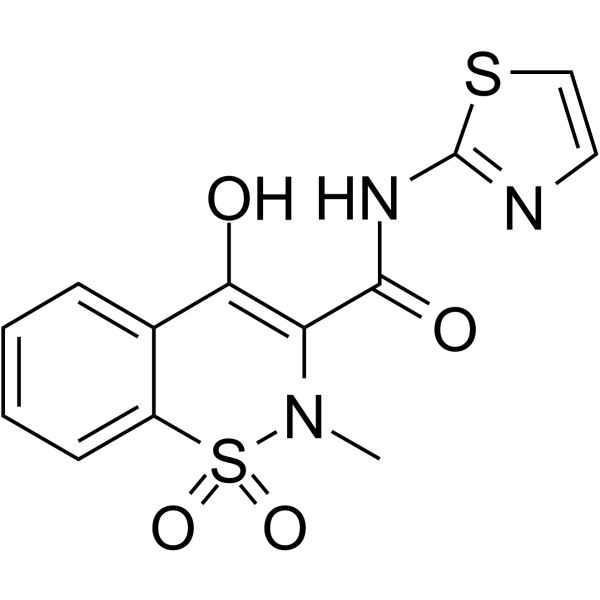
Cas No.: 34042-85-8
Sample solution is provided at 25 µL, 10mM.
_1-3.$$$39978408@51.jpg');)
_1-9.$$$38538795@65.jpg');)
_1-9.$$$39112701@51.jpg');)
_1-7.$$$37316672@70.jpg');)
_366-372.$$$36198801@70.jpg');)
.$$$38565142@65.jpg');)
_1867-1883.$$$33248023@67.jpg');)
_eads6055.$$$39977546@45.jpg');)
_eadm9805.$$$40080571@45.jpg');)
_eadj3020.$$$39666821@45.jpg');)
_1-20.$$$39757301@28.jpg');)
_1-24.$$$38898113@28.jpg');)
_273-287.$$$36806353@46.jpg');)
_1-16.$$$37156877@44.jpg');)
_1-19.$$$37460805@44.jpg');)
_1291-1307.$$$34518654@46.jpg');)
Sudoxicam is a reversible and orally active COX antagonist and a non-steroidal anti-inflammatory drug (NSAID) from the enol-carboxamide class. Sudoxicam has potent anti-inflammatory, anti-edema and antipyretic activity[1][2][3].
Sudoxicam demonstrates NADPH-dependent covalent binding to human liver microsomes. With addition of glutathione (GSH) in microsomal incubations, about half of the covalent incorporation of Sudoxicam is blocked by addition of GSH[1].Metabolite identification studies on [14C]-Sudoxicam in NADPH-supplemented human liver microsomes indicated that the primary route of metabolism involved a P450-mediated thiazole ring scission to the corresponding acylthiourea metabolite (S3), a well-established pro-toxin[1].In vitro, Sudoxicam underwent the oxidative thiazole-open biotransformation, resulting in the formation of an acylthiourea and the subsequent hydroxylated metabolite[3].
Sudoxicam (1-10 mg/kg; oral administration; daily; for 7 days; rats) treatment effective reduces plasma inflammation units, reduces the swelling of inflamed hind-paws and restores toward normal the daily gain in body weight[2].In the intact rat, Sudoxicam significantly inhibited edema formation at doses as low as 0.1 mg/kg, p.o[2].Sudoxicam inhibits the erythema caused by ultraviolet irradiation in the guinea pig. Sudoxicam (3.3 mg/kg, i.p.) is capable of counteracting the pyrexia induced by the intraperitoneal injection of typhoid/paratyphoid vaccine in rats, maintaining body temperature about that of uninjected control rats[2]. The plasma half-life of Sudoxicam ranged between 8 hours (monkey), 13 hours (rat), and 60 hours (dog)[2].
[1]. Obach RS, et al. In vitro metabolism and covalent binding of enol-carboxamide derivatives and anti-inflammatory agents sudoxicam and meloxicam: insights into the hepatotoxicity of sudoxicam. Chem Res Toxicol. 2008 Sep;21(9):1890-9.
[2]. Wiseman EH, et al. Anti-inflammatory and pharmacokinetic properties of sudoxicam N-(2-thiazolyl)-4-hydroxy-2-methyl-2H-1,2-benzothiazine-3-carboxamide 1,1-dioxide. Biochem Pharmacol. 1972 Sep 1;21(17):2323-34.
[3]. Zhi-Yi Zhang. Sudoxicam. Handbook of Metabolic Pathways of Xenobiotics. September 2014.
| Cas No. | 34042-85-8 | SDF | |
| Formula | C13H11N3O4S2 | M.Wt | 337.37 |
| Solubility | DMSO : 83.33 mg/mL (247.00 mM; ultrasonic and warming and heat to 80°C) | Storage | Store at -20°C |
| General tips | Please select the appropriate solvent to prepare the stock solution according to the
solubility of the product in different solvents; once the solution is prepared, please store it in
separate packages to avoid product failure caused by repeated freezing and thawing.Storage method
and period of the stock solution: When stored at -80°C, please use it within 6 months; when stored
at -20°C, please use it within 1 month. To increase solubility, heat the tube to 37°C and then oscillate in an ultrasonic bath for some time. |
||
| Shipping Condition | Evaluation sample solution: shipped with blue ice. All other sizes available: with RT, or with Blue Ice upon request. | ||
| Prepare stock solution | |||

|
1 mg | 5 mg | 10 mg |
| 1 mM | 2.9641 mL | 14.8205 mL | 29.641 mL |
| 5 mM | 592.8 μL | 2.9641 mL | 5.9282 mL |
| 10 mM | 296.4 μL | 1.4821 mL | 2.9641 mL |
Step 1: Enter information below (Recommended: An additional animal making an allowance for loss during the experiment)
 g
μL
g
μL
Step 2: Enter the in vivo formulation (This is only the calculator, not formulation. Please contact us first if there is no in vivo formulation at the solubility Section.)
Calculation results:
Working concentration: mg/ml;
Method for preparing DMSO master liquid: mg drug pre-dissolved in μL DMSO ( Master liquid concentration mg/mL, Please contact us first if the concentration exceeds the DMSO solubility of the batch of drug. )
Method for preparing in vivo formulation: Take μL DMSO master liquid, next addμL PEG300, mix and clarify, next addμL Tween 80, mix and clarify, next add μL saline, mix and clarify.
Method for preparing in vivo formulation: Take μL DMSO master liquid, next add μL Corn oil, mix and clarify.
Note: 1. Please make sure the liquid is clear before adding the next solvent.
2. Be sure to add the solvent(s) in order. You must ensure that the solution obtained, in the previous addition, is a clear solution before proceeding to add the next solvent. Physical methods such as vortex, ultrasound or hot water bath can be used to aid dissolving.
3. All of the above co-solvents are available for purchase on the GlpBio website.
Quality Control & SDS
- View current batch:
- Purity: >99.00% Appearance: A solid
- COA (Certificate of Analysis)
- SDS (Safety Data Sheet)
- Datasheet
Average Rating: 5 (Based on Reviews and 30 reference(s) in Google Scholar.)