

Sulfo-NHS-LC-Biotin sodium |
Catalog No.GC10252
 One-Click Copy Product Info
|

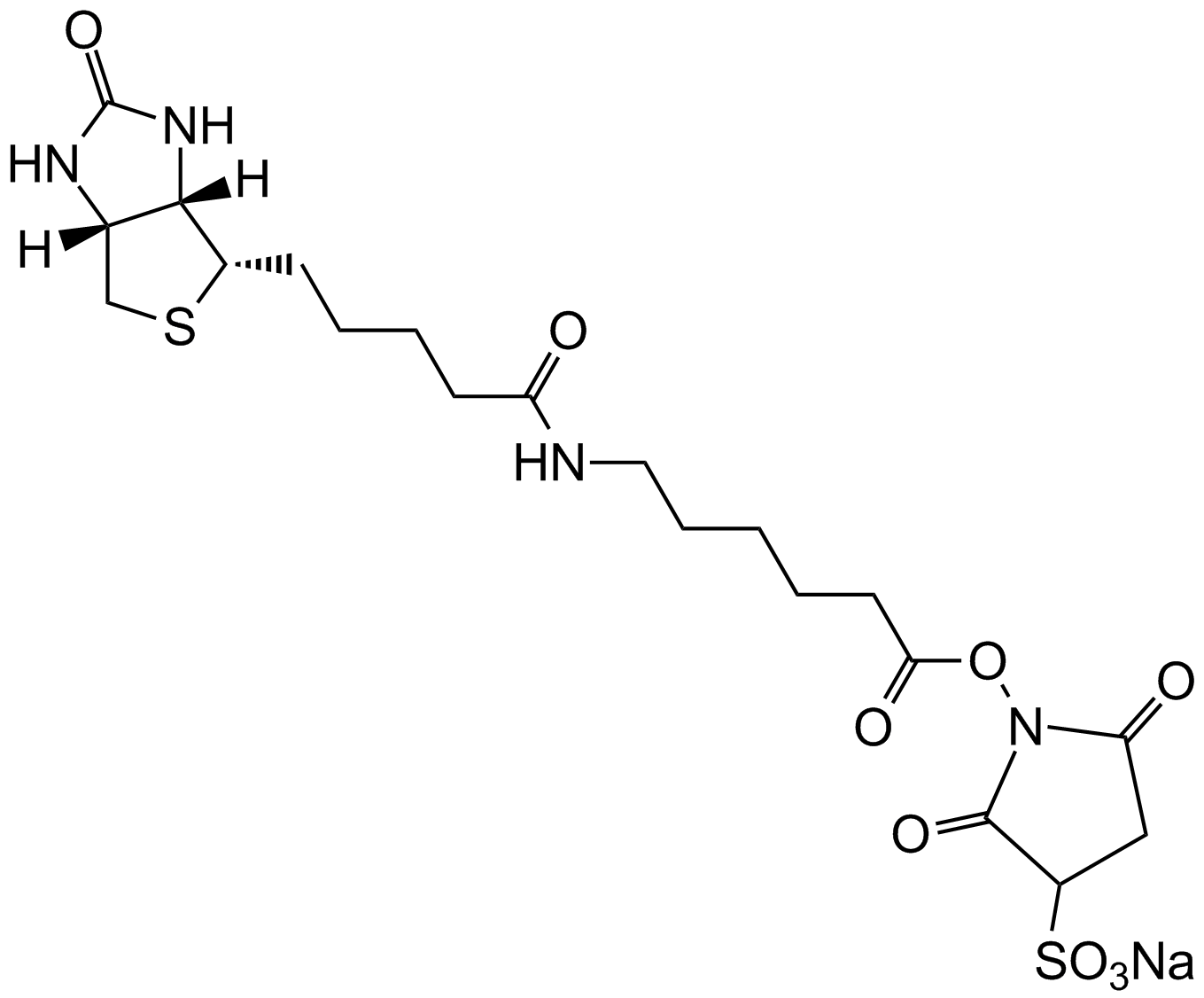
Sulfo-NHS-LC-Biotin is a labeling reagent with a long-chain structure that reacts with amines.
Products are for research use only. Not for human use. We do not sell to patients.
Cas No.: 127062-22-0,191671-46-2
Sample solution is provided at 25 µL, 10mM.
Sulfo-NHS-LC-Biotin is a labeling reagent with a long-chain structure that reacts with amines. Its biotin-like groups can be efficiently eluted from streptomycin avidin, making it suitable for purification or labeling of cell surface proteins. The spacer arm between the biotin and amine reactive linker is large, aiding in overcoming steric hindrance and enhancing the efficiency of surface labeling [1-3].
Sulfo-NHS-LC-Biotin (10 mM) can be used for biotinization of exosomes from Mycobacterium tuberculosis (Mtb)-infected cells [4]. Sulfo-NHS-LC-Biotin also can be used for label cells[5]. It also can monitor sertoli cell Blood-Testis Barrier (BTB) integrity [6].
References:
[1]. Diaz G, Wolfe LM, et,al. Changes in the Membrane-Associated Proteins of Exosomes Released from Human Macrophages after Mycobacterium tuberculosis Infection. Sci Rep. 2016 Nov 29;6:37975. doi: 10.1038/srep37975. PMID: 27897233; PMCID: PMC5126699.
[2]. Gabant G, Augier J, et,al. Assessment of solvent residues accessibility using three Sulfo-NHS-biotin reagents in parallel: application to footprint changes of a methyltransferase upon binding its substrate. J Mass Spectrom. 2008 Mar;43(3):360-70. doi: 10.1002/jms.1328. PMID: 17968972.
[3]. Ghebrehiwet B, Peerschke EI. Structure and function of gC1q-R: a multiligand binding cellular protein. Immunobiology. 1998 Aug;199(2):225-38. doi: 10.1016/S0171-2985(98)80029-6. PMID: 9777408.
[4]. Diaz G, Wolfe LM, et,al. Changes in the Membrane-Associated Proteins of Exosomes Released from Human Macrophages after Mycobacterium tuberculosis Infection. Sci Rep. 2016 Nov 29;6:37975. doi: 10.1038/srep37975. PMID: 27897233; PMCID: PMC5126699.
[5]. Luo Y, McDonald K, et,al. Trafficking of immature DeltaF508-CFTR to the plasma membrane and its detection by biotinylation. Biochem J. 2009 Apr 1;419(1):211-9, 2 p following 219. doi: 10.1042/BJ20081869. PMID: 19053947.
[6]. Wu S, Wang L, et,al. An In Vitro Assay to Monitor Sertoli Cell Blood-Testis Barrier (BTB) Integrity. Methods Mol Biol. 2021;2367:207-213. doi: 10.1007/7651_2021_390. PMID: 33830455.
|
Protocol for biotinylation of exosome proteins [1]: |
|
Sulfo-NHS-LC-Biotin was utilized to tag proteins that are exposed on the external surface of intact exosomes. It features a larger spacer arm measuring 30.5 Å between the biotin molecule and the amine reactive linker. This extended spacer arm is beneficial as it helps overcome steric hindrance, especially in the crowded environment of the exosome surface, leading to improved labeling efficiency.
|
|
Protocol for monitor cell Blood-Testis Barrier (BTB) integrity [2]: |
|
Note: Freshly prepare a stock of 10 mg/ml Sulfo-NHS-LC-Biotin in PBS/CM pH 8.0 (10 mM sodium phosphate, 0.15 M NaCl) containing 1 mM CaCl2 as labeling buffer (biotin reagent is freshly prepared immediately before use, within 1–2 h before its use; do not prepare stock solution for storage).
Phosphate-buffered saline (PBS)/CM: 10 mM NaH2PO4, 0.15 M NaCl, 1 mM CaCl2, pH 8.0 at 22℃. |
|
References: [1]. Diaz G, Wolfe LM, et,al. Changes in the Membrane-Associated Proteins of Exosomes Released from Human Macrophages after Mycobacterium tuberculosis Infection. Sci Rep. 2016 Nov 29;6:37975. doi: 10.1038/srep37975. PMID: 27897233; PMCID: PMC5126699. [2]. Wu S, Wang L, et,al. An In Vitro Assay to Monitor Sertoli Cell Blood-Testis Barrier (BTB) Integrity. Methods Mol Biol. 2021;2367:207-213. doi: 10.1007/7651_2021_390. PMID: 33830455. |
| Cas No. | 127062-22-0,191671-46-2 | SDF | |
| Chemical Name | 2,5-dioxo-1-[6-[5-(2-oxo-1,3,3a,4,6,6a-hexahydrothieno[3,4-d]imidazol-4-yl)pentanoylamino]hexanoyloxy]pyrrolidine-3-sulfonic acid;sodium | ||
| Canonical SMILES | C1C(C(=O)N(C1=O)OC(=O)CCCCCNC(=O)CCCCC2C3C(CS2)NC(=O)N3)S(=O)(=O)O.[Na] | ||
| Formula | C20H29N4NaO9S2 | M.Wt | 556.6 |
| Solubility | >27.8mg/mL in DMSO | Storage | Store at -20°C, sealed storage, away from moisture, unstable in solution, ready to use. |
| General tips | Please select the appropriate solvent to prepare the stock solution according to the
solubility of the product in different solvents; once the solution is prepared, please store it in
separate packages to avoid product failure caused by repeated freezing and thawing.Storage method
and period of the stock solution: When stored at -80°C, please use it within 6 months; when stored
at -20°C, please use it within 1 month. To increase solubility, heat the tube to 37°C and then oscillate in an ultrasonic bath for some time. |
||
| Shipping Condition | Evaluation sample solution: shipped with blue ice. All other sizes available: with RT, or with Blue Ice upon request. | ||
| Prepare stock solution | |||

|
1 mg | 5 mg | 10 mg |
| 1 mM | 1.7966 mL | 8.9831 mL | 17.9662 mL |
| 5 mM | 359.3 μL | 1.7966 mL | 3.5932 mL |
| 10 mM | 179.7 μL | 898.3 μL | 1.7966 mL |
Step 1: Enter information below (Recommended: An additional animal making an allowance for loss during the experiment)
 g
μL
g
μL
Step 2: Enter the in vivo formulation (This is only the calculator, not formulation. Please contact us first if there is no in vivo formulation at the solubility Section.)
Calculation results:
Working concentration: mg/ml;
Method for preparing DMSO master liquid: mg drug pre-dissolved in μL DMSO ( Master liquid concentration mg/mL, Please contact us first if the concentration exceeds the DMSO solubility of the batch of drug. )
Method for preparing in vivo formulation: Take μL DMSO master liquid, next addμL PEG300, mix and clarify, next addμL Tween 80, mix and clarify, next add μL saline, mix and clarify.
Method for preparing in vivo formulation: Take μL DMSO master liquid, next add μL Corn oil, mix and clarify.
Note: 1. Please make sure the liquid is clear before adding the next solvent.
2. Be sure to add the solvent(s) in order. You must ensure that the solution obtained, in the previous addition, is a clear solution before proceeding to add the next solvent. Physical methods such as vortex, ultrasound or hot water bath can be used to aid dissolving.
3. All of the above co-solvents are available for purchase on the GlpBio website.
Quality Control & SDS
- View current batch:
- Purity: >95.00% Appearance: A solid
- COA (Certificate of Analysis)
- SDS (Safety Data Sheet)
- Datasheet
Average Rating: 5 (Based on Reviews and 30 reference(s) in Google Scholar.)