

Tangeretin (Synonyms: NSC 53909, NSC 618905, Ponkanetin) |
Catalog No.GN10797
 One-Click Copy Product Info
|

Tangeretin is a naturally polymethoxylated flavone compound extracted from the citrus peel and acts as a Notch-1 inhibitor.
Products are for research use only. Not for human use. We do not sell to patients.
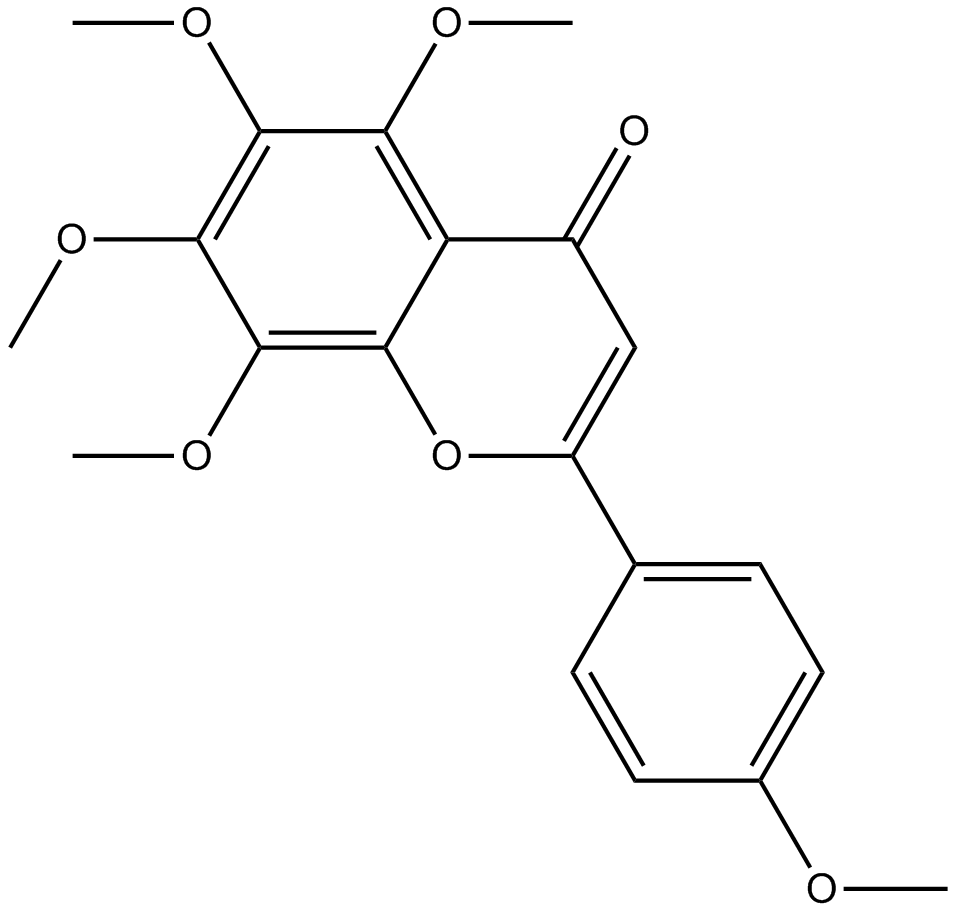
Cas No.: 481-53-8
Sample solution is provided at 25 µL, 10mM.
_1-3.$$$39978408@51.jpg');)
_1-9.$$$38538795@65.jpg');)
_1-9.$$$39112701@51.jpg');)
_1-7.$$$37316672@70.jpg');)
_366-372.$$$36198801@70.jpg');)
.$$$38565142@65.jpg');)
_1867-1883.$$$33248023@67.jpg');)
_eads6055.$$$39977546@45.jpg');)
_eadm9805.$$$40080571@45.jpg');)
_eadj3020.$$$39666821@45.jpg');)
_1-20.$$$39757301@28.jpg');)
_1-24.$$$38898113@28.jpg');)
_273-287.$$$36806353@46.jpg');)
_1-16.$$$37156877@44.jpg');)
_1-19.$$$37460805@44.jpg');)
_1291-1307.$$$34518654@46.jpg');)
Tangeretin is a naturally polymethoxylated flavone compound extracted from the citrus peel and acts as a Notch-1 inhibitor[1]. Tangeretin exhibits antitumor properties in several types of cancerous cell lines[2] and targets some hallmarks of cancer, such as antiproliferative, apoptotic, anti-inflammatory, anti-metastatic, anti-angiogenic, antioxidant, regulatory expression of tumor-suppressor genes, and epigenetic modulation[3].
Tangeretin (20μM; 24h) inhibits ROS generation and GSH depletion induced by t-BHP in HepG2 cells[4]. Tangeretin (45μM; 48h) treatment increases G2/M arrest and apoptosis by modulating PTEN and cell-cycle regulated genes such as cyclin-D mRNA and protein expressions[5].
Tangeretin (100mg/kg) pre-treatment significantly alleviated liver damage, inhibited cisplatin-induced lipid profile aberrations (total cholesterol and triglycerides) and diminished histopathologic structural damage in rat liver tissues[6]. Tangeretin (100mg/kg; 3d; i.g.) inhibits human respiratory syncytial virus (RSV) replication and RSV-induced lung inflammation in mouse[7].
References:
[1]. Liu LL, Li FH, Zhang Y, et al. Tangeretin has anti-asthmatic effects via regulating PI3K and Notch signaling and modulating Th1/Th2/Th17 cytokine balance in neonatal asthmatic mice. Braz J Med Biol Res. 2017 Jul 20;50(8):e5991. doi: 10.1590/1414-431X20175991. PMID: 28746467; PMCID: PMC5520220.
[2]. Arafa EA, Shurrab NT, Buabeid MA. Therapeutic Implications of a Polymethoxylated Flavone, Tangeretin, in the Management of Cancer via Modulation of Different Molecular Pathways. Adv Pharmacol Pharm Sci. 2021 Mar 5;2021:4709818. doi: 10.1155/2021/4709818. PMID: 33748757; PMCID: PMC7954633.
[3]. de Luna FCF, Ferreira WAS, Casseb SMM, de Oliveira EHC. Anticancer Potential of Flavonoids: An Overview with an Emphasis on Tangeretin. Pharmaceuticals (Basel). 2023 Aug 30;16(9):1229. doi: 10.3390/ph16091229. PMID: 37765037; PMCID: PMC10537037.
[4]. Liang F, Fang Y, Cao W, et al. Attenuation of tert-Butyl Hydroperoxide (t-BHP)-Induced Oxidative Damage in HepG2 Cells by Tangeretin: Relevance of the Nrf2-ARE and MAPK Signaling Pathways. J Agric Food Chem. 2018 Jun 27;66(25):6317-6325. doi: 10.1021/acs.jafc.8b01875. Epub 2018 Jun 14. PMID: 29871486.
[5]. Ma LL, Wang DW, Yu XD, et al. Tangeretin induces cell cycle arrest and apoptosis through upregulation of PTEN expression in glioma cells. Biomed Pharmacother. 2016 Jul;81:491-496. doi: 10.1016/j.biopha.2016.04.006. PMID: 27261630.
[6]. Omar HA, Mohamed WR, Arab HH, et al. Tangeretin Alleviates Cisplatin-Induced Acute Hepatic Injury in Rats: Targeting MAPKs and Apoptosis. PLoS One. 2016 Mar 31;11(3):e0151649. doi: 10.1371/journal.pone.0151649. PMID: 27031695; PMCID: PMC4816535.
[7]. Xu JJ, Liu Z, Tang W, et al. Tangeretin from Citrus reticulate Inhibits Respiratory Syncytial Virus Replication and Associated Inflammation in Vivo. J Agric Food Chem. 2015 Nov 4;63(43):9520-7. doi: 10.1021/acs.jafc.5b03482. Epub 2015 Oct 26. PMID: 26468759.
| Cell experiment [1]: | |
Cell lines | HepG2 cells |
Preparation Method | HepG2 cells were pretreated with Tangeretin (0−20μM) for 24h and then exposed to t-BHP for another 3h. Then MTT assay was used for the determination of cytotoxicity. |
Reaction Conditions | 20μM; 24h |
Applications | Tangeretin markedly protected HepG2 cells from t-BHP-induced cytotoxicity. |
| Animal experiment [2]: | |
Animal models | Adult male Wistar Rats |
Preparation Method | Rats received Tangeretin for 7 days and a single dose of cisplatin (7.5mg/kg) on the 2nd day of the experiment day, 1 hour after the dose of Tangeretin. Animals were sacrificed and blood samples were collected to separate serum. The collected serum was used for the colorimetric estimation of alanine aminotransferase (ALT) and aspartate aminotransferase (AST) by measuring the amount of pyruvate or oxaloacetate produced by forming 2,4-dinitrophenylhydrazone. |
Dosage form | 100mg/kg/day; 7d; oral |
Applications | Tangeretin pretreatment significantly alleviated the development of cisplatin-induced liver tissue damage. |
References: | |
| Cas No. | 481-53-8 | SDF | |
| Synonyms | NSC 53909, NSC 618905, Ponkanetin | ||
| Chemical Name | 5,6,7,8-tetramethoxy-2-(4-methoxyphenyl)chromen-4-one | ||
| Canonical SMILES | COC1=CC=C(C=C1)C2=CC(=O)C3=C(O2)C(=C(C(=C3OC)OC)OC)OC | ||
| Formula | C20H20O7 | M.Wt | 372.38 |
| Solubility | ≥ 37.2mg/mL in DMSO | Storage | Store at RT |
| General tips | Please select the appropriate solvent to prepare the stock solution according to the
solubility of the product in different solvents; once the solution is prepared, please store it in
separate packages to avoid product failure caused by repeated freezing and thawing.Storage method
and period of the stock solution: When stored at -80°C, please use it within 6 months; when stored
at -20°C, please use it within 1 month. To increase solubility, heat the tube to 37°C and then oscillate in an ultrasonic bath for some time. |
||
| Shipping Condition | Evaluation sample solution: shipped with blue ice. All other sizes available: with RT, or with Blue Ice upon request. | ||
| Prepare stock solution | |||

|
1 mg | 5 mg | 10 mg |
| 1 mM | 2.6854 mL | 13.4271 mL | 26.8543 mL |
| 5 mM | 537.1 μL | 2.6854 mL | 5.3709 mL |
| 10 mM | 268.5 μL | 1.3427 mL | 2.6854 mL |
Step 1: Enter information below (Recommended: An additional animal making an allowance for loss during the experiment)
 g
μL
g
μL
Step 2: Enter the in vivo formulation (This is only the calculator, not formulation. Please contact us first if there is no in vivo formulation at the solubility Section.)
Calculation results:
Working concentration: mg/ml;
Method for preparing DMSO master liquid: mg drug pre-dissolved in μL DMSO ( Master liquid concentration mg/mL, Please contact us first if the concentration exceeds the DMSO solubility of the batch of drug. )
Method for preparing in vivo formulation: Take μL DMSO master liquid, next addμL PEG300, mix and clarify, next addμL Tween 80, mix and clarify, next add μL saline, mix and clarify.
Method for preparing in vivo formulation: Take μL DMSO master liquid, next add μL Corn oil, mix and clarify.
Note: 1. Please make sure the liquid is clear before adding the next solvent.
2. Be sure to add the solvent(s) in order. You must ensure that the solution obtained, in the previous addition, is a clear solution before proceeding to add the next solvent. Physical methods such as vortex, ultrasound or hot water bath can be used to aid dissolving.
3. All of the above co-solvents are available for purchase on the GlpBio website.
Quality Control & SDS
- View current batch:
- Purity: >98.00% Appearance: A solid
- COA (Certificate of Analysis)
- SDS (Safety Data Sheet)
- Datasheet
Average Rating: 5 (Based on Reviews and 30 reference(s) in Google Scholar.)