

TAS1553 |
Catalog No.GC68033
 One-Click Copy Product Info
|

TAS1553 is a small-molecule protein-protein interaction inhibitor that effectively suppresses the activity of ribonucleotide reductase (RNR). By disrupting the DNA replication process and reducing intracellular deoxyadenosine triphosphate (dATP) levels, TAS1553 ultimately induces apoptosis.
Products are for research use only. Not for human use. We do not sell to patients.
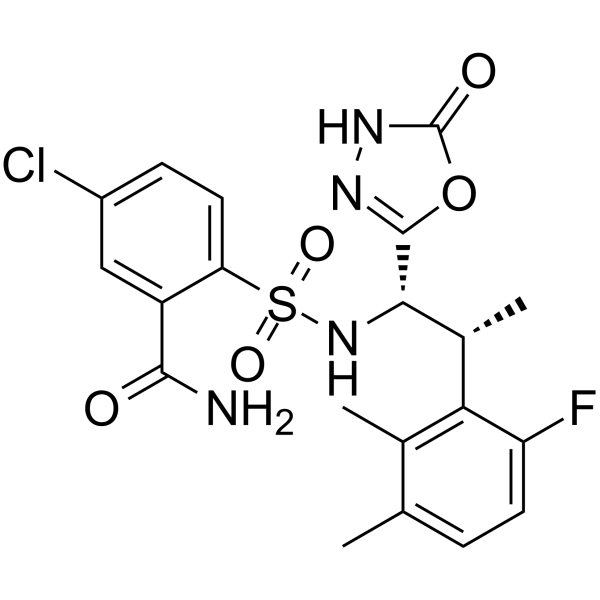
Cas No.: 2166023-31-8
Sample solution is provided at 25 µL, 10mM.
_1-3.$$$39978408@51.jpg');)
_1-9.$$$38538795@65.jpg');)
_1-9.$$$39112701@51.jpg');)
_1-7.$$$37316672@70.jpg');)
_366-372.$$$36198801@70.jpg');)
.$$$38565142@65.jpg');)
_1867-1883.$$$33248023@67.jpg');)
_eads6055.$$$39977546@45.jpg');)
_eadm9805.$$$40080571@45.jpg');)
_eadj3020.$$$39666821@45.jpg');)
_1-20.$$$39757301@28.jpg');)
_1-24.$$$38898113@28.jpg');)
_273-287.$$$36806353@46.jpg');)
_1-16.$$$37156877@44.jpg');)
_1-19.$$$37460805@44.jpg');)
_1291-1307.$$$34518654@46.jpg');)
TAS1553 is a small-molecule protein-protein interaction inhibitor that effectively suppresses the activity of ribonucleotide reductase (RNR). By disrupting the DNA replication process and reducing intracellular deoxyadenosine triphosphate (dATP) levels, TAS1553 ultimately induces apoptosis[1].
In vitro, treatment of human cancer cell lines (HCC38 and MV-4-11) with TAS1553 (0.228–10μmol/L) for 30 minutes to 24 hours significantly depletes the intracellular dATP pool, induces DNA replication stress and replication fork stalling, and leads to apoptotic cell death[1].
In vivo, oral administration of TAS1553 (50–400mg/kg) once daily for 14–21 days in female NOD/SCID mice bearing MV-4-11 xenografts significantly suppresses tumor growth and promotes tumor regression. This is accompanied by reduced intratumoral dATP levels and activation of replication stress and apoptotic pathways [1].
References:
[1] Ueno H, Hoshino T, Yano W, et al. TAS1553, a small molecule subunit interaction inhibitor of ribonucleotide reductase, exhibits antitumor activity by causing DNA replication stress. Commun Biol. 2022 Jun 9;5(1):571.
| Cell experiment [1]: | |
Cell lines | Human cancer cell lines (HCC38 breast cancer, MV-4-11 acute myelogenous leukemia) |
Preparation Method | Cells were maintained in RPMI-1640 or DMEM supplemented with 10% fetal bovine serum (FBS) at 37°C, 5% CO₂. Cells were treated with TAS1553 at concentrations ranging from 0.228 to 10μmol/L for 30 minutes to 24 hours. |
Reaction Conditions | 0.228–10μmol/L; 30min–24h |
Applications | TAS1553 significantly reduced the intracellular dATP pool by disrupting the protein-protein interaction between RNR subunits R1 and R2, leading to DNA replication stress and replication fork stalling. This was accompanied by phosphorylation of Chk1 (Ser345) and RPA2 (Ser4/Ser8, Thr21) within 2 hours. TAS1553 induced apoptosis via caspase-3/7 activation and PARP cleavage, with efficacy strongly correlated with SLFN11 expression levels. |
| Animal experiment [1]: | |
Animal models | F344/NJcl-mu/rnu rats bearing MV-4-11 xenografts, BALB/cAJcl-nu/nu mice bearing HCC38 xenografts, and B6N-Tyrc-Brd/BrdCrCrl mice with systemic MLL-AF9-driven acute myelogenous leukemia (AML). |
Preparation Method | Rats and mice were subcutaneously implanted with tumor cells or intravenously inoculated with AML cells. TAS1553 was administered orally once daily at doses of 50–400mg/kg for 14–21 days. For pharmacodynamic studies, tumors were collected at 1, 2, and 4 hours after a single oral dose. |
Dosage form | 50–400mg/kg; p.o.; Once daily for 14–21 days |
Applications | TAS1553 administration significantly suppressed tumor growth in MV-4-11 xenografts and induced complete tumor regression at 400mg/kg. TAS1553 reduced intratumoral dATP pools within 1–2 hours, triggered DNA replication stress (phospho-Chk1 elevation), and activated apoptosis (cleaved PARP and caspase-3). In the systemic AML model, TAS1553 (100mg/kg) extended median survival by 34.8%. Body weight remained stable, indicating tolerability. |
References: | |
| Cas No. | 2166023-31-8 | SDF | |
| Formula | C20H20ClFN4O5S | M.Wt | 482.91 |
| Solubility | DMSO : 100 mg/mL (207.08 mM; Need ultrasonic) | Storage | Store at -20°C |
| General tips | Please select the appropriate solvent to prepare the stock solution according to the
solubility of the product in different solvents; once the solution is prepared, please store it in
separate packages to avoid product failure caused by repeated freezing and thawing.Storage method
and period of the stock solution: When stored at -80°C, please use it within 6 months; when stored
at -20°C, please use it within 1 month. To increase solubility, heat the tube to 37°C and then oscillate in an ultrasonic bath for some time. |
||
| Shipping Condition | Evaluation sample solution: shipped with blue ice. All other sizes available: with RT, or with Blue Ice upon request. | ||
| Prepare stock solution | |||

|
1 mg | 5 mg | 10 mg |
| 1 mM | 2.0708 mL | 10.3539 mL | 20.7078 mL |
| 5 mM | 414.2 μL | 2.0708 mL | 4.1416 mL |
| 10 mM | 207.1 μL | 1.0354 mL | 2.0708 mL |
Step 1: Enter information below (Recommended: An additional animal making an allowance for loss during the experiment)
 g
μL
g
μL
Step 2: Enter the in vivo formulation (This is only the calculator, not formulation. Please contact us first if there is no in vivo formulation at the solubility Section.)
Calculation results:
Working concentration: mg/ml;
Method for preparing DMSO master liquid: mg drug pre-dissolved in μL DMSO ( Master liquid concentration mg/mL, Please contact us first if the concentration exceeds the DMSO solubility of the batch of drug. )
Method for preparing in vivo formulation: Take μL DMSO master liquid, next addμL PEG300, mix and clarify, next addμL Tween 80, mix and clarify, next add μL saline, mix and clarify.
Method for preparing in vivo formulation: Take μL DMSO master liquid, next add μL Corn oil, mix and clarify.
Note: 1. Please make sure the liquid is clear before adding the next solvent.
2. Be sure to add the solvent(s) in order. You must ensure that the solution obtained, in the previous addition, is a clear solution before proceeding to add the next solvent. Physical methods such as vortex, ultrasound or hot water bath can be used to aid dissolving.
3. All of the above co-solvents are available for purchase on the GlpBio website.
Quality Control & SDS
- View current batch:
- Purity: >98.00% Appearance: A solid
- COA (Certificate of Analysis)
- SDS (Safety Data Sheet)
- Datasheet
Average Rating: 5 (Based on Reviews and 30 reference(s) in Google Scholar.)