

Tis108 |
Catalog No.GC19278
 One-Click Copy Product Info
|

Tis108 is a triazole-type strigolactone (SL)-biosynthesis inhibitor.
Products are for research use only. Not for human use. We do not sell to patients.
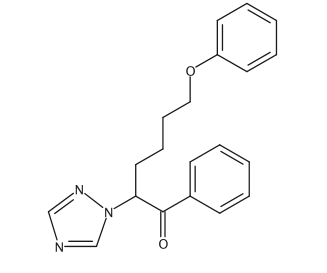
Cas No.: 1315459-30-3
Sample solution is provided at 25 µL, 10mM.
_1-3.$$$39978408@51.jpg');)
_1-9.$$$38538795@65.jpg');)
_1-9.$$$39112701@51.jpg');)
_1-7.$$$37316672@70.jpg');)
_366-372.$$$36198801@70.jpg');)
.$$$38565142@65.jpg');)
_1867-1883.$$$33248023@67.jpg');)
_eads6055.$$$39977546@45.jpg');)
_eadm9805.$$$40080571@45.jpg');)
_eadj3020.$$$39666821@45.jpg');)
_1-20.$$$39757301@28.jpg');)
_1-24.$$$38898113@28.jpg');)
_273-287.$$$36806353@46.jpg');)
_1-16.$$$37156877@44.jpg');)
_1-19.$$$37460805@44.jpg');)
_1291-1307.$$$34518654@46.jpg');)
Tis108 is a triazole-type strigolactone (SL)-biosynthesis inhibitor[1].
TIS108 (3μM) increased the number of branches in Arabidopsis and inhibited root hair elongation[1].Tis108 TIS108 (0, 0.2μM, 1μM and 5μM) has been confirmed to enhance the shoot regeneration capacity of woody plants in M26 material (Malus pumila Mill., a type of apple rootstock)[2]. Tis108 (10μM; 5, 10 and 30 days) promotes stem growth and development of cherry rootstocks and increases the size of cortical cells in cherry rootstocks[3].Treatment of rice seedlings with Tis108 (10-100nM) reduces the levels of strigolactones (SL) in both roots and root exudates in a concentration-dependent manner. The root exudates from Tis108 (1μM)-treated rice seedlings have a weaker stimulatory effect on the germination of Striga compared to those from control plants[4]. Tis108 (3μM; 3 weeks) decreased cotton resistance to Verticillium wilt[5].
References:
[1] Ito S, Umehara M, Hanada A, Yamaguchi S, Asami T. Effects of strigolactone-biosynthesis inhibitor TIS108 on Arabidopsis. Plant Signal Behav. 2013 May;8(5):e24193.
[2] Asghar S, Xiong Y, Che M, Fan X, Li H, Wang Y, Xu X, Li W, Han Z. Transcriptome analysis reveals the effects of strigolactone on shoot regeneration of apple. Plant Cell Rep. 2022 Jul;41(7):1613-1626.
[3] Liu X, Xu Y, Sun W, Wang J, Gao Y, Wang L, Xu W, Wang S, Jiu S, Zhang C. Strigolactones modulate stem length and diameter of cherry rootstocks through interaction with other hormone signaling pathways. Front Plant Sci. 2023 Feb 9;14:1092654.
[4] Ito S, Umehara M, Hanada A, Kitahata N, Hayase H, Yamaguchi S, Asami T. Effects of triazole derivatives on strigolactone levels and growth retardation in rice. PLoS One. 2011;6(7):e21723.
[5] Yi F, Song A, Cheng K, Liu J, Wang C, Shao L, Wu S, Wang P, Zhu J, Liang Z, Chang Y, Chu Z, Cai C, Zhang X, Wang P, Chen A, Xu J, Burritt DJ, Herrera-Estrella L, Tran LP, Li W, Cai Y. Strigolactones positively regulate Verticillium wilt resistance in cotton via crosstalk with other hormones. Plant Physiol. 2023 May 31;192(2):945-966.
| Plant experiment [1]: | |
|
Plant models |
Hai7124 |
|
Preparation Method |
Twenty-four hours prior to inoculation with V.dahliae spores, cotton seedlings (Hai7124) were subjected to soil drenching with 5mL of Tis108 solution (3μM) or an equal volume of water (containing an equivalent amount of ethanol). During the infection period, Tis108 or mock control treatment was applied twice a week to maintain the effect of Tis108. Three weeks after V.dahliae infection, Hai7124 cotton seedlings treated with Tis108 exhibited more severe disease symptoms compared with mock control plants. The disease index of Tis108-treated plants increased by approximately 20% compared with the control group. |
|
Dosage form |
3μM; 3 weeks |
|
Applications |
Tis108 (3μM; 3 weeks) decreased cotton resistance to Verticillium wilt. |
|
References: |
|
| Cas No. | 1315459-30-3 | SDF | |
| Chemical Name | 6-phenoxy-1-phenyl-2-(1H-1,2,4-triazol-1-yl)hexan-1-one | ||
| Formula | C20H21N3O2 | M.Wt | 335.40 |
| Solubility | DMSO : ≥ 125 mg/mL (372.69 mM) | Storage | Store at -20℃ |
| General tips | Please select the appropriate solvent to prepare the stock solution according to the
solubility of the product in different solvents; once the solution is prepared, please store it in
separate packages to avoid product failure caused by repeated freezing and thawing.Storage method
and period of the stock solution: When stored at -80°C, please use it within 6 months; when stored
at -20°C, please use it within 1 month. To increase solubility, heat the tube to 37°C and then oscillate in an ultrasonic bath for some time. |
||
| Shipping Condition | Evaluation sample solution: shipped with blue ice. All other sizes available: with RT, or with Blue Ice upon request. | ||
| Prepare stock solution | |||

|
1 mg | 5 mg | 10 mg |
| 1 mM | 2.9815 mL | 14.9076 mL | 29.8151 mL |
| 5 mM | 596.3 μL | 2.9815 mL | 5.963 mL |
| 10 mM | 298.2 μL | 1.4908 mL | 2.9815 mL |
Step 1: Enter information below (Recommended: An additional animal making an allowance for loss during the experiment)
 g
μL
g
μL
Step 2: Enter the in vivo formulation (This is only the calculator, not formulation. Please contact us first if there is no in vivo formulation at the solubility Section.)
Calculation results:
Working concentration: mg/ml;
Method for preparing DMSO master liquid: mg drug pre-dissolved in μL DMSO ( Master liquid concentration mg/mL, Please contact us first if the concentration exceeds the DMSO solubility of the batch of drug. )
Method for preparing in vivo formulation: Take μL DMSO master liquid, next addμL PEG300, mix and clarify, next addμL Tween 80, mix and clarify, next add μL saline, mix and clarify.
Method for preparing in vivo formulation: Take μL DMSO master liquid, next add μL Corn oil, mix and clarify.
Note: 1. Please make sure the liquid is clear before adding the next solvent.
2. Be sure to add the solvent(s) in order. You must ensure that the solution obtained, in the previous addition, is a clear solution before proceeding to add the next solvent. Physical methods such as vortex, ultrasound or hot water bath can be used to aid dissolving.
3. All of the above co-solvents are available for purchase on the GlpBio website.
Quality Control & SDS
- View current batch:
- Purity: >99.00% Appearance: A solid
- COA (Certificate of Analysis)
- SDS (Safety Data Sheet)
- Datasheet
Average Rating: 5 (Based on Reviews and 30 reference(s) in Google Scholar.)