

Traumatic Acid (Synonyms: trans-2-Dodecenedioic Acid) |
Catalog No.GC45074
 One-Click Copy Product Info
|

Traumatic Acid is a plant wound hormone and is used as an intermediate in prostaglandin synthesis.
Products are for research use only. Not for human use. We do not sell to patients.
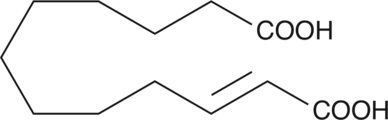
Cas No.: 6402-36-4
Sample solution is provided at 25 µL, 10mM.
_1-3.$$$39978408@51.jpg');)
_1-9.$$$38538795@65.jpg');)
_1-9.$$$39112701@51.jpg');)
_1-7.$$$37316672@70.jpg');)
_366-372.$$$36198801@70.jpg');)
.$$$38565142@65.jpg');)
_1867-1883.$$$33248023@67.jpg');)
_eads6055.$$$39977546@45.jpg');)
_eadm9805.$$$40080571@45.jpg');)
_eadj3020.$$$39666821@45.jpg');)
_1-20.$$$39757301@28.jpg');)
_1-24.$$$38898113@28.jpg');)
_273-287.$$$36806353@46.jpg');)
_1-16.$$$37156877@44.jpg');)
_1-19.$$$37460805@44.jpg');)
_1291-1307.$$$34518654@46.jpg');)
Traumatic Acid is a plant wound hormone and is used as an intermediate in prostaglandin synthesis[1]. Traumatic Acid maintains liver and intestinal dysfunction by suppressing TNF and IL-17 signaling pathways, and supports neuromuscular function, improves immune function, regulates lipid metabolism[2]. Traumatic Acid has been widely used as an antioxidant to enhance antioxidant enzyme activity and suppress lipid peroxidation and oxidative destruction of proteins[3].
In vitro, Traumatic Acid treatment (100μM) for 24 hours significantly inhibited the viability of MCF-7 and MDA-MB-231 cells[4]. Treatment with 200μM Traumatic Acid for 24 hours induced apoptosis in ZR-75-1 cells, stimulated oxidative stress, and led to a decrease in thiol group content[5]. 10μM Traumatic Acid incubated for 5 days promoted the proliferation of human skin fibroblasts, reduced the level of membrane phospholipid peroxidation, facilitated the biosynthesis of collagen, and increased the content of reduced glutathione (GSH)[6].
In vivo, daily exposure to an aqueous environment containing 200µM Traumatic Acid for 6 hours over 3 consecutive days reduced lipid accumulation and inhibited high-fat diet (HFD)-induced body weight gain in zebrafish larvae[7].
References:[1] Tsai J S, Wang S Y, Chang C H, et al. Identification of traumatic acid as a potential plasma biomarker for sarcopenia using a metabolomics‐based approach[J]. Journal of cachexia, sarcopenia and muscle, 2022, 13(1): 276-286.
[2] Naveed M, Atta A, Rui B, et al. Combination of Withania coagulans and Fagonia cretica ameliorates hyperuricemia by re-modulating gut microbiota-derived spermidine and traumatic acid[J]. Phytomedicine, 2025: 157079.
[3] Pietryczuk A, Czerpak R. Effect of traumatic acid on antioxidant activity in Chlorella vulgaris (Chlorophyceae)[J]. Plant Growth Regulation, 2011, 65(2): 279-286.
[4] Jabłońska-Trypuć A, Wydro U, Wołejko E, et al. Toxicological effects of traumatic acid and selected herbicides on human breast cancer cells: In vitro cytotoxicity assessment of analyzed compounds[J]. Molecules, 2019, 24(9): 1710.
[5] Jabłońska-Trypuć A, Wydro U, Wołejko E, et al. Possible protective effects of TA on the cancerous effect of mesotrione[J]. Nutrients, 2020, 12(5): 1343.
[6] Jabłońska-Trypuć A, Pankiewicz W, Czerpak R. Traumatic acid reduces oxidative stress and enhances collagen biosynthesis in cultured human skin fibroblasts[J]. Lipids, 2016, 51(9): 1021-1035.
[7] Gao J, Zhang Z, Dong X, et al. Traumatic acid inhibits ACSL4 associated lipid accumulation in adipocytes to attenuate high‐fat diet‐induced obesity[J]. The FASEB Journal, 2023, 37(12): e23278.
| Cell experiment [1]: | |
|
Cell lines |
ZR-75-1 cells |
|
Preparation Method |
ZR-75-1 cells were cultured in RPMI-1640 medium supplemented with 10% inactivated fetal bovine serum, 25mM glucose and 1% penicillin-streptomycin at 37°C, in a humidified atmosphere containing 5% CO2. Cells were seeded in a 96-well plate at a density of 2×10⁴ cells/well overnight, were treated with different concentrations of Traumatic Acid (0.5, 1, 10, 50, 100, 200, 500, and 1000µM) for 24h. Cell viability was measured. |
|
Reaction Conditions |
0.5, 1, 10, 50, 100, 200, 500, and 1000µM; 24h |
|
Applications |
Traumatic Acid treatment reduced cell viability of ZR-75-1 cells in a dose-dependent manner. |
| Animal experiment [2]: | |
|
Animal models |
Zebrafish larvae of TU strain |
|
Preparation Method |
Zebrafish larvae of TU strain were randomly assigned to the different treatment groups. The sample size per treatment group was 17 zebrafish larvae. From 4 to 6dpf (days post fertilization), larvae zebrafish were placed in HFD [diluting 1:10 clotted cream in fish water containing 200μM 1-phenyl 2-thiourea (PTU), ingredients: 56.0g of fat, of which saturates 35.5g, 2.2g of carbohydrate, of which sugar 2.2g, 1.6g of protein, trace of salt] or control diet (paramecium solution). From 4 to 6dpf, zebrafish larvae were exposed to Traumatic Acid (200μM) and fed for 6h with HFD or a control diet. 7dpf zebrafish larvae fixed and stained with Oil Red O are shown under the light microscope. |
|
Dosage form |
200μM; 6h every day; 3 days; environment expose |
|
Applications |
Traumatic Acid treatment mitigated HFD-induced lipid accumulation in zebrafish larvae. |
| References: [1] Jabłońska-Trypuć A, Wydro U, Wołejko E, et al. Possible protective effects of TA on the cancerous effect of mesotrione[J]. Nutrients, 2020, 12(5): 1343. [2] Gao J, Zhang Z, Dong X, et al. Traumatic acid inhibits ACSL4 associated lipid accumulation in adipocytes to attenuate high‐fat diet‐induced obesity[J]. The FASEB Journal, 2023, 37(12): e23278. | |
| Cas No. | 6402-36-4 | SDF | |
| Synonyms | trans-2-Dodecenedioic Acid | ||
| Chemical Name | 2E-dodecenedioic acid | ||
| Canonical SMILES | OC(=O)CCCCCCCC/C=C\C(=O)O | ||
| Formula | C12H20O4 | M.Wt | 228.3 |
| Solubility | >21.6 mg/ml in DMF, 21.4 mg/ml in DMSO, >10.7 mg/ml in ethanol | Storage | Store at -20°C |
| General tips | Please select the appropriate solvent to prepare the stock solution according to the
solubility of the product in different solvents; once the solution is prepared, please store it in
separate packages to avoid product failure caused by repeated freezing and thawing.Storage method
and period of the stock solution: When stored at -80°C, please use it within 6 months; when stored
at -20°C, please use it within 1 month. To increase solubility, heat the tube to 37°C and then oscillate in an ultrasonic bath for some time. |
||
| Shipping Condition | Evaluation sample solution: shipped with blue ice. All other sizes available: with RT, or with Blue Ice upon request. | ||
| Prepare stock solution | |||

|
1 mg | 5 mg | 10 mg |
| 1 mM | 4.3802 mL | 21.901 mL | 43.802 mL |
| 5 mM | 876 μL | 4.3802 mL | 8.7604 mL |
| 10 mM | 438 μL | 2.1901 mL | 4.3802 mL |
Step 1: Enter information below (Recommended: An additional animal making an allowance for loss during the experiment)
 g
μL
g
μL
Step 2: Enter the in vivo formulation (This is only the calculator, not formulation. Please contact us first if there is no in vivo formulation at the solubility Section.)
Calculation results:
Working concentration: mg/ml;
Method for preparing DMSO master liquid: mg drug pre-dissolved in μL DMSO ( Master liquid concentration mg/mL, Please contact us first if the concentration exceeds the DMSO solubility of the batch of drug. )
Method for preparing in vivo formulation: Take μL DMSO master liquid, next addμL PEG300, mix and clarify, next addμL Tween 80, mix and clarify, next add μL saline, mix and clarify.
Method for preparing in vivo formulation: Take μL DMSO master liquid, next add μL Corn oil, mix and clarify.
Note: 1. Please make sure the liquid is clear before adding the next solvent.
2. Be sure to add the solvent(s) in order. You must ensure that the solution obtained, in the previous addition, is a clear solution before proceeding to add the next solvent. Physical methods such as vortex, ultrasound or hot water bath can be used to aid dissolving.
3. All of the above co-solvents are available for purchase on the GlpBio website.
Quality Control & SDS
- View current batch:
- Purity: >96.00% Appearance: A solid
- COA (Certificate of Analysis)
- SDS (Safety Data Sheet)
- Datasheet
Average Rating: 5 (Based on Reviews and 13 reference(s) in Google Scholar.)