

Tricin |
Catalog No.GC39158
 One-Click Copy Product Info
|

Tricin is a natural flavonoid widely distributed in grasses and legumes, possessing various biological activities such as anti-inflammatory, antioxidant, and antitumor effects.
Products are for research use only. Not for human use. We do not sell to patients.
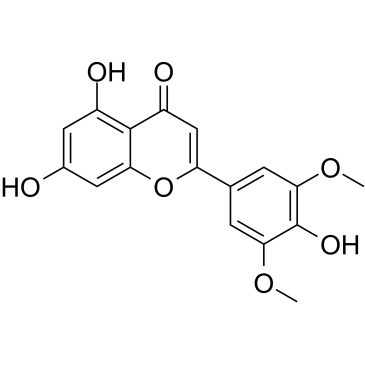
Cas No.: 520-32-1
Sample solution is provided at 25 µL, 10mM.
_1-3.$$$39978408@51.jpg');)
_1-9.$$$38538795@65.jpg');)
_1-9.$$$39112701@51.jpg');)
_1-7.$$$37316672@70.jpg');)
_366-372.$$$36198801@70.jpg');)
.$$$38565142@65.jpg');)
_1867-1883.$$$33248023@67.jpg');)
_eads6055.$$$39977546@45.jpg');)
_eadm9805.$$$40080571@45.jpg');)
_eadj3020.$$$39666821@45.jpg');)
_1-20.$$$39757301@28.jpg');)
_1-24.$$$38898113@28.jpg');)
_273-287.$$$36806353@46.jpg');)
_1-16.$$$37156877@44.jpg');)
_1-19.$$$37460805@44.jpg');)
_1291-1307.$$$34518654@46.jpg');)
Tricin is a natural flavonoid widely distributed in grasses and legumes, possessing various biological activities such as anti-inflammatory, antioxidant, and antitumor effects[1-2]. Tricin can ameliorate non-alcoholic fatty liver disease by modulating the AMPK-dependent pathway[3]. Tricin anti-inflammatory activity is mediated through regulation of the NF-κB and MAPK signaling pathways[4].
In vitro, treatment of high glucose-induced H9C2 cardiomyocytes with Tricin (2.5–10μM) for 48 hours significantly inhibited the release of reactive oxygen species (ROS) and lactate dehydrogenase (LDH), while enhancing superoxide dismutase (SOD) activity, thereby alleviating oxidative stress damage[5]. Pretreatment of PC12 and SH-SY5Y cells with Tricin (20-100μM) for 24 hours markedly increased the expression of the autophagy marker LC3-II and promoted autophagy activation, while reducing abnormal aggregation of α-synuclein[6].
In vivo, Tricin (50mg/kg diet) administered via feed for 15 weeks in a mouse model of inflammation-associated colon cancer induced by azoxymethane (AOM; 10mg/kg) combined with dextran sulfate sodium (DSS; 1.5%w/v) significantly suppressed the incidence of colon adenocarcinoma and reduced TNF-α expression levels in the colonic mucosa[7]. In a C57BL/6J mouse tumor model transplanted with LLC cells, daily intraperitoneal injection of Tricin (25mg/kg) for 15 days markedly inhibited the growth of KRASG12C-mutant non-small cell lung cancer tumors and significantly reduced SRC phosphorylation and PD-L1 protein expression levels in tumor tissues[8].
References:
[1] Jiang B, Song J, Jin Y. A flavonoid monomer tricin in Gramineous plants: Metabolism, bio/chemosynthesis, biological properties, and toxicology. Food Chem. 2020 Aug 1;320:126617.
[2] Leonte D, Ungureanu D, Zaharia V. Flavones and Related Compounds: Synthesis and Biological Activity. Molecules. 2023 Sep 8;28(18):6528.
[3] Chang BY, Bae JH, Lim CY, et al. Tricin-enriched Zizania latifolia ameliorates non-alcoholic fatty liver disease through AMPK-dependent pathways. Food Sci Biotechnol. 2023 Jun 30;32(14):2117-2129.
[4] Li XX, Chen SG, Yue GG, et al. Natural flavone tricin exerted anti-inflammatory activity in macrophage via NF-κB pathway and ameliorated acute colitis in mice. Phytomedicine. 2021 Sep;90:153625.
[5] Yu R, Zhang Y, Wang T, et al. Effect of Tricin on cardiomyocyte damage caused by diabetic cardiomyopathy (DCM). BMC Cardiovasc Disord. 2024 Nov 23;24(1):668.
[6] Wang X, Hu W, Qu L, et al. Tricin promoted ATG-7 dependent autophagic degradation of α-synuclein and dopamine release for improving cognitive and motor deficits in Parkinson's disease. Pharmacol Res. 2023 Oct;196:106874.
[7] Tanaka T, Oyama T, Sugie S. Dietary Tricin Suppresses Inflammation-Related Colon Carcinogenesis in Mice. J Nutr Sci Vitaminol (Tokyo). 2019;65(Supplement):S100-S103.
[8] Li JX, Tan SY, Li LQ, et al. Tricin selectively combats KRAS-mutant non-small cell lung cancer by inhibiting the PDGF-BB-induced SRC/MAPK/AP-1/PD-L1 signaling pathway and potentiating the antitumor effect of an anti-PD-1 antibody. Front Pharmacol. 2025 Jun 17;16:1594213.
| Cell experiment [1]: | |
Cell lines | Rat H9C2 cardiomyocytes |
Preparation Method | H9C2 cells were maintained in Dulbecco’s Modified Eagle Medium (DMEM) supplemented with 10% fetal bovine serum (FBS) and 1% penicillin-streptomycin at 37°C, 5% CO₂. Cells were serum-starved in low-glucose DMEM for 24 hours to establish a high glucose (HG)-induced diabetic cardiomyopathy (DCM) model. Cells were treated with Tricin at concentrations of 2.5μM, 5μM, and 10μM for 48 hours under HG conditions (150mM glucose). |
Reaction Conditions | 2.5–10μM; 48h |
Applications | Tricin significantly reduced high glucose-induced reactive oxygen species (ROS) and lactate dehydrogenase (LDH) levels while increasing superoxide dismutase (SOD) activity in a dose-dependent manner. Tricin also suppressed the expression of pro-inflammatory cytokines (TNF-α, IL-1β, and IL-6) and inhibited the activation of the TLR4/MYD88/NF-κB signaling pathway. |
| Animal experiment [2]: | |
Animal models | C57BL/6J mice (xenograft tumor model) |
Preparation Method | LLC cells (KRASG12C-mutant) were transplanted into mice. Tricin (25mg/kg; i.p.; daily) and anti-PD-1 antibody (250μg/mouse; i.p.; every 3 days) were administered alone or in combination for 15 days after tumor volume reached 50–100mm³. |
Dosage form | 25mg/kg; i.p.; for 15 days |
Applications | Combined treatment with Tricin and anti-PD-1 antibody significantly suppressed tumor growth and increased CD8⁺ T lymphocytes and B lymphocytes in spleen, blood, and tumor tissues. Combined treatment also enhanced functional cytokines (TNF-α, IFN-γ, Granzyme B) and disrupted PD-1/PD-L1 pathway, demonstrating synergistic antitumor immunity with minimal organ toxicity. |
References: | |
| Cas No. | 520-32-1 | SDF | |
| Canonical SMILES | O=C1C=C(C2=CC(OC)=C(O)C(OC)=C2)OC3=CC(O)=CC(O)=C13 | ||
| Formula | C17H14O7 | M.Wt | 330.29 |
| Solubility | DMSO: 125 mg/mL (378.46 mM) | Storage | 4°C, protect from light |
| General tips | Please select the appropriate solvent to prepare the stock solution according to the
solubility of the product in different solvents; once the solution is prepared, please store it in
separate packages to avoid product failure caused by repeated freezing and thawing.Storage method
and period of the stock solution: When stored at -80°C, please use it within 6 months; when stored
at -20°C, please use it within 1 month. To increase solubility, heat the tube to 37°C and then oscillate in an ultrasonic bath for some time. |
||
| Shipping Condition | Evaluation sample solution: shipped with blue ice. All other sizes available: with RT, or with Blue Ice upon request. | ||
| Prepare stock solution | |||

|
1 mg | 5 mg | 10 mg |
| 1 mM | 3.0276 mL | 15.1382 mL | 30.2764 mL |
| 5 mM | 605.5 μL | 3.0276 mL | 6.0553 mL |
| 10 mM | 302.8 μL | 1.5138 mL | 3.0276 mL |
Step 1: Enter information below (Recommended: An additional animal making an allowance for loss during the experiment)
 g
μL
g
μL
Step 2: Enter the in vivo formulation (This is only the calculator, not formulation. Please contact us first if there is no in vivo formulation at the solubility Section.)
Calculation results:
Working concentration: mg/ml;
Method for preparing DMSO master liquid: mg drug pre-dissolved in μL DMSO ( Master liquid concentration mg/mL, Please contact us first if the concentration exceeds the DMSO solubility of the batch of drug. )
Method for preparing in vivo formulation: Take μL DMSO master liquid, next addμL PEG300, mix and clarify, next addμL Tween 80, mix and clarify, next add μL saline, mix and clarify.
Method for preparing in vivo formulation: Take μL DMSO master liquid, next add μL Corn oil, mix and clarify.
Note: 1. Please make sure the liquid is clear before adding the next solvent.
2. Be sure to add the solvent(s) in order. You must ensure that the solution obtained, in the previous addition, is a clear solution before proceeding to add the next solvent. Physical methods such as vortex, ultrasound or hot water bath can be used to aid dissolving.
3. All of the above co-solvents are available for purchase on the GlpBio website.
Quality Control & SDS
- View current batch:
- Purity: >99.00% Appearance: A solid
- COA (Certificate of Analysis)
- SDS (Safety Data Sheet)
- Datasheet
Average Rating: 5 (Based on Reviews and 23 reference(s) in Google Scholar.)