

Trifluoperazine |
Catalog No.GC63240
 One-Click Copy Product Info
|

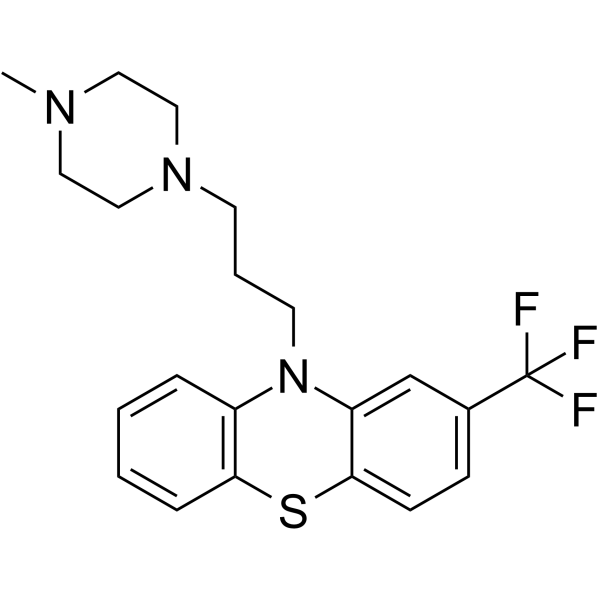
Trifluoperazine (TFP) is an antagonist against dopamine receptors, act as antipsychotic agent and is widely used to treat schizophrenia or related psychoses.
Products are for research use only. Not for human use. We do not sell to patients.
Cas No.: 117-89-5
Sample solution is provided at 25 µL, 10mM.
_1-3.$$$39978408@51.jpg');)
_1-9.$$$38538795@65.jpg');)
_1-9.$$$39112701@51.jpg');)
_1-7.$$$37316672@70.jpg');)
_366-372.$$$36198801@70.jpg');)
.$$$38565142@65.jpg');)
_1867-1883.$$$33248023@67.jpg');)
_eads6055.$$$39977546@45.jpg');)
_eadm9805.$$$40080571@45.jpg');)
_eadj3020.$$$39666821@45.jpg');)
_1-20.$$$39757301@28.jpg');)
_1-24.$$$38898113@28.jpg');)
_273-287.$$$36806353@46.jpg');)
_1-16.$$$37156877@44.jpg');)
_1-19.$$$37460805@44.jpg');)
_1291-1307.$$$34518654@46.jpg');)
Trifluoperazine (TFP) is an antagonist against dopamine receptors, act as antipsychotic agent and is widely used to treat schizophrenia or related psychoses [1,2]. Trifluoperazine is also a well-known calmodulin antagonist [3].
Trifluoperazine significantly restricted the invasion of glioblastoma cells at a concentration higher than 1 µmol/L, with a half-maximal effective concentration at around 10 µmol/L on invasion of U87MG cells by performing Matrigel transwell invasion assay. The ratio of proliferated glioblastoma cells was significantly decreased in TFP-treated cells [4]. Trifluoperazine inhibits cell vitality, proliferation, and induces cell apoptosis of HCT116 cells with IC50 =14 µM [3]. Trifluoperazine (30 µM, 24h) induced pancreatic adenocarcinoma (PDAC) MiaPaCa-2 cell death and decreased in intracellular availability of ATP [5].
Trifluoperazine (5 mg/kg/day) significantly suppressed the glioblastoma growth of the xenograft mice as evidenced by a marked decrease of glioblastoma tumor size in TFP-treated mice at day 21, there was no lung metastasis in TFP-treated group in the skin xenograft model [4]. Administration of TFP induced remarkably tumor regression with decreased tumor volume in the xenograft model of human HCT116 [3]. Trifluoperazine binds and mimics the effect of the genetic inhibition of NUPR1, a stress protein that promotes tumor growth and acts as a strong anticancer drug in vitro and in vivo in xenografted nude mice [6].
References:
[1]. de Oliveira Marques L, Soares B, de Lima M S. Trifluoperazine for schizophrenia[J]. Cochrane Database of Systematic Reviews, 2004 (1).
[2]. Hong M, Jenner P, Marsden C D. Comparison of the acute actions of amine-depleting drugs and dopamine receptor antagonists on dopamine function in the brain in rats[J]. Neuropharmacology, 1987, 26(2-3): 237-245.
[3]. Qian K, Sun L, Zhou G, et al. Trifluoperazine as an alternative strategy for the inhibition of tumor growth of colorectal cancer[J]. Journal of cellular biochemistry, 2019, 120(9): 15756-15765.
[4]. Kang S, Hong J, Lee J M, et al. Trifluoperazine, a well-known antipsychotic, inhibits glioblastoma invasion by binding to calmodulin and disinhibiting calcium release channel IP3R[J]. Molecular cancer therapeutics, 2017, 16(1): 217-227.
[5]. Huang C, Lan W, Fraunhoffer N, et al. Dissecting the anticancer mechanism of trifluoperazine on pancreatic ductal adenocarcinoma[J]. Cancers, 2019, 11(12): 1869.
[6]. Neira J L, Bintz J, Arruebo M, et al. Identification of a drug targeting an intrinsically disordered protein involved in pancreatic adenocarcinoma[J]. Scientific reports, 2017, 7(1): 1-15.
| Cell experiment [1]: | |
|
Cell lines |
U87MG human glioblastoma cells |
|
Preparation Method |
Cells were seeded into 96-well plates at a density of 1.5 × 10³ cells per well and allowed to attach for 24 hours. Cells were treated with vehicle or the indicated concentrations of Trifluoperazine diluted in complete media for each 24, 48, and 72 hours. Cell proliferation was determined by 3-[4, 5-dimethylthiazol-2-yl]-2, 5-diphenyltetrazolium bromide (MTT) assay. |
|
Reaction Conditions |
0-20µM for 24, 48, and 72 hours |
|
Applications |
U87MG cell viability decreased time dependently (24, 48, and 72-hour Trifluoperazine treatment) as well as dose dependently (1, 2, 5, 10, and 20 µmol/L of Trifluoperazine) |
| Animal experiment [2]: | |
|
Animal models |
nude mice |
|
Preparation Method |
In total 2 × 10⁶ HCT116 cells were subcutaneously injected in rear flank of nude mice (five per group). The TFP (10 mg/kg, intraperitoneal) was administrated to each group for five times, 3 days apart. |
|
Dosage form |
Intraperitoneal injection, 10 mg/kg, 5 times, 3 days apart |
|
Applications |
Administration of TFP induced remarkably tumor regression with decreased tumor volume. The proliferation index Ki-67 was analyzed and found that TFP was able to reduce the Ki-67 levels in vivo. |
|
References: [1]: Kang S, Hong J, Lee J M, et al. Trifluoperazine, a well-known antipsychotic, inhibits glioblastoma invasion by binding to calmodulin and disinhibiting calcium release channel IP3R[J]. Molecular cancer therapeutics, 2017, 16(1): 217-227. |
|
| Cas No. | 117-89-5 | SDF | |
| Formula | C21H24F3N3S | M.Wt | 407.5 |
| Solubility | DMSO : 50mg/mL | Storage | Store at -20°C |
| General tips | Please select the appropriate solvent to prepare the stock solution according to the
solubility of the product in different solvents; once the solution is prepared, please store it in
separate packages to avoid product failure caused by repeated freezing and thawing.Storage method
and period of the stock solution: When stored at -80°C, please use it within 6 months; when stored
at -20°C, please use it within 1 month. To increase solubility, heat the tube to 37°C and then oscillate in an ultrasonic bath for some time. |
||
| Shipping Condition | Evaluation sample solution: shipped with blue ice. All other sizes available: with RT, or with Blue Ice upon request. | ||
| Prepare stock solution | |||

|
1 mg | 5 mg | 10 mg |
| 1 mM | 2.454 mL | 12.2699 mL | 24.5399 mL |
| 5 mM | 490.8 μL | 2.454 mL | 4.908 mL |
| 10 mM | 245.4 μL | 1.227 mL | 2.454 mL |
Step 1: Enter information below (Recommended: An additional animal making an allowance for loss during the experiment)
 g
μL
g
μL
Step 2: Enter the in vivo formulation (This is only the calculator, not formulation. Please contact us first if there is no in vivo formulation at the solubility Section.)
Calculation results:
Working concentration: mg/ml;
Method for preparing DMSO master liquid: mg drug pre-dissolved in μL DMSO ( Master liquid concentration mg/mL, Please contact us first if the concentration exceeds the DMSO solubility of the batch of drug. )
Method for preparing in vivo formulation: Take μL DMSO master liquid, next addμL PEG300, mix and clarify, next addμL Tween 80, mix and clarify, next add μL saline, mix and clarify.
Method for preparing in vivo formulation: Take μL DMSO master liquid, next add μL Corn oil, mix and clarify.
Note: 1. Please make sure the liquid is clear before adding the next solvent.
2. Be sure to add the solvent(s) in order. You must ensure that the solution obtained, in the previous addition, is a clear solution before proceeding to add the next solvent. Physical methods such as vortex, ultrasound or hot water bath can be used to aid dissolving.
3. All of the above co-solvents are available for purchase on the GlpBio website.
Quality Control & SDS
- View current batch:
- Purity: >98.00% Appearance: A solid
- COA (Certificate of Analysis)
- SDS (Safety Data Sheet)
- Datasheet
Average Rating: 5 (Based on Reviews and 30 reference(s) in Google Scholar.)