

2,3-Butanedione-2-monoxime (Synonyms: BDM|Diacetyl Monoxime|NSC 660|NSC 116103) |
Catalog No.GC12469
 One-Click Copy Product Info
|

2,3-Butanedione-2-monoxime, a non-competitive inhibitor of myosin ATPase, inhibits the ATPase rate of myosin-V and non-muscle myosin-II but not of kinesin or dynein.
Products are for research use only. Not for human use. We do not sell to patients.
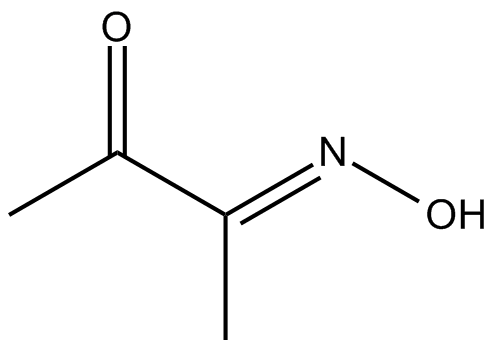
Cas No.: 57-71-6
Sample solution is provided at 25 µL, 10mM.
_1-3.$$$39978408@51.jpg');)
_1-9.$$$38538795@65.jpg');)
_1-9.$$$39112701@51.jpg');)
_1-7.$$$37316672@70.jpg');)
_366-372.$$$36198801@70.jpg');)
.$$$38565142@65.jpg');)
_1867-1883.$$$33248023@67.jpg');)
_eads6055.$$$39977546@45.jpg');)
_eadm9805.$$$40080571@45.jpg');)
_eadj3020.$$$39666821@45.jpg');)
_1-20.$$$39757301@28.jpg');)
_1-24.$$$38898113@28.jpg');)
_273-287.$$$36806353@46.jpg');)
_1-16.$$$37156877@44.jpg');)
_1-19.$$$37460805@44.jpg');)
_1291-1307.$$$34518654@46.jpg');)
2,3-Butanedione-2-monoxime, a non-competitive inhibitor of myosin ATPase, inhibits the ATPase rate of myosin-V and non-muscle myosin-II but not of kinesin or dynein.
2,3-Butanedione-2-monoxime also acts as a reactivator of phosphorylated acetylcholinesterase by removing the phosphate group from the enzyme[1].
In vitro, 2,3-Butanedione-2-monoxime (50mM; 6h or 48h) decreased protein secretion in C. cinerea[2]. 2,3-Butanedione-2-monoxime (50mM; 2h or 4h) resulted in Golgi aggregation but did not alter ER localization in C. cinerea[2]. 2,3-Butanedione-2-monoxime (30mM; 10min; 37℃) decreased accumulated sarcoplasmic reticulum (SR) Ca2+ in Canine ventricular myocytes in the absence of efflux inhibitors[3].
In vivo, 2,3-Butanedione-2-monoxime (5-200mg/kg; i.v.; once) dose-dependently reduced blood pressure in Male spontaneously hypertensive (SHR) and age-matched Wistar-Kyoto (WKY) rat, with a greater antihypertensive effect in SHR rats[4]. 2,3-Butanedione-2-monoxime (0-205mg/kg; i.p.; once) dose-dependently suppressed clonic and tonic-clonic seizures induced by picrotoxin (PTX) in adult mice[5].
References:
[1] Ostap, E Michael. “2,3-Butanedione monoxime (BDM) as a myosin inhibitor.” Journal of muscle research and cell motility vol. 23,4 (2002): 305-8.
[2] Hashimoto, Kohsuke et al. “The myosin ATPase inhibitor, 2,3-butanedione 2-monoxime, prevents protein secretion by the basidiomycete Coprinopsis cinerea.” Biotechnology letters vol. 33,4 (2011): 769-75.
[3] Phillips, R M, and R A Altschuld. “2,3-Butanedione 2-monoxime (BDM) induces calcium release from canine cardiac sarcoplasmic reticulum.” Biochemical and biophysical research communications vol. 229,1 (1996): 154-7.
[4] Xiao, Y F, and J J McArdle. “Effects of 2,3-butanedione monoxime on blood pressure, myocardial Ca2+ currents, and action potentials of rats.” American journal of hypertension vol. 8,12 Pt 1 (1995): 1232-40. doi:10.1016/0895-7061(95)00251-0
[5] Brightman, T et al. “2,3-Butanedione monoxime protects mice against the convulsant effect of picrotoxin by facilitating GABA-activated currents.” Brain research vol. 678,1-2 (1995): 110-6.
| Kinase experiment [1]: | |
Preparation Method | All experiments were performed at 25±0.1℃ in KMg50–MOPS buffer (10mM MOPS, pH 7.0, 50mM KCl, 1mM MgCl2, 1mM EGTA, 1mM DTT). 160mM 2,3-Butanedione-2-monoxime (BDM) stock solution was made in KMg50–MOPS immediately before each set of experiments. Solutions of 2,3-Butanedione-2-monoxime were used within 2h of preparation. The reaction was initiated by mixing 4mM MgATP with an equal volume of myosin or actomyosin in 2·-reaction mix (400µM NADH, 1mM phosphoenolpyruvate, 40U/ml lactate dehydrogenase, 200U/ml pyruvate kinase, KMg50–MOPS buffer). 2,3-Butanedione-2-monoxime (0-50mM) did not inhibit the NADH-coupled reaction as measured by direct mixing with MgADP. 2,3-Butanedione-2-monoxime was added tomyosin solutions from concentrated stock 5min before each ATPase measurement. |
Reaction Conditions | 0-50mM; 5min |
Applications | The 2,3-Butanedione-2-monoxime concentration at half maximal inhibition (KI) in KMg50–MOPS is 4.1±1.0mM. The steady-state ATPase rates of myole and Acanthamoeba myosin-IC were not inhibited by 2,3-Butanedione monoxime |
| Cell experiment [2]: | |
Cell lines | Canine ventricular myocytes |
Preparation Method | Myocytes were washed twice and resuspended in the following buffer at room temperature: in (mM) NaCl 50, Na2HPO4/NaH2PO4 50, glucose 11, N,N-bis[2-hydroxyethyl]-2-aminoethanesulfonic acid (BES) 20, rotenone 0.016, EGTA 0.2. The buffer was then supplemented with oligomycin 0.01, phosphocreatine 10, dithiothreitol 1, MgATP 10, and 0.2units/ml creatine phosphokinase. Where indicated, ruthenium red 0.03, and procaine 10 were added to inhibit SR Ca2+ efflux. All cells were lysed with 16mg digitonin/mg myocyte protein, and pH was adjusted to 7.2. At this point, the lysed myocytes were divided into 1.5ml aliquots, and the proper quantity of 2,3-Butanedione-2-monoxime (1M stock) and/or vehicle (water) was added. Cells were warmed to 37℃ during a 5 minute pre-incubation and the appropriate 45Ca2+ EGTA buffer was added. The cells were incubated for 5 minutes at 37℃, when duplicate 0.5ml samples were sedimented through a layer of 97% bromododecane/3% dodecane into 0.1ml of 2N perchloric acid, all layered in a 1.5ml microcentrifuge tube. SR 45Ca2+ uptake was determined by counting a 75ml aliquot of the acid extract using Beckman Ready Caps in a Beckman LS 6800 liquid scintillation counter. |
Reaction Conditions | 30mM; 5+5min |
Applications | 2,3-Butanedione-2-monoxime has no effect on sarcoplasmic reticulum (SR) Ca2+ uptake when efflux is prevented with ruthenium red and procaine. In the absence of efflux inhibitors, a substantial decrease in accumulated SR Ca2+ is observed in the curve with 30mM 2,3-Butanedione-2-monoxime and a synergistic relationship between 2,3-Butanedione-2-monoxime and free Ca2+ concentration is observed. |
| Animal experiment [3]: | |
Animal models | Male spontaneously hypertensive (SHR) and age-matched Wistar-Kyoto (WKY) rat |
Preparation Method | 2,3-Butanedione-2-monoxime was freshly dissolved in physiological saline. Doses of 2,3-Butanedione-2-monoxime ranging from 5 to 200mg/kg were slowly given by intravenous injection over 30sec. The volume of 2,3-Butanedione-2-monoxime solution injected was about 1ml/kg. |
Dosage form | 5, 30, 100 and 200mg/kg; i.v.; once |
Applications | 5, 30, 100 and 200mg/kg 2,3-Butanedione-2-monoxime (intravenously) reduced blood pressure (BP) of the SHR by 9±3, 20±3, 49±5, and 63±7mmHg, respectively. The same doses of 2,3-Butanedione-2-monoxime reduced BP of the WKY by 0, 2±0.4, 18±3, and 26±3mmHg. |
References: | |
| Cas No. | 57-71-6 | SDF | |
| Synonyms | BDM|Diacetyl Monoxime|NSC 660|NSC 116103 | ||
| Chemical Name | 2,3-butanedione, 2-oxime | ||
| Canonical SMILES | CC(/C(C)=N/O)=O | ||
| Formula | C4H7NO2 | M.Wt | 101.1 |
| Solubility | DMF: 30 mg/ml,DMSO: 30 mg/ml,Ethanol: 30 mg/ml,PBS (pH 7.2): 2 mg/ml | Storage | Store at -20°C |
| General tips | Please select the appropriate solvent to prepare the stock solution according to the
solubility of the product in different solvents; once the solution is prepared, please store it in
separate packages to avoid product failure caused by repeated freezing and thawing.Storage method
and period of the stock solution: When stored at -80°C, please use it within 6 months; when stored
at -20°C, please use it within 1 month. To increase solubility, heat the tube to 37°C and then oscillate in an ultrasonic bath for some time. |
||
| Shipping Condition | Evaluation sample solution: shipped with blue ice. All other sizes available: with RT, or with Blue Ice upon request. | ||
| Prepare stock solution | |||

|
1 mg | 5 mg | 10 mg |
| 1 mM | 9.8912 mL | 49.456 mL | 98.912 mL |
| 5 mM | 1.9782 mL | 9.8912 mL | 19.7824 mL |
| 10 mM | 989.1 μL | 4.9456 mL | 9.8912 mL |
Step 1: Enter information below (Recommended: An additional animal making an allowance for loss during the experiment)
 g
μL
g
μL
Step 2: Enter the in vivo formulation (This is only the calculator, not formulation. Please contact us first if there is no in vivo formulation at the solubility Section.)
Calculation results:
Working concentration: mg/ml;
Method for preparing DMSO master liquid: mg drug pre-dissolved in μL DMSO ( Master liquid concentration mg/mL, Please contact us first if the concentration exceeds the DMSO solubility of the batch of drug. )
Method for preparing in vivo formulation: Take μL DMSO master liquid, next addμL PEG300, mix and clarify, next addμL Tween 80, mix and clarify, next add μL saline, mix and clarify.
Method for preparing in vivo formulation: Take μL DMSO master liquid, next add μL Corn oil, mix and clarify.
Note: 1. Please make sure the liquid is clear before adding the next solvent.
2. Be sure to add the solvent(s) in order. You must ensure that the solution obtained, in the previous addition, is a clear solution before proceeding to add the next solvent. Physical methods such as vortex, ultrasound or hot water bath can be used to aid dissolving.
3. All of the above co-solvents are available for purchase on the GlpBio website.
Quality Control & SDS
- View current batch:
- Purity: >98.00% Appearance: A solid
- COA (Certificate of Analysis)
- SDS (Safety Data Sheet)
- Datasheet
Average Rating: 5 (Based on Reviews and 24 reference(s) in Google Scholar.)