

A-385358 |
Catalog No.GC32981
 One-Click Copy Product Info
|

A-385358 is a selective inhibitor of Bcl-XL with Kis of 0.80 and 67 nM for Bcl-XL and Bcl-2, respectively.
Products are for research use only. Not for human use. We do not sell to patients.
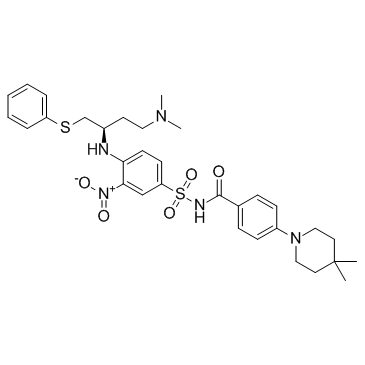
Cas No.: 406228-55-5
Sample solution is provided at 25 µL, 10mM.
_1-3.$$$39978408@51.jpg');)
_1-9.$$$38538795@65.jpg');)
_1-9.$$$39112701@51.jpg');)
_1-7.$$$37316672@70.jpg');)
_366-372.$$$36198801@70.jpg');)
.$$$38565142@65.jpg');)
_1867-1883.$$$33248023@67.jpg');)
_eads6055.$$$39977546@45.jpg');)
_eadm9805.$$$40080571@45.jpg');)
_eadj3020.$$$39666821@45.jpg');)
_1-20.$$$39757301@28.jpg');)
_1-24.$$$38898113@28.jpg');)
_273-287.$$$36806353@46.jpg');)
_1-16.$$$37156877@44.jpg');)
_1-19.$$$37460805@44.jpg');)
_1291-1307.$$$34518654@46.jpg');)
A-385358 is a selective inhibitor of Bcl-XL with Kis of 0.80 and 67 nM for Bcl-XL and Bcl-2, respectively.
A-385358 is a selective inhibitor of Bcl-XL with Kis of 0.80 and 67 nM for Bcl-XL and Bcl-2, respectively, in fluorescence polarization assays. Treatment of IL-3-deprived FL5.12/Bcl-XL cells for 24 hours with A-385358 results in cell killing with an EC50 of 0.47±0.05 μM (n=68). This effect is accompanied by an increase in caspase-3 activity. Consistent with the greater affinity for the Bcl-XL versus Bcl-2 hydrophobic grooves, the EC50 of A-385358 for IL-3-depleted FL5.12/Bcl-2 cells (1.9±0.1 μM; n=55) is 4-fold higher relative to the cytokine-deprived FL5.12/Bcl-XL cells. In addition, A-385358 is more effective at stimulating cytochrome c release from mitochondria isolated from FL5.12/Bcl-XL versus Bcl-2 cells[1].
The combination of A-385358 given at 100 mg/kg/d plus the lower dose of paclitaxel produces a significant reduction in tumor growth (%T/C) compare with paclitaxel monotherapy. This combination also yields a >100% increase in time for tumors to reach 900 mm3 (%ILS) compare with vehicle control. Maximal efficacy is observed during the dosing period for A-385358, with slow but steady increase in the tumor growth after termination of treatment. The combination of A-385358 at 75 mg/kg/d plus paclitaxel at 30 mg/kg/d is also well tolerated and inhibits tumor growth rate by nearly 80%. Significant effects on tumor growth relative to paclitaxel monotherapy are observed with doses as low as 50 mg/kg/d[1].
[1]. Shoemaker AR, et al. A small-molecule inhibitor of Bcl-XL potentiates the activity of cytotoxic drugs in vitro and in vivo. Cancer Res. 2006 Sep 1;66(17):8731-9.
Kinase experiment: | FL5.12 cells suspended in EMB growth medium containing 4% fetal bovine serum (FBS) are incubated at 37°C for 1 hour in 10 μM A-385358. Compound concentration is determined by high-performance liquid chromatography before and after the 1-hour incubation following brief centrifugation. To analyze membrane-bound fractions following compound incubation, cells are washed once with 10 volumes of cold PBS and lysed with 4 mL of water. A-385358 concentration is determined from aliquots of lysate before and after centrifugation[1]. |
Cell experiment: | A549 cells (1×10⁵) are plated in 96-well plates in medium containing 10% fetal bovine serum. Following attachment, A-385358 is added to one set of wells (final concentration of 50 μM in 10% FBS) and medium is added to another set. [3H]Paclitaxel (5 μM; 0.5 μCi/mL final concentration) is added to all wells and the cells are incubated at 37°C for various periods of time. For washout experiments, cells are exposed first to [3H]paclitaxel for 2 hours. The cells are washed once with medium and then incubated with fresh medium with or without 50 μM A-385358 at 37°C for various periods of time[1]. |
Animal experiment: | For efficacy studies, male CD-1 nude mice are inoculated with a 1:5 dilution of tumor brei in 50% Matrigel and analysis is conducted. A-385358 is delivered in a vehicle containing 5% Tween 80, 20% propylene glycol, and 75% PBS (pH 3.8). Paclitaxel is formulated according to the recommendations of the manufacturer. For combination therapy of paclitaxel plus A-385358, both drugs are administered i.p. with the paclitaxel given several hours before treatment with A-385358 (except for immunohistochemistry studies looking at expression of MPM-2 and caspase-3 wherein the two drugs are given simultaneously)[1]. |
References: [1]. Shoemaker AR, et al. A small-molecule inhibitor of Bcl-XL potentiates the activity of cytotoxic drugs in vitro and in vivo. Cancer Res. 2006 Sep 1;66(17):8731-9. | |
| Cas No. | 406228-55-5 | SDF | |
| Canonical SMILES | O=C(NS(=O)(C1=CC=C(N[C@@H](CSC2=CC=CC=C2)CCN(C)C)C([N+]([O-])=O)=C1)=O)C3=CC=C(N4CCC(C)(C)CC4)C=C3 | ||
| Formula | C32H41N5O5S2 | M.Wt | 639.83 |
| Solubility | DMSO : 125 mg/mL (195.36 mM) | Storage | Store at -20°C |
| General tips | Please select the appropriate solvent to prepare the stock solution according to the
solubility of the product in different solvents; once the solution is prepared, please store it in
separate packages to avoid product failure caused by repeated freezing and thawing.Storage method
and period of the stock solution: When stored at -80°C, please use it within 6 months; when stored
at -20°C, please use it within 1 month. To increase solubility, heat the tube to 37°C and then oscillate in an ultrasonic bath for some time. |
||
| Shipping Condition | Evaluation sample solution: shipped with blue ice. All other sizes available: with RT, or with Blue Ice upon request. | ||
| Prepare stock solution | |||

|
1 mg | 5 mg | 10 mg |
| 1 mM | 1.5629 mL | 7.8146 mL | 15.6292 mL |
| 5 mM | 312.6 μL | 1.5629 mL | 3.1258 mL |
| 10 mM | 156.3 μL | 781.5 μL | 1.5629 mL |
Step 1: Enter information below (Recommended: An additional animal making an allowance for loss during the experiment)
 g
μL
g
μL
Step 2: Enter the in vivo formulation (This is only the calculator, not formulation. Please contact us first if there is no in vivo formulation at the solubility Section.)
Calculation results:
Working concentration: mg/ml;
Method for preparing DMSO master liquid: mg drug pre-dissolved in μL DMSO ( Master liquid concentration mg/mL, Please contact us first if the concentration exceeds the DMSO solubility of the batch of drug. )
Method for preparing in vivo formulation: Take μL DMSO master liquid, next addμL PEG300, mix and clarify, next addμL Tween 80, mix and clarify, next add μL saline, mix and clarify.
Method for preparing in vivo formulation: Take μL DMSO master liquid, next add μL Corn oil, mix and clarify.
Note: 1. Please make sure the liquid is clear before adding the next solvent.
2. Be sure to add the solvent(s) in order. You must ensure that the solution obtained, in the previous addition, is a clear solution before proceeding to add the next solvent. Physical methods such as vortex, ultrasound or hot water bath can be used to aid dissolving.
3. All of the above co-solvents are available for purchase on the GlpBio website.
Quality Control & SDS
- View current batch:
- Purity: >98.50% Appearance: A solid
- COA (Certificate of Analysis)
- SDS (Safety Data Sheet)
- Datasheet
Average Rating: 5 (Based on Reviews and 17 reference(s) in Google Scholar.)