

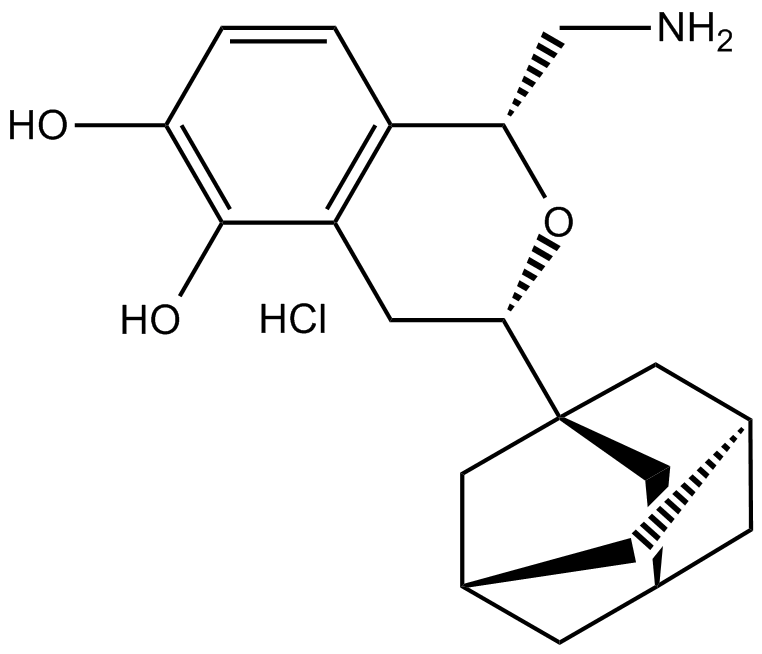
A 77636 hydrochloride |
Catalog No.GC11183
 One-Click Copy Product Info
|

A 77636 hydrochloride is a selective dopamine D1 receptor agonist with pKi=7.40±0.09; Ki=39.8nM and EC50=1.1nM.
Products are for research use only. Not for human use. We do not sell to patients.
Cas No.: 145307-34-2
Sample solution is provided at 25 µL, 10mM.
_1-3.$$$39978408@51.jpg');)
_1-9.$$$38538795@65.jpg');)
_1-9.$$$39112701@51.jpg');)
_1-7.$$$37316672@70.jpg');)
_366-372.$$$36198801@70.jpg');)
.$$$38565142@65.jpg');)
_1867-1883.$$$33248023@67.jpg');)
_eads6055.$$$39977546@45.jpg');)
_eadm9805.$$$40080571@45.jpg');)
_eadj3020.$$$39666821@45.jpg');)
_1-20.$$$39757301@28.jpg');)
_1-24.$$$38898113@28.jpg');)
_273-287.$$$36806353@46.jpg');)
_1-16.$$$37156877@44.jpg');)
_1-19.$$$37460805@44.jpg');)
_1291-1307.$$$34518654@46.jpg');)
A 77636 hydrochloride is a selective dopamine D1 receptor agonist with pKi=7.40±0.09; Ki=39.8nM and EC50=1.1nM. A 77636 is commonly used in Parkinson's disease research [1].
In vitro, pretreatment of SK-N-MC cells with A 77636 (200nM; 1h) led to a persistent elevation of cAMP levels, and can be blocked by SCH 23390 [2]. A 77636 (1-20μM) upregulated the phosphorylation of eIF2α, inhibited proliferation, motility, and bone metastatic activity of 4T1.2 mammary tumor cells and MDA-MB-231 breast cancer cells [3].
In vivo, A 77636 (3μmole/kg; s.c.) increased locomotor activity and decreased the severity of the parkinsonian-like symptoms in marmosets treated with MPTP (1-Methyl-4-phenyl-1,2,3,6-tetrahydropyridine) induced parkinsonian-like model [1]. A 77636 (3-60mg/kg; s.c.) increased horizontal locomotion and rearing at lower doses in Male hD1 mice [4]. A 77636 (3 and 10mg/kg; i.p.) produced dose-related attenuation and decreased peak responding to cocaine in Swiss-Webster mice [5]. A 77636 (0.1–1.0mg/kg, s.c.) exerted a suppressant effect on food intake in rat, due to a reduction in meal size and duration [6].
References:
[1]. Kebabian, John W., et al. "A 77636: a potent and selective dopamine D1 receptor agonist with antiparkinsonian activity in marmosets." European journal of pharmacology 229.2-3 (1992): 203-209.
[2]. Lin, Chun Wel, et al. "Persistent activation of the dopamine D1 receptor contributes to prolonged receptor desensitization: studies with A 77636." The Journal of pharmacology and experimental therapeutics 276.3 (1996): 1022-1029.
[3]. Minami, Kazumasa, et al. "Inhibitory effects of dopamine receptor D1 agonist on mammary tumor and bone metastasis." Scientific reports 7.1 (2017): 45686.
[4]. Svensson, Kjell A., et al. "An allosteric potentiator of the dopamine D1 receptor increases locomotor activity in human D1 knock-in mice without causing stereotypy or tachyphylaxis." The Journal of pharmacology and experimental therapeutics 360.1 (2017): 117-128.
[5]. Chausmer, Allison L., and Jonathan L. Katz. "Comparison of interactions of D1-like agonists, SKF 81297, SKF 82958 and A 77636, with cocaine: locomotor activity and drug discrimination studies in rodents." Psychopharmacology 159.2 (2002): 145-153.
| Cell experiment [1]: | |
Cell lines | MDA-MB-231 cells |
Preparation Method | 4T1.2 mouse mammary tumor cells were cultured in DMEM, the culture media contained 10% fetal bovine serum (FBS) and antibiotics (50units/ml penicillin, and 50μg/ml streptomycin). Cells were maintained at 37°C and 5% CO2 in a humidified incubator. Then add 2, 5, and 10μM A 77636 in the culture media for 32-48h. |
Reaction Conditions | 2, 5, and 10μM; 32-48h |
Applications | A 77636 (2, 5, and 10 μM) reduced the cellular motility of MDA-MB-231 cells in a dose-dependent manner in the wound healing scratch assay. |
| Animal experiment [2]: | |
Animal models | Male hD1 mice, 8–10 weeks old |
Preparation Method | Mice were placed inside individual locomotor activity (LMA) boxes for 1 hour during an acclimation period. Mice were then dosed with test compounds (oral or subcutaneous) and were replaced inside individual LMA boxes for the start of LMA. Photocell activity (total ambulations) was collected for 60 minutes using software from Hamilton Kinder. DETQ was dissolved in 20% 2-hydroxypropyl-β-cyclodextrin, and D1 agonists SKF 82958 and A 77636 and D1 antagonist SCH39166 were dissolved in 0.9% dihydrexidine saline. |
Dosage form | 3-60mg/kg; s.c. |
Applications | The D1 agonists SKF 82958 and A 77636 showed an increase in horizontal locomotion and rearing at lower doses. |
References: | |
| Cas No. | 145307-34-2 | SDF | |
| Chemical Name | (1R,3S)-3-((1s,3R,5R,7S)-adamantan-1-yl)-1-(aminomethyl)isochroman-5,6-diol hydrochloride | ||
| Canonical SMILES | OC(C1=C(C=C2)[C@H](CN)O[C@@H](C1)[C@]3(C[C@H](C4)C5)C[C@@H]4C[C@H]5C3)=C2O.Cl | ||
| Formula | C20H27NO3.HCl | M.Wt | 365.9 |
| Solubility | DMF: 33 mg/ml,DMSO: 33 mg/ml,Ethanol: 33 mg/ml,Ethanol:PBS (pH 7.2) (1:6): 0.14 mg/ml | Storage | Store at -20°C |
| General tips | Please select the appropriate solvent to prepare the stock solution according to the
solubility of the product in different solvents; once the solution is prepared, please store it in
separate packages to avoid product failure caused by repeated freezing and thawing.Storage method
and period of the stock solution: When stored at -80°C, please use it within 6 months; when stored
at -20°C, please use it within 1 month. To increase solubility, heat the tube to 37°C and then oscillate in an ultrasonic bath for some time. |
||
| Shipping Condition | Evaluation sample solution: shipped with blue ice. All other sizes available: with RT, or with Blue Ice upon request. | ||
| Prepare stock solution | |||

|
1 mg | 5 mg | 10 mg |
| 1 mM | 2.733 mL | 13.6649 mL | 27.3299 mL |
| 5 mM | 546.6 μL | 2.733 mL | 5.466 mL |
| 10 mM | 273.3 μL | 1.3665 mL | 2.733 mL |
Step 1: Enter information below (Recommended: An additional animal making an allowance for loss during the experiment)
 g
μL
g
μL
Step 2: Enter the in vivo formulation (This is only the calculator, not formulation. Please contact us first if there is no in vivo formulation at the solubility Section.)
Calculation results:
Working concentration: mg/ml;
Method for preparing DMSO master liquid: mg drug pre-dissolved in μL DMSO ( Master liquid concentration mg/mL, Please contact us first if the concentration exceeds the DMSO solubility of the batch of drug. )
Method for preparing in vivo formulation: Take μL DMSO master liquid, next addμL PEG300, mix and clarify, next addμL Tween 80, mix and clarify, next add μL saline, mix and clarify.
Method for preparing in vivo formulation: Take μL DMSO master liquid, next add μL Corn oil, mix and clarify.
Note: 1. Please make sure the liquid is clear before adding the next solvent.
2. Be sure to add the solvent(s) in order. You must ensure that the solution obtained, in the previous addition, is a clear solution before proceeding to add the next solvent. Physical methods such as vortex, ultrasound or hot water bath can be used to aid dissolving.
3. All of the above co-solvents are available for purchase on the GlpBio website.
Quality Control & SDS
- View current batch:
- Purity: >99.50% Appearance: A solid
- COA (Certificate of Analysis)
- SDS (Safety Data Sheet)
- Datasheet
Average Rating: 5 (Based on Reviews and 27 reference(s) in Google Scholar.)