

Roflumilast N-oxide |
Catalog No.GC37554
 One-Click Copy Product Info
|

A PDE4 inhibitor and active metabolite of roflumilast
Products are for research use only. Not for human use. We do not sell to patients.
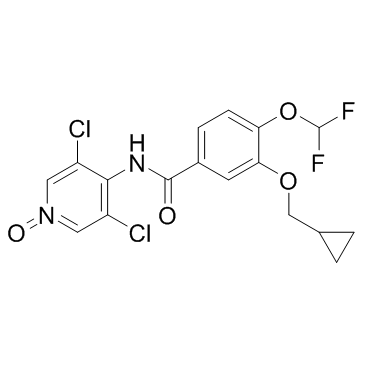
Cas No.: 292135-78-5
Sample solution is provided at 25 µL, 10mM.
_1-3.$$$39978408@51.jpg');)
_1-9.$$$38538795@65.jpg');)
_1-9.$$$39112701@51.jpg');)
_1-7.$$$37316672@70.jpg');)
_366-372.$$$36198801@70.jpg');)
.$$$38565142@65.jpg');)
_1867-1883.$$$33248023@67.jpg');)
_eads6055.$$$39977546@45.jpg');)
_eadm9805.$$$40080571@45.jpg');)
_eadj3020.$$$39666821@45.jpg');)
_1-20.$$$39757301@28.jpg');)
_1-24.$$$38898113@28.jpg');)
_273-287.$$$36806353@46.jpg');)
_1-16.$$$37156877@44.jpg');)
_1-19.$$$37460805@44.jpg');)
_1291-1307.$$$34518654@46.jpg');)
Roflumilast N-oxide is a PDE type 4 inhibitor. PDE type 4[1]
Roflumilast N-oxide at 2 nM partly mitigates the cigarette smoke extract (CSE)-induced epithelial to mesenchymal transition (EMT) in WD-HBEC in vitro. Roflumilast N-oxide (2 nM) reverses the compromised expression of E-cadherin transcripts following CSE by 45%. The expression of collagen type I is abrogated by Roflumilast N-oxide (2 nM). The epithelial cell phenotype appears protected when cells are co-incubated with Roflumilast N-oxide (2 nM). Pre-incubation with Roflumilast N-oxide (2 nM) also partly attenuates the nuclear translocation of β-catenin[2].
Single treatment of db/db mice with 10 mg/kg Roflumilast N-oxide enhances plasma glucagon-like peptide-1 (GLP-1) 4-fold. Chronic treatment of db/db mice with Roflumilast N-oxide at 3 mg/kg shows prevention of disease progression. Roflumilast-N-oxide abolishes the increase in blood glucose, reduces the increment in HbA1c by 50% and doubles fasted serum insulin compare with vehicle, concomitants with preservation of pancreatic islet morphology. Furthermore, Roflumilast-N-oxide amplifies forskolin-induced insulin release in primary islets. Roflumilast-N-oxide also shows stronger glucose-lowering effects than its parent compound[3].
[1]. Victoni T, et al. Roflumilast n-oxide associated with PGE2 prevents the neutrophil elastase-induced production of chemokines by epithelial cells. Int Immunopharmacol. 2016 Jan;30:1-8. [2]. Milara J,et al. Simvastatin Increases the Ability of Roflumilast N-oxide to Inhibit Cigarette Smoke-Induced Epithelial to Mesenchymal Transition in Well-differentiated Human Bronchial Epithelial Cells in vitro. COPD. 2015 Jun;12(3):320-31. [3]. Vollert S, et al. The glucose-lowering effects of the PDE4 inhibitors roflumilast and roflumilast-N-oxide in db/db mice. Diabetologia. 2012 Oct;55(10):2779-2788.
Cell experiment: | A549 cells are washed and cultured overnight in serum-free F-12 K medium supplemented with antibiotics, L-glutamine and HEPES. The starved cells are incubated with Neutrophil elastase (NE) for 30 min or vehicle (PBS), washed with PBS and then cultured in serum free F-12 K. After stimulation, cell supernatants are collected at 24 h (for cytokine measurements) and cell pellets are collected after 2 h (for mRNA expression analysis). Alternatively, A549 cells are pre-incubated for 2 h with Roflumilast N-oxide (RNO) (at 0.1 μM, 0.3 μM and 1 μM), vehicle (DMSO 0.01%) prior to the addition of NE. All experiments are performed in serum-free medium in triplicate and are repeated at least three times. At the end of the incubation period, culture supernatants are harvested and stored at -80°C until further analysis[1]. |
Animal experiment: | At 7 weeks of age, 16 h fasting mice receive a single oral dose of vehicle (4% methocel) or 10 mg/kg Roflumilast-N-oxide, and a glucose bolus of 2 g/kg body weight is co-administered as a physiological initiator for glucagon-like peptide-1 (GLP-1) secretion. Plasma GLP-1 is analyzed 60 min before, and 10 and 60 min after administration of Roflumilast-N-oxide and glucose. The effect of Roflumilast-N-oxide on plasma GLP-1 is also investigated in the absence of the glucose bolus[3]. |
References: [1]. Victoni T, et al. Roflumilast n-oxide associated with PGE2 prevents the neutrophil elastase-induced production of chemokines by epithelial cells. Int Immunopharmacol. 2016 Jan;30:1-8. | |
| Cas No. | 292135-78-5 | SDF | |
| Canonical SMILES | O=C(NC1=C(Cl)C=N(C=C1Cl)=O)C2=CC=C(OC(F)F)C(OCC3CC3)=C2 | ||
| Formula | C17H14Cl2F2N2O4 | M.Wt | 419.21 |
| Solubility | DMSO: 320 mg/mL (763.34 mM and warming) | Storage | Store at -20°C |
| General tips | Please select the appropriate solvent to prepare the stock solution according to the
solubility of the product in different solvents; once the solution is prepared, please store it in
separate packages to avoid product failure caused by repeated freezing and thawing.Storage method
and period of the stock solution: When stored at -80°C, please use it within 6 months; when stored
at -20°C, please use it within 1 month. To increase solubility, heat the tube to 37°C and then oscillate in an ultrasonic bath for some time. |
||
| Shipping Condition | Evaluation sample solution: shipped with blue ice. All other sizes available: with RT, or with Blue Ice upon request. | ||
| Prepare stock solution | |||

|
1 mg | 5 mg | 10 mg |
| 1 mM | 2.3854 mL | 11.9272 mL | 23.8544 mL |
| 5 mM | 477.1 μL | 2.3854 mL | 4.7709 mL |
| 10 mM | 238.5 μL | 1.1927 mL | 2.3854 mL |
Step 1: Enter information below (Recommended: An additional animal making an allowance for loss during the experiment)
 g
μL
g
μL
Step 2: Enter the in vivo formulation (This is only the calculator, not formulation. Please contact us first if there is no in vivo formulation at the solubility Section.)
Calculation results:
Working concentration: mg/ml;
Method for preparing DMSO master liquid: mg drug pre-dissolved in μL DMSO ( Master liquid concentration mg/mL, Please contact us first if the concentration exceeds the DMSO solubility of the batch of drug. )
Method for preparing in vivo formulation: Take μL DMSO master liquid, next addμL PEG300, mix and clarify, next addμL Tween 80, mix and clarify, next add μL saline, mix and clarify.
Method for preparing in vivo formulation: Take μL DMSO master liquid, next add μL Corn oil, mix and clarify.
Note: 1. Please make sure the liquid is clear before adding the next solvent.
2. Be sure to add the solvent(s) in order. You must ensure that the solution obtained, in the previous addition, is a clear solution before proceeding to add the next solvent. Physical methods such as vortex, ultrasound or hot water bath can be used to aid dissolving.
3. All of the above co-solvents are available for purchase on the GlpBio website.
Quality Control & SDS
- View current batch:
- Purity: >99.50% Appearance: A solid
- COA (Certificate of Analysis)
- SDS (Safety Data Sheet)
- Datasheet
Average Rating: 5 (Based on Reviews and 34 reference(s) in Google Scholar.)