

Adenosine Dialdehyde (ADOX) |
Catalog No.GC16509
 One-Click Copy Product Info
|

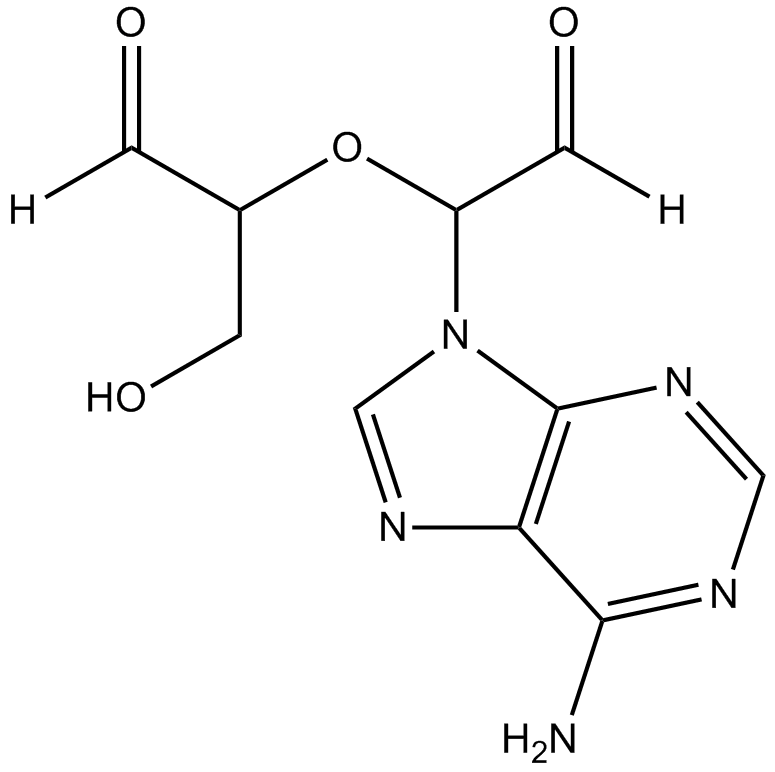
Adox, a purine nucleoside analogue, is a potent inhibitor of S-Adenosylhomocysteine hydrolase (SAHH) (Ki=3.3 nM). Adenosine Dialdehyde exhibits potent anti-tumor activity in vivo and can be used for the cancer research.
Products are for research use only. Not for human use. We do not sell to patients.
Cas No.: 34240-05-6
Sample solution is provided at 25 µL, 10mM.
_1-3.$$$39978408@51.jpg');)
_1-9.$$$38538795@65.jpg');)
_1-9.$$$39112701@51.jpg');)
_1-7.$$$37316672@70.jpg');)
_366-372.$$$36198801@70.jpg');)
.$$$38565142@65.jpg');)
_1867-1883.$$$33248023@67.jpg');)
_eads6055.$$$39977546@45.jpg');)
_eadm9805.$$$40080571@45.jpg');)
_eadj3020.$$$39666821@45.jpg');)
_1-20.$$$39757301@28.jpg');)
_1-24.$$$38898113@28.jpg');)
_273-287.$$$36806353@46.jpg');)
_1-16.$$$37156877@44.jpg');)
_1-19.$$$37460805@44.jpg');)
_1291-1307.$$$34518654@46.jpg');)
Adenosine Dialdehyde (ADOX) is an adenosine analog, acts as an inhibitor of S-adenosylhomocysteine hydrolase (SAHH)[1]. SAHH is an enzyme that regulates cellular methylation process, resulting in broad inhibition of methylation reactions. Adenosine Dialdehyde as an SAHH inhibitor, can effectively arrest the cell cycle at the G2 phase and induce apoptosis in HeLa, HCT116 cells[1]. Adenosine Dialdehyde is a potent anti-cancer drug with broad inhibiting proliferative effects and anti-invasive and anti-migratory properties[1].
In vitro, Adenosine Dialdehyde (0.01, 0.1, 1, 10 and 100μM; 72h) significantly inhibited the proliferation of MCF-7, MDA-MB-231, H292 cells in a dose dependent manner[2].
In vivo, Adenosine Dialdehyde (1.5-2.5mg/kg; 7d; s.c.) significantly increased the mean life span of A/J mice bearing C1300 murine neuroblastoma tumor[3]. Adenosine Dialdehyde (10μmol/kg; 32d; q1w; i.p.) suppressed prostate cancer growth in NCr-nu/nu mice inoculated with LNCaP cells[4].
References:[1] Nguyen T T, Hemmer J, Kiemer A K, et al. Biodynamers as prodrugs with controlled uptake and activity [J]. Journal of controlled release, 2026, 390: 114538.
[2] Ghemrawi R, Al Qassem A, Ramadan A, et al. DNA and protein methyltransferases inhibition by adenosine dialdehyde reduces the proliferation and migration of breast and lung cancer cells by downregulating autophagy [J]. PLoS One, 2023, 18(7): e0288791.
[3] Bostrom B, Hogenkamp H P, Mirkin B L. Inhibitory effect of adenosine dialdehyde on in situ murine neuroblastoma growth [J]. Cancer Research, 1988, 48(21): 5933-5936.
[4] Shiota M, Takeuchi A, Yokomizo A, et al. Methyltransferase inhibitor adenosine dialdehyde suppresses androgen receptor expression and prostate cancer growth [J]. The Journal of urology, 2012, 188(1): 300-306.
| Cell experiment [1]: | |
|
Cell lines |
H292 cells |
|
Preparation Method |
H292 cells (5×10⁴ cells/well) were seeded in a 96-well plate and treated with different concentrations (0.01, 0.1, 1, 10 and 100μM) of Adenosine Dialdehyde (DMSO as control) for 72h. The colorimetric MTT metabolic activity assay was used to assess cell proliferation. |
|
Reaction Conditions |
0.01, 0.1, 1, 10 and 100μM; 72h |
|
Applications |
Adenosine Dialdehyde significantly inhibited the proliferation of H292 cells in a dose dependent manner. |
| Animal experiment [2]: | |
|
Animal models |
Male NCr-nu/nu mice |
|
Preparation Method |
LNCaP cells (1.0×10⁷) were inoculated subcutaneously in the lateral flank of 10 mice. At 5 days the mice were randomly divided into 2 groups of 5 each and administered vehicle or 10μmol/kg Adenosine Dialdehyde by intraperitoneal injection. Vehicle or Adenosine Dialdehyde was administered intraperitoneally once per week. Inoculated tumor size was determined every 2 to 3 days using calipers. |
|
Dosage form |
10μmol/kg; 32d; q1w; i.p. |
|
Applications |
Adenosine Dialdehyde suppressed prostate cancer growth in vivo in the mouse xenograft model. |
| [1] Ghemrawi R, Al Qassem A, Ramadan A, et al. DNA and protein methyltransferases inhibition by adenosine dialdehyde reduces the proliferation and migration of breast and lung cancer cells by downregulating autophagy [J]. PLoS One, 2023, 18(7): e0288791. [2]Shiota M, Takeuchi A, Yokomizo A, et al. Methyltransferase inhibitor adenosine dialdehyde suppresses androgen receptor expression and prostate cancer growth [J]. The Journal of urology, 2012, 188(1): 300-306. | |
| Cas No. | 34240-05-6 | SDF | |
| Chemical Name | 2-(1-(6-amino-9H-purin-9-yl)-2-oxoethoxy)-3-hydroxypropanal | ||
| Canonical SMILES | O=C(C(OC(CO)C([H])=O)N1C=NC2=C1N=CN=C2N)[H] | ||
| Formula | C10H11N5O4 | M.Wt | 265.23 |
| Solubility | 10mg/mL in DMSO, or in DMF | Storage | Store at -20°C |
| General tips | Please select the appropriate solvent to prepare the stock solution according to the
solubility of the product in different solvents; once the solution is prepared, please store it in
separate packages to avoid product failure caused by repeated freezing and thawing.Storage method
and period of the stock solution: When stored at -80°C, please use it within 6 months; when stored
at -20°C, please use it within 1 month. To increase solubility, heat the tube to 37°C and then oscillate in an ultrasonic bath for some time. |
||
| Shipping Condition | Evaluation sample solution: shipped with blue ice. All other sizes available: with RT, or with Blue Ice upon request. | ||
| Prepare stock solution | |||

|
1 mg | 5 mg | 10 mg |
| 1 mM | 3.7703 mL | 18.8516 mL | 37.7031 mL |
| 5 mM | 754.1 μL | 3.7703 mL | 7.5406 mL |
| 10 mM | 377 μL | 1.8852 mL | 3.7703 mL |
Step 1: Enter information below (Recommended: An additional animal making an allowance for loss during the experiment)
 g
μL
g
μL
Step 2: Enter the in vivo formulation (This is only the calculator, not formulation. Please contact us first if there is no in vivo formulation at the solubility Section.)
Calculation results:
Working concentration: mg/ml;
Method for preparing DMSO master liquid: mg drug pre-dissolved in μL DMSO ( Master liquid concentration mg/mL, Please contact us first if the concentration exceeds the DMSO solubility of the batch of drug. )
Method for preparing in vivo formulation: Take μL DMSO master liquid, next addμL PEG300, mix and clarify, next addμL Tween 80, mix and clarify, next add μL saline, mix and clarify.
Method for preparing in vivo formulation: Take μL DMSO master liquid, next add μL Corn oil, mix and clarify.
Note: 1. Please make sure the liquid is clear before adding the next solvent.
2. Be sure to add the solvent(s) in order. You must ensure that the solution obtained, in the previous addition, is a clear solution before proceeding to add the next solvent. Physical methods such as vortex, ultrasound or hot water bath can be used to aid dissolving.
3. All of the above co-solvents are available for purchase on the GlpBio website.
Quality Control & SDS
- View current batch:
- Purity: >95.00% Appearance: A solid
- COA (Certificate of Analysis)
- SDS (Safety Data Sheet)
- Datasheet
Average Rating: 5 (Based on Reviews and 12 reference(s) in Google Scholar.)