

Asiatic acid (Synonyms: Dammarolic Acid, NSC 166063) |
Catalog No.GN10702
 One-Click Copy Product Info
|

Asiatic acid is a pentacyclic triterpenoid that inhibits EGFR activity, with IC50 values of 0.035nM and 0.348nM for wild-type EGFR and T790M/L858R EGFR, respectively.
Products are for research use only. Not for human use. We do not sell to patients.
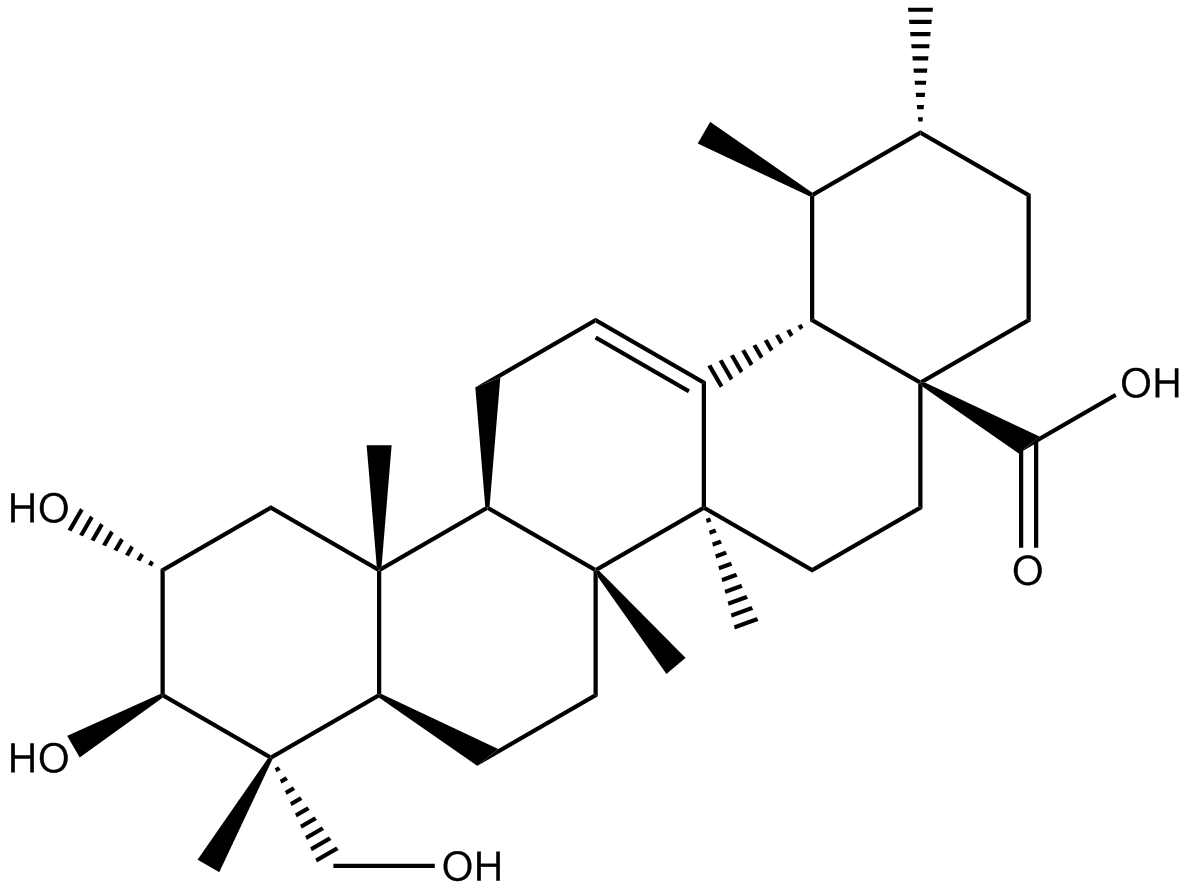
Cas No.: 464-92-6
Sample solution is provided at 25 µL, 10mM.
_1-3.$$$39978408@51.jpg');)
_1-9.$$$38538795@65.jpg');)
_1-9.$$$39112701@51.jpg');)
_1-7.$$$37316672@70.jpg');)
_366-372.$$$36198801@70.jpg');)
.$$$38565142@65.jpg');)
_1867-1883.$$$33248023@67.jpg');)
_eads6055.$$$39977546@45.jpg');)
_eadm9805.$$$40080571@45.jpg');)
_eadj3020.$$$39666821@45.jpg');)
_1-20.$$$39757301@28.jpg');)
_1-24.$$$38898113@28.jpg');)
_273-287.$$$36806353@46.jpg');)
_1-16.$$$37156877@44.jpg');)
_1-19.$$$37460805@44.jpg');)
_1291-1307.$$$34518654@46.jpg');)
Asiatic acid is a pentacyclic triterpenoid that inhibits EGFR activity, with IC50 values of 0.035nM and 0.348nM for wild-type EGFR and T790M/L858R EGFR, respectively [1]. Asiatic acid induces endoplasmic reticulum stress (by increasing GRP78 and calpain, and decreasing calnexin and IRE1α expression), enhances free intracellular calcium, and damages cellular organization[2]. Asiatic acid has been widely used to attenuate inflammation, tumor cell proliferation, and induce mitochondrial pathway of apoptosis [3].
In vitro, Asiatic acid treatment for 24 hours significantly inhibited the viability of SH-SY5Y cells, with an IC50 value of 34.99±0.12µM[4]. Treatment with 80µM Asiatic acid for 12 hours led to mitochondrial dysfunction in A549 cells, accompanied by an increase in ROS levels[5]. Treatment with Asiatic acid (40µg/ml) for 48 hours can cause the cell cycle of SKOV3 cells to be arrested at the G0/G1 phase, and significantly reduce the protein levels of CDK2, CDK4, CDK6, cyclin D1 and cyclin E[6].
In vivo, Asiatic acid treatment via oral administration at a dose of 20mg/kg daily for 45 days significantly improved the blood glucose and insulin levels of diabetic rats and inhibited oxidative stress[7]. Asiatic acid treatment (20mg/kg/day; p.o.) for 2 weeks improved metabolic, hemodynamic abnormalities in metabolic syndrome (MS) rats[8].
References:
[1] Monmai C, Sabuakham S, Pabuprapap W, et al. Asiatic Acid from Centella asiatica as a Potent EGFR Tyrosine Kinase Inhibitor with Anticancer Activity in NSCLC Cells Harboring Wild-Type and T790M-Mutated EGFR[J]. Biomolecules, 2025, 15(10): 1410.
[2] Lv J, Sharma A, Zhang T, et al. Pharmacological review on asiatic acid and its derivatives: a potential compound[J]. SLAS TECHNOLOGY: Translating Life Sciences Innovation, 2018, 23(2): 111-127.
[3] Nagoor Meeran M F, Goyal S N, Suchal K, et al. Pharmacological properties, molecular mechanisms, and pharmaceutical development of asiatic acid: a pentacyclic triterpenoid of therapeutic promise[J]. Frontiers in pharmacology, 2018, 9: 892.
[4] Tangrodchanapong T, Jiso A, Changkaew P, et al. Radioprotective effects of asiaticoside and asiatic acid in neural stem cells derived from human stem cells from apical papilla through increasing dose-reduction factor and their lowering effects on SH-SY5Y cell viability[J]. PLoS One, 2025, 20(6): e0325480.
[5] Wu T, Geng J, Guo W, et al. Asiatic acid inhibits lung cancer cell growth in vitro and in vivo by destroying mitochondria[J]. Acta Pharmaceutica Sinica B, 2017, 7(1): 65-72.
[6] Ren L, Cao Q X, Zhai F R, et al. Asiatic acid exerts anticancer potential in human ovarian cancer cells via suppression of PI3K/Akt/mTOR signalling[J]. Pharmaceutical biology, 2016, 54(11): 2377-2382.
[7] Ramachandran V, Saravanan R. Asiatic acid prevents lipid peroxidation and improves antioxidant status in rats with streptozotocin-induced diabetes[J]. Journal of Functional Foods, 2013, 5(3): 1077-1087.
[8] Pakdeechote P, Bunbupha S, Kukongviriyapan U, et al. Asiatic acid alleviates hemodynamic and metabolic alterations via restoring eNOS/iNOS expression, oxidative stress, and inflammation in diet-induced metabolic syndrome rats[J]. Nutrients, 2014, 6(1): 355-370.
| Cell experiment [1]: | |
Cell lines | SH-SY5Y cells |
Preparation Method | SH-SY5Y cells were cultured in DMEM/F-12 medium containing 10% fetal bovine serum (FBS) and 1% antibiotics-antifungal agents at 37 ℃, 5% CO2, and 95% humidity. SH-SY5Y cells (30,000 cells/well) were seeded in 96-well plates and cultured for 24 hours. Then, the cells were treated with different concentrations (0, 1, 2, 10, 20, 50, 100, 250, and 500µM) of Asiatic acid for 24 hours. The control group cells were cultured in the basal medium, while the vehicle group cells were cultured in the basal medium supplemented with 0.5% DMSO. The absorbance was measured at 570nm by the MTT method. |
Reaction Conditions | 0, 1, 2, 10, 20, 50, 100, 250, and 500µM; 24h |
Applications | Asiatic acid treatment significantly inhibited the proliferation of SH-SY5Y cells in a dose-dependent manner. |
| Animal experiment [2]: | |
Animal models | Sprague-Dawley rats |
Preparation Method | Adult male Sprague-Dawley rats weighing 180-200g (at six weeks of age) were housed in a standard sterile environment. After one week of adaptation to the environment, the experimental group rats were fed a high-cholesterol and high-fat (HCHF) diet and 15% fructose was added to the drinking water for 12 weeks to induce metabolic syndrome (MS). The rats were randomly divided into 4 groups (n=10 in each group), and were given Asiatic acid or vehicle daily. Control group: Normal rats were given a vehicle (propylene glycol) by gavage daily for three consecutive weeks, at a dose of 0.15ml/100g. Control group: Normal rats were given Asiatic acid (20mg/kg) by gavage daily for three consecutive weeks. MS group: MS rats were given a solvent by gavage daily for three consecutive weeks, at a dose of 0.15ml/100g. MS treatment group: MS rats were given Asiatic acid (20mg/kg) by gavage daily for three consecutive weeks, and the blood serum was collected for analysis. |
Dosage form | 20mg/kg/day for 3 weeks; p.o. |
Applications | Asiatic acid treatment alleviated dyslipidemia by decreasing serum total cholesterol and triglycerides in MS rats. |
References: | |
| Cas No. | 464-92-6 | SDF | |
| Synonyms | Dammarolic Acid, NSC 166063 | ||
| Chemical Name | (1S,2R,4aS,6aR,6aS,6bR,8aR,9R,10R,11R,12aR,14bS)-10,11-dihydroxy-9-(hydroxymethyl)-1,2,6a,6b,9,12a-hexamethyl-2,3,4,5,6,6a,7,8,8a,10,11,12,13,14b-tetradecahydro-1H-picene-4a-carboxylic acid | ||
| Canonical SMILES | CC1CCC2(CCC3(C(=CCC4C3(CCC5C4(CC(C(C5(C)CO)O)O)C)C)C2C1C)C)C(=O)O | ||
| Formula | C30H48O5 | M.Wt | 488.7 |
| Solubility | ≥ 24.45mg/mL in DMSO | Storage | 4°C, protect from light |
| General tips | Please select the appropriate solvent to prepare the stock solution according to the
solubility of the product in different solvents; once the solution is prepared, please store it in
separate packages to avoid product failure caused by repeated freezing and thawing.Storage method
and period of the stock solution: When stored at -80°C, please use it within 6 months; when stored
at -20°C, please use it within 1 month. To increase solubility, heat the tube to 37°C and then oscillate in an ultrasonic bath for some time. |
||
| Shipping Condition | Evaluation sample solution: shipped with blue ice. All other sizes available: with RT, or with Blue Ice upon request. | ||
| Prepare stock solution | |||

|
1 mg | 5 mg | 10 mg |
| 1 mM | 2.0462 mL | 10.2312 mL | 20.4625 mL |
| 5 mM | 409.2 μL | 2.0462 mL | 4.0925 mL |
| 10 mM | 204.6 μL | 1.0231 mL | 2.0462 mL |
Step 1: Enter information below (Recommended: An additional animal making an allowance for loss during the experiment)
 g
μL
g
μL
Step 2: Enter the in vivo formulation (This is only the calculator, not formulation. Please contact us first if there is no in vivo formulation at the solubility Section.)
Calculation results:
Working concentration: mg/ml;
Method for preparing DMSO master liquid: mg drug pre-dissolved in μL DMSO ( Master liquid concentration mg/mL, Please contact us first if the concentration exceeds the DMSO solubility of the batch of drug. )
Method for preparing in vivo formulation: Take μL DMSO master liquid, next addμL PEG300, mix and clarify, next addμL Tween 80, mix and clarify, next add μL saline, mix and clarify.
Method for preparing in vivo formulation: Take μL DMSO master liquid, next add μL Corn oil, mix and clarify.
Note: 1. Please make sure the liquid is clear before adding the next solvent.
2. Be sure to add the solvent(s) in order. You must ensure that the solution obtained, in the previous addition, is a clear solution before proceeding to add the next solvent. Physical methods such as vortex, ultrasound or hot water bath can be used to aid dissolving.
3. All of the above co-solvents are available for purchase on the GlpBio website.
Quality Control & SDS
- View current batch:
- Purity: >99.00% Appearance: A solid
- COA (Certificate of Analysis)
- SDS (Safety Data Sheet)
- Datasheet
Average Rating: 5 (Based on Reviews and 30 reference(s) in Google Scholar.)