

AT-130 |
Catalog No.GC61821
 One-Click Copy Product Info
|

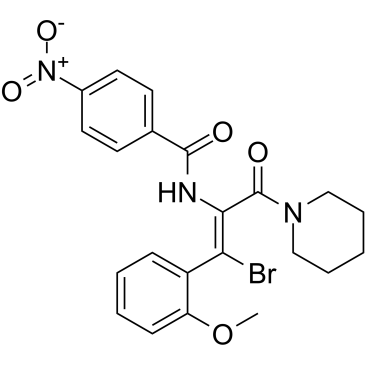
AT-130, a phenylpropenamide derivative, is a potent hepatitis B virus (HBV) replication non-nucleoside inhibitor.
Products are for research use only. Not for human use. We do not sell to patients.
Cas No.: 211364-06-6
Sample solution is provided at 25 µL, 10mM.
_1-3.$$$39978408@51.jpg');)
_1-9.$$$38538795@65.jpg');)
_1-9.$$$39112701@51.jpg');)
_1-7.$$$37316672@70.jpg');)
_366-372.$$$36198801@70.jpg');)
.$$$38565142@65.jpg');)
_1867-1883.$$$33248023@67.jpg');)
_eads6055.$$$39977546@45.jpg');)
_eadm9805.$$$40080571@45.jpg');)
_eadj3020.$$$39666821@45.jpg');)
_1-20.$$$39757301@28.jpg');)
_1-24.$$$38898113@28.jpg');)
_273-287.$$$36806353@46.jpg');)
_1-16.$$$37156877@44.jpg');)
_1-19.$$$37460805@44.jpg');)
_1291-1307.$$$34518654@46.jpg');)
AT-130, a phenylpropenamide derivative, is a potent hepatitis B virus (HBV) replication non-nucleoside inhibitor. AT-130 inhibits the viral DNA synthesis with an IC50 of 0.13 uM. AT-130 inhibits both wt and mutant HBVs. AT-130 has anti-HBV activity in hepatoma cells[1][2][3].
AT-130 inhibits Wt HBV (IC50=2.4 µM), rtL180M HBV (IC50=9.8 µM), rtM204I HBV (IC50=35.6 µM)[1]. AT-130 (0.1, 1, 5, 10, 100 uM; for 7 days) causes dose-dependent inhibition of wt HBV replication in HepG2 cells transduced with HBV baculovirus. AT-130 at a concentration of 2.5 uM, reduces encapsidated HBV DNA by 50% (IC50) and at 18.5 uM by 90% (IC90)[1]. AT-130 has no toxic to either HepG2 or Huh-7 cells at concentrations of up to 250 µM[1]. AT-130 (0.005, 0.05, 0.5, 5, 50 uM) does not inhibit HBV DNA synthesis by blocking the HBV endogenous DNA polymerase reaction directly in Huh 7 or HepG2 cells. AT-130 inhibits HBV DNA replication in hepatoma cells but has no effect on viral DNA polymerase activity or core protein translation[3]. AT-130 (2.5, 18.5 uM) has no effect on total HBV RNA production but does reduce encapsidated RNA. AT-130 does not affect core protein or nucleocapsid production and the activity of the protein expression vector[3].
References:
[1]. William E Delaney 4th, et al. Phenylpropenamide derivatives AT-61 and AT-130 inhibit replication of wild-type and lamivudine-resistant strains of hepatitis B virus in vitro. Antimicrob Agents Chemother. 2002 Sep;46(9):3057-60.
[2]. R B Perni , et al. Phenylpropenamide derivatives as inhibitors of hepatitis B virus replication. Bioorg Med Chem Lett. 2000 Dec 4;10(23):2687-90.
[3]. J J Feld, et al. The phenylpropenamide derivative AT-130 blocks HBV replication at the level of viral RNA packaging. Antiviral Res. 2007 Nov;76(2):168-77.
| Cas No. | 211364-06-6 | SDF | |
| Canonical SMILES | O=C(N/C(C(N1CCCCC1)=O)=C(Br)\C2=CC=CC=C2OC)C3=CC=C([N+]([O-])=O)C=C3 | ||
| Formula | C22H22BrN3O5 | M.Wt | 488.33 |
| Solubility | DMSO : 25 mg/mL (51.19 mM) | Storage | Store at -20°C |
| General tips | Please select the appropriate solvent to prepare the stock solution according to the
solubility of the product in different solvents; once the solution is prepared, please store it in
separate packages to avoid product failure caused by repeated freezing and thawing.Storage method
and period of the stock solution: When stored at -80°C, please use it within 6 months; when stored
at -20°C, please use it within 1 month. To increase solubility, heat the tube to 37°C and then oscillate in an ultrasonic bath for some time. |
||
| Shipping Condition | Evaluation sample solution: shipped with blue ice. All other sizes available: with RT, or with Blue Ice upon request. | ||
| Prepare stock solution | |||

|
1 mg | 5 mg | 10 mg |
| 1 mM | 2.0478 mL | 10.239 mL | 20.478 mL |
| 5 mM | 409.6 μL | 2.0478 mL | 4.0956 mL |
| 10 mM | 204.8 μL | 1.0239 mL | 2.0478 mL |
Step 1: Enter information below (Recommended: An additional animal making an allowance for loss during the experiment)
 g
μL
g
μL
Step 2: Enter the in vivo formulation (This is only the calculator, not formulation. Please contact us first if there is no in vivo formulation at the solubility Section.)
Calculation results:
Working concentration: mg/ml;
Method for preparing DMSO master liquid: mg drug pre-dissolved in μL DMSO ( Master liquid concentration mg/mL, Please contact us first if the concentration exceeds the DMSO solubility of the batch of drug. )
Method for preparing in vivo formulation: Take μL DMSO master liquid, next addμL PEG300, mix and clarify, next addμL Tween 80, mix and clarify, next add μL saline, mix and clarify.
Method for preparing in vivo formulation: Take μL DMSO master liquid, next add μL Corn oil, mix and clarify.
Note: 1. Please make sure the liquid is clear before adding the next solvent.
2. Be sure to add the solvent(s) in order. You must ensure that the solution obtained, in the previous addition, is a clear solution before proceeding to add the next solvent. Physical methods such as vortex, ultrasound or hot water bath can be used to aid dissolving.
3. All of the above co-solvents are available for purchase on the GlpBio website.
Quality Control & SDS
- View current batch:
- Purity: >98.00% Appearance: A solid
- COA (Certificate of Analysis)
- SDS (Safety Data Sheet)
- Datasheet
Average Rating: 5 (Based on Reviews and 5 reference(s) in Google Scholar.)